

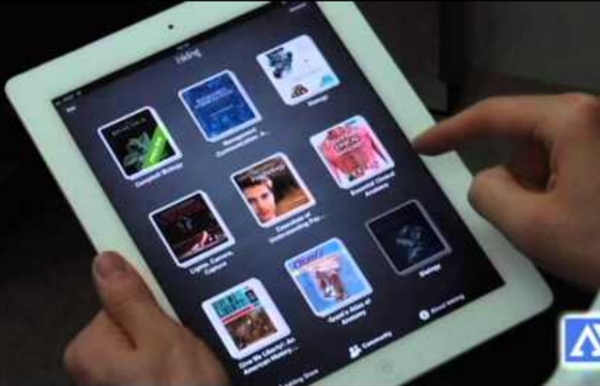
http://www.youtube.com/watch?v=mzi2RIt8_nk
Séminaire TIC ENS Cachan 2011-2012 Responsables : Éric Bruillard, directeur du laboratoire STEF, ENS Cachan et Institut français d’éducation Joël Boissière, service innovation, direction de la stratégie, Caisse des Dépôts le jeudi de 18h à 20h ENS de Cachan, Pavillon des jardins Présentation Aurasma, la apuesta de Hewlett Packard para realidad aumentada El stand de Hewlett Packard en Andicom estuvo bastante concurrido en durante este miércoles y todo con motivo de una aplicación que llamó la atención de los asistentes que participaban en el primer día de la feria de tecnología e innovación. Enmarcados en el tema de Ciudades Inteligentes, la compañía norteamericana exhibía su apuesta para el mercado de realidad aumentada que actualmente se encuentra en crecimiento a nivel mundial. Con la descarga de esta aplicación que actualmente se encuentra disponible para Android y iOS usted podrá tener a la mano un scanner de realidad aumentada que reaccionará a cualquier material físico programado con Aurasma.
TPaCK, un modèle pour mieux cerner les leviers de l’intégration des TIC en classe par les enseignants Au moment ou il est question de l’introduction des TICE dans le système éducatif Ivoirien, il nous semble indiqué de bien comprendre certains leviers de l’intégration de ces outils numériques par les enseignants dans la classe. En effet, selon la littérature scientifique, pour qu’un enseignant intègre les outils numériques dans sa pratique pédagogique, la simple maîtrise de ces outils est insuffisante. Il devient alors important d’identifier des dimensions à prendre en compte dans le cadre d’une formation initiale et/ou continue des enseignants pour l’usage des TIC dans la classe. C’est dans ce sens que le modèle TPaCK devient pertinent à notre sens. En effet, il a l’avantage de présenter une structure intéressante pour appréhender les nouvelles dynamiques crées par le processus d’intégration des TIC dans l’enseignement et de l’apprentissage.
Smartphones as Tools for Education Introduction The smartphone owner population is growing. Multi-functionality, portability, and connectivity are opening doors for learning. No wonder students harness smartphone technology to help them in education. How To Use Technology To Engage Students In Poverty- Brain Based Learning Here’s a great video from am innovative teacher that is using technology to engage students that are in poverty. Many of his students speak English as a second language, and the blogging approach he provides aids in their development. Favorite quote from the video below: “It’s not basics then enrichment… the basics can be addressed move covertly, authentically, and effective when those skills are developed in a meaningful and motivational context”. From TED: Brian Crosby, a teacher for 29 years in Sparks, Nevada, guides the learning in a model technology classroom. Coming from a background in outdoor education and educational technology, Brian fuses his “at risk” students’ use of technology with field trips, art, hands-on activities and a problem-based approach, to build their schema of the world while at once connecting them to it.
Enseignement de l'informatique et des TIC - Archive Informatique au lycée Ce site, dans sa forme actuelle, va disparaître en juin 2019. Il sera remplacé par un site consacré aux enseignements SNT de seconde et NSI de première et terminale. Vous pouvez déjà consulter des activités destinées aux élèves de seconde et de première. Epinet n° 213, mars 2019. Recommandations pour le choix des spécialités Approuvé en Assemblée Permanente le 7 février 2019. Technology Transforms Pedagogy: Combining the Tools and the Vision Do mobile devices in the classroom really improve learning outcomes? Mobile devices as teaching tools are becoming a more and more common part of the American education experience in classrooms, from preschool through graduate school. A recent Pew Research Center survey found that 58% of U.S. teachers own smartphones — 10 percentage points higher than the national average for adults. Those teachers are building that tech-savviness into their lesson plans, too, by embracing bring-your-own-device policies and leading the push for an iPad for every student. In 2013, an estimated 25% of U.S. schools had BYOD policies in place and it’s reasonable to assume those numbers have risen in the past two years. What do these mobile devices really add, though?
What are the benefits of using technology for math instruction? 22 March 2018 Kristine Scharaldi, Education Consultant This week we have another guest blog post from Kristine Scharaldi, an education consultant and instructional coach with a specialization in the fields of educational technology, Mind-Brain-Education, Universal Design for Learning (UDL), and 21st Century Skills/Global Education.