

Bloom's Taxonomy of Learning Domains Note: This site is moving to KnowledgeJump.com. Please reset your bookmark. Bloom's Taxonomy was created in 1956 under the leadership of educational psychologist Dr Benjamin Bloom in order to promote higher forms of thinking in education, such as analyzing and evaluating concepts, processes, procedures, and principles, rather than just remembering facts (rote learning). It is most often used when designing educational, training, and learning processes. The Three Domains of Learning The committee identified three domains of educational activities or learning (Bloom, et al. 1956): Cognitive: mental skills (knowledge) Affective: growth in feelings or emotional areas (attitude or self) Psychomotor: manual or physical skills (skills) Since the work was produced by higher education, the words tend to be a little bigger than we normally use. While the committee produced an elaborate compilation for the cognitive and affective domains, they omitted the psychomotor domain. Cognitive Domain Review
Creating significant learning experiences: an integrated approach to ... - L. Dee Fink bloom's taxonomy of learning domains - bloom's learning model, for teaching, lesson plans, training cousres design planning and evaluation development of bloom's taxonomy Benjamin S Bloom (1913-99) attained degrees at Pennsylvania State University in 1935. He joined the Department of Education at the University of Chicago in 1940 and attained a PhD in Education in 1942, during which time he specialised in examining. Here he met his mentor Ralph Tyler with whom he first began to develop his ideas for developing a system (or 'taxonomy') of specifications to enable educational training and learning objectives to be planned and measured properly - improving the effectiveness of developing 'mastery' instead of simply transferring facts for mindless recall. Bloom continued to develop the Learning Taxonomy model through the 1960's, and was appointed Charles H Swift Distinguished Service Professor at Chicago in 1970. He served as adviser on education to several overseas governments including of Israel and India. explanation of bloom's taxonomy bloom's taxonomy definitions bloom's taxonomy overview N.B. in conclusion see also
Outcomes, Learning Activities, Assessment. Steps to create outcomes-based assessment: Define or review outcomes for your program. This may include both student learning outcomes and service unit outcomes. Align outcomes with activities of the program. Develop a plan for assessing outcomes. Definition of an academic support program student learning outcome: Student learning outcomes within academic support programs describe the expected knowledge, skills, attitudes, competencies, and habits of mind students are expected to acquire as a result of interaction with your program, services and/or events. take into consideration the HSU mission and institutional level outcomes and professional standards such as those proposed by the Council for the Advancement of Standards in Higher Education (CAS); are understandable by multiple audiences; are reviewed regularly and revised to reflect current standards in the profession; are shared with students; are prominently posted in the program location and in program documents.
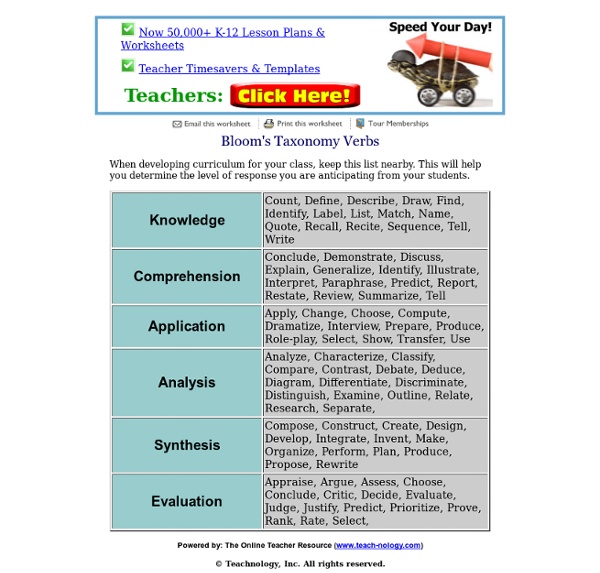
Writing Objectives Using Bloom's Taxonomy | The Center for Teaching and Learning Various researchers have summarized how to use Bloom’s Taxonomy. Following are four interpretations that you can use as guides in helping to write objectives using Bloom’s Taxonomy. From: KC Metro [old link, no longer functioning?] Bloom’s Taxonomy divides the way people learn into three domains. One of these is the cognitive domain, which emphasizes intellectual outcomes. From: UMUC From: Stewards Task Oriented Question Construction Wheel Based on Bloom’s Taxonomy Task Oriented Question Construction Wheel Based on Bloom’s Taxonomy. ©2001 St. From: GA Tech According to Benjamin Bloom, and his colleagues, there are six levels of cognition: Ideally, each of these levels should be covered in each course and, thus, at least one objective should be written for each level. Below are examples of objectives written for each level of Bloom’s Taxonomy and activities and assessment tools based on those objectives. Attachment: Writing Objectives Using Bloom's Taxonomy [PDF, 323 KB]
What does an instructional designer do? In the past few months, I’ve been asked by a number of different people what an instructional designer does and how to get into the field. I love instructional design because it is a field where I am constantly learning and I have a great variety in what I do. I use so many different skills—writing, web design, graphics, collaboration, planning, plus of course how people learn. Since this question has come up more than once, I thought it would be useful to collect all the information I have emailed people privately and post it here. This will be a series of posts over the week or so. I have about five pages of emails to revise for this format, so it’s waaay too long to put into one post. So without further ado, here’s the first installation: What does an instructional designer do? I’m emphasizing “experiences” here deliberately, even though that isn’t always how others would describe the job. How do we do that? Update: Other Posts in this Series Free Subscription
Differentiated Instruction with UDL By Tracey Hall, Nicole Strangman, and Anne Meyer Note: Updated on 11/2/09; 1/14/11; Please visit the AIM Center home page. Introduction Not all students are alike. This report on differentiated instruction and UDL begins with an introduction to differentiated instruction in which we provide the definition, a sampling of considerations and curriculum applications, and research evidence for effectiveness. The literature review in this paper is also available as a stand alone document, with annotated references. Top Definition To differentiate instruction is to recognize students' varying background knowledge, readiness, language, preferences in learning and interests; and to react responsively. Figure 1. Image description:This graphic organizer is entitled "Learning Cycle and Decision Factors Used in Planning and Implementing Differentiated Instruction" and is made up of a series of seven labeled boxes connected by arrows. Identifying Components/Features Content Process Products Figure 2.
Instructional design History[edit] Origins[edit] During World War II, a considerable amount of training materials for the military were developed based on the principles of instruction, learning, and human behavior. Tests for assessing a learner’s abilities were used to screen candidates for the training programs. After the success of military training, psychologists began to view training as a system, and developed various analysis, design, and evaluation procedures.[5] 1946 – Edgar Dale’s Cone of Experience[edit] In 1946, Dale outlined a hierarchy of instructional methods and their effectiveness.[6] Mid-1950s through mid-1960s - The Programmed Instruction Movement[edit] Early 1960s - The Criterion-Referenced Testing Movement[edit] Robert Glaser first used the term “criterion-referenced measures” in 1962. 1965 - Domains of Learning, Events of Instruction, and Hierarchical Analysis[edit] 1967 - Formative Evaluation[edit] The 1970s - Growing of Interest in the Systems Approach[edit] 2010 and forward[edit]