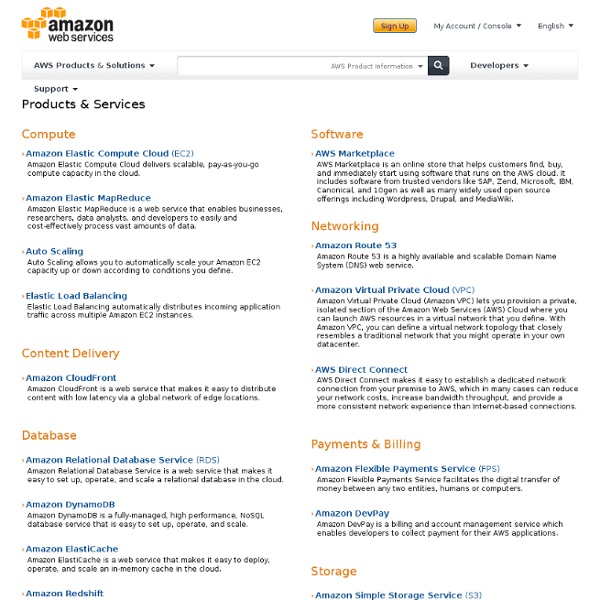
AWS Products and Services - Global Compute, Storage, Database, Analytics, Mobile, Application, and Deployment Services
Amazon Elastic Cloud Compute.pdf
Table of Contents What Is Amazon EC2? ................................................................................................................... 1 Features of Amazon EC2 ........................................................................................................ 1 How to Get Started with Amazon EC2 ....................................................................................... 2 Related Services ................................................................................................................... 2 Accessing Amazon EC2 ......................................................................................................... 3 Pricing for Amazon EC2 ......................................................................................................... 3 Instances and AMIs ............................................................................................................... 4 API Version 2014-06-15 iii Amazon Elastic Compute Cloud User Guide
Chapter 3 - Design Guidelines for Application Performance
Improving .NET Application Performance and Scalability J.D. Meier, Srinath Vasireddy, Ashish Babbar, Rico Mariani, and Alex Mackman Microsoft Corporation May 2004 Related Links Home Page for Improving .NET Application Performance and Scalability Chapter 4 — Architecture and Design Review of a .NET Application for Performance and Scalability Checklist: Architecture and Design Review for Performance and Scalability Send feedback to Scale@microsoft.com patterns & practices Library Summary: This chapter presents a set of performance guidelines and principles for application architects and designers. Contents ObjectivesOverviewHow to Use This ChapterPrinciplesDeployment ConsiderationsScale Up vs. Objectives Learn design tradeoffs for performance and scalability. Overview Performance and scalability are two quality-of-service (QoS) considerations. During your design phase, identify performance objectives. How to Use This Chapter Jump to topics or read from beginning to end. Principles Design Principles
Openstack, AWS, HyperV, VMware
Who Uses These Cloud and Virtualization Systems? OpenStack, AWS, Hyper-V and VMware are different services offering cloud computing or virtualization services. Let's take a closer look to see the advantages of each, as well as look at some companies using them. OpenStack OpenStack provides Infrastructure-as-a-Service (IaaS). OpenStack is a cloud operating system consisting of several projects. Amazon Web Services (AWS) Amazon Web Services (AWS) offers a suite of services for cloud computing. AWS cannot be hosted in-house. Hyper-V Previously known as Windows Server Virtualization, Hyper-V is a hypervisor-based platform that provides virtualization. Companies using Hyper-V include Siva Group, Avanade and the MLS Property Information Network. VMware VMWare creates virtualization software and cloud computing programs for Intel-based computers. It is unique because it can actually run other operating systems as if they were on their own computer. Conclusion
Designing Your Cloud Infrastructure
Many network architectures include a tiered design with three or more tiers such as core, distribution, and access. Designs are driven by the port bandwidth and quantity required at the edge, in addition to the ability of the distribution and core tiers to provide higher speed uplinks to aggregate traffic. Additional considerations include Ethernet broadcast boundaries and limitations, spanning tree or other loop-avoidance technologies. A dedicated management network is a frequent feature of advanced data center virtualization solutions. Most virtualization vendors recommend that hosts be managed via a dedicated network so that there is no competition with tenant traffic and to provide a degree of separation for security and ease of management purposes. With advanced data center virtualization, a frequent use case is to provide isolated networks where different owners such as particular departments or applications are provided their own dedicated networks.
Related:
Related:

