

Episodes - Brain Science Podcast Episode 1-10 can now be purchased for download as a single zip file. Other episodes and transcripts may be purchased separately. Please see the episode show notes for links. Mind Wide Open: A general introduction to why neuroscience matters, based on Mind Wide Open: Your Brain and the Neuroscience of Everyday Life, by Steven Johnson. On Intelligence: A discussion of On Intelligence, by Jeff Hawkins. In Search of Memory: Nobel laureate Eric Kandel's excellent introduction to neuroscience.
fonds Monod par JACQUES MONOD Service de Biochimie de l'Institut Pasteur, Paris Un jour, il y a presque exactement vingt-cinq ans c'était au début du sombre hiver de 1940 j'entrai dans le bureau d'André Lwoff, à l'Institut Pasteur. Je désirais discuter avec lui d'assez surprenantes observations que j'avais récemment faites. Je travaillais alors dans un antique laboratoire de la vieille Sorbonne ouvrant sur une galerie remplie de singes empaillés. Démobilisé au mois d'Août en zone libre, après la débâcle, j'étais parvenu à retrouver ma famille, restée en zone nord, et je m'étais remis au travail avec acharnement. Travail interrompu seulement de temps en temps par la circulation des premiers tracts clandestins. Fig.1. Il s'agissait en fait d'une manifestation de l' "effet glucose" découvert par Dienert dès 1900, plus connu aujourd'hui sous le nom de "répression catabolique" à la suite des travaux de Magtasanik ( 2 ). Fig.2. Fig.3. Fig. 4.
Time on the Brain: How You Are Always Living In the Past, and Other Quirks of Perception I always knew we humans have a rather tenuous grip on the concept of time, but I never realized quite how tenuous it was until a couple of weeks ago, when I attended a conference on the nature of time organized by the Foundational Questions Institute. This meeting, even more than FQXi’s previous efforts, was a mashup of different disciplines: fundamental physics, philosophy, neuroscience, complexity theory. Crossing academic disciplines may be overrated, as physicist-blogger Sabine Hossenfelder has pointed out, but it sure is fun. Like Sabine, I spend my days thinking about planets, dark matter, black holes—they have become mundane to me. Neuroscientist Kathleen McDermott of Washington University began by quoting famous memory researcher Endel Tulving, who called our ability to remember the past and to anticipate the future “mental time travel.” McDermott outlined the case of Patient K.C., who has even worse amnesia than the better-known H.M. on whom the film Memento was based.
The Singularity is Far: A Neuroscientist's View David J. Linden is the author of a new book,The Compass of Pleasure: How Our Brains Make Fatty Foods, Orgasm, Exercise, Marijuana, Generosity, Vodka, Learning, and Gambling Feel So Good. He is a professor of neuroscience at The Johns Hopkins University School of Medicine and Chief Editor of the Journal of Neurophysiology. Ray Kurzweil, the prominent inventor and futurist, can't wait to get nanobots into his brain. In his view, these devices will be equipped with a variety of sensors and stimulators and will communicate wirelessly with computers outside of the body. In addition to providing unprecedented insight into brain function at the cellular level, brain-penetrating nanobots would provide the ultimate virtual reality experience. "By the late 2020s, nanobots in our brain, that will get there noninvasively, through the capillaries, will create full-immersion virtual-reality environments from within the nervous system. Image: Harris KM, Fiala JC, Ostroff L. Space Invaders
10 Practical Uses For Psychological Research in Everyday Life | People love to give each other advice. The web is full to bursting with all types of pseudo-psychological advice about life. The problem is, how much of this is based on real scientific evidence? Well, here on PsyBlog we’ve got the scientific evidence. So here’s my top 10 list of what you can learn practically from the psychological research discussed here recently. 1. 2. 3. 4. 5. 6. 7. 8. 9. 10. Thinking Methods: Creative Problem Solving They further divided the six stages into three phases, as follows: 1. Exploring the Challenge (Objective Finding, Fact Finding, and Problem Finding), Generating Ideas (Idea Finding), and Preparing for Action (Solution Finding and Acceptance Finding). Description: Since the arrival of the now classical Osborn-Parnes structure, any number of academic and business entities have re-sorted and renamed the stages and phases of what we now call the Creative Problem Solving Process (CPS). The Creative Problem Solving Institute of Buffalo, New York, has finessed the Osborn-Parnes process to include a divergent and a convergent stage within each of the six stages. In his 1988 book, Techniques of Structured Problems, Arthur B. Mess FindingData FindingProblem FindingIdea FindingSolution Finding Where to Learn CPS
Learn How to Think Different(ly) - Jeff Dyer and Hal Gregersen by Jeff Dyer and Hal Gregersen | 10:24 AM September 27, 2011 In the Economist review of our book, The Innovator’s DNA, the reviewer wondered whether genius-level innovators such as Marc Benioff, Jeff Bezos, and Steve Jobs challenge the idea that working adults can really learn how to think differently and become innovators. We don’t think so. Remember, it was Steve Jobs who jump-started the now-famous “Think Different” advertising campaign as a way to inspire consumers and recharge Apple’s innovation efforts. It worked. Reams of relevant research (including our own) proves Jobs right. But neither Steve Jobs nor Apple nor any other high-profile innovator or company has a corner on the think-different market. Take Gavin Symanowitz, whom we recently met in South Africa. Innovators (of new businesses, products, and processes) spend almost 50% more time trying to think different compared to non-innovators. Just do It. Shake it up. Repeat. As a leader, how often do you think different?
Spatial Analysis.co.uk NLP Trainings, Communication Skills and Team Building, Vancouver Island, Vancouver, B.C. Getting to the Root of the Problem NLP Books and ebooks by Roger Ellerton This article may not be republished without written permission from Roger Ellerton/Renewal Technologies Inc. If you republish this article without permission, you will be in violation of copyright law and sent an invoice. You may share this and other pages with your friends via facebook, twitter, google+, etc., simply use the buttons in the left hand margin. Or you can link directly to this page from your website or blog. By Roger Ellerton Phd, ISP, CMC, Renewal Technologies Inc. www.renewal.ca When addressing a problem or issue, coaches, counselors, consultants, managers, parents and even ourselves often focus on the symptom, use a 'bandage' to cover it up and then wonder why the problem or issue is not resolved. To fully address a problem or issue, the root cause must be identified and resolved. This very useful technique can be improved using the following NLP concepts: In NLP, we prefer to avoid using a 'Why' question. In the UK or USA?
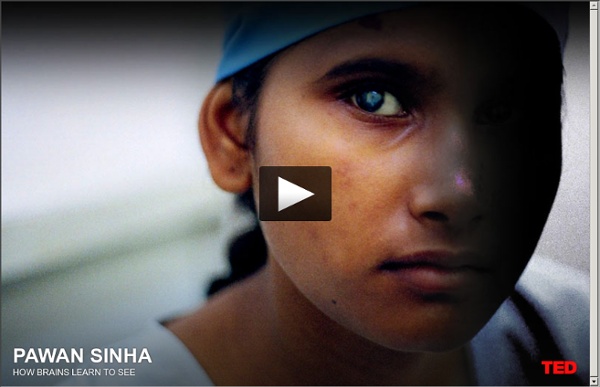
Pawan Sinha's disagreees with the theory that the brains critical phase ends after the first year (see [Michael Merzenich on re-wiring the brain | TED]). His clinical results show that children can learn to see after their brain's supposed critical phase has ended. Pawan has learned that the brain first 'sees' coloured 'pixels', then it recognizes shapes (called visual integration). Movement helps the brain to distinguish these shapes. Pawan Sinha asks "could the impairment in visual intregration be the manifestation of something underneath of dynamic information processing deficiency in autism?" by kaspervandenberg Dec 27