background preloader

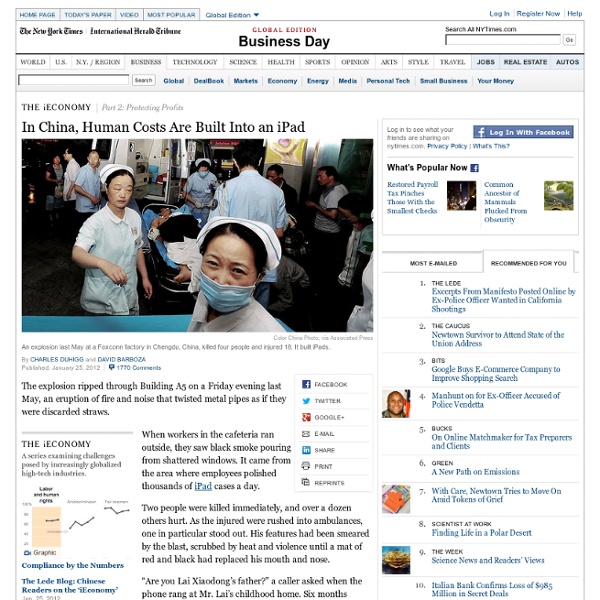
Apple’s iPad and the Human Costs for Workers in China

Apple’s iPad and the Human Costs for Workers in China

Rebecca MacKinnon: Inside China’s censorship machine In a new book, excerpted below, former CNN correspondent Rebecca MacKinnon explains how Beijing, and its loyal corporate minions, scrub ‘disharmonious’ material from the Chinese Web: In fall 2009, I sat in a large auditorium festooned with red banners and watched as Robin Li, CEO of Baidu, China’s dominant search engine, paraded onstage with executives from 19 other companies to receive the “China Internet Self-Discipline Award.” Officials from the quasi-governmental Internet Society of China praised them for fostering “harmonious and healthy Internet development.” In the Chinese regulatory context, “healthy” is a euphemism for “porn-free” and “crime-free.” “Harmonious” implies prevention of activity that would provoke social or political disharmony. China’s censorship system is complex and multilayered. These blocks can be circumvented by people who know how to use anti-censorship software tools.

How Lagos hopes a railway will end daily endurance test and change lives | World news When Danladi Verheijen has to attend an important meeting, he doesn't know whether getting there will take 10 minutes or three hours. "You're going to upset someone," he says. "You're going to arrive very early or very late. It leads to massive loss of productivity." Verheijen works in Lagos, one of the world's fastest growing megacities – and one of the most congested. The simplest journey here can be a trial of will. But Verheijen believes he can do something to break the deadlock. "I think it will dramatically change the face of Lagos," he said. "It's cheaper than the alternative, it's faster, it's safer, it's more reliable, it's more environmentally friendly. Many railways laid during Africa's colonial era have decayed due to neglect, leaving Cecil John Rhodes's Cape-to-Cairo fantasy more remote than ever. But Lagos is badly in need of mass public transport beyond its recently introduced bus rapid transit system. It is hoped that a rail renaissance can be part of the solution.

Apple, America and a Squeezed Middle Class Photo When joined Silicon Valley’s top luminaries for dinner in California last February, each guest was asked to come with a question for the president. But as of spoke, interrupted with an inquiry of his own: what would it take to make iPhones in the United States? Not long ago, Apple boasted that its products were made in America. Why can’t that work come home? Mr. The president’s question touched upon a central conviction at Apple. Apple has become one of the best-known, most admired and most imitated companies on earth, in part through an unrelenting mastery of global operations. However, what has vexed Mr. Apple employs 43,000 people in the United States and 20,000 overseas, a small fraction of the over 400,000 American workers at General Motors in the 1950s, or the hundreds of thousands at General Electric in the 1980s. “If it’s the pinnacle of capitalism, we should be worried.” Apple executives say that going overseas, at this point, is their only option. ‘I Want a Glass Screen’

China-based corporate web behind troubled Africa resource deals For centuries, wave after wave of colonists and foreign investors have swept through Africa, looking for profits from the continent’s abundant reserves of oil and prized minerals. Many instead left records of corruption and broken promises of shared wealth with Africans. It is against this backdrop that an eager conglomerate has recently been drawing attention and generating headlines throughout Africa. China-Sonangol is part of a global network of companies extracting oil in Angola, buying gold in Zimbabwe, building luxury condominiums in Singapore and developing property in Manhattan. Its executives have met with African heads of state and challenged the global oil and mining giants who’ve been operating on the continent. And China Sonangol ventures have attracted strategic curiosity — some of its deals are the subjects of U.S. China Sonangol has shown itself to be innovative and well-connected. New business model CIF’s first major foray into Africa was in 2005. The Angola connection

Electricity to be costlier by 24.15% in Delhi from July 1 PTI Jun 26, 2012, 07.48PM IST NEW DELHI: Electricity will cost more in Delhi from July one with power regulator DERC today raising domestic tariff by 24.15 per cent for the year 2012-13. The Delhi Electricity Regulatory Commission (DERC) Chairman P D Sudhakar said the average hike is 20.87 per cent in all categories and domestic tarrif has been hiked by 24.15 per cent. The regulator had in August last year hiked the tariff by 22 per cent hike for all categories of consumers. The tariff was hiked by five per cent in February and by upto two per cent in May this year to adjust the power purchase cost of the distribution companies. All the three power distribution companies, BSES Rajdhani Power Ltd, BSES Yamuna Power Ltd and Tata Power Delhi Distribution Ltd have been pushing for a hefty hike citing their "severe" finacial condition. The two BSES discoms have said the situation has worsened due to absence of a cost-reflective tariff structure.

What is Governance? | Francis Fukuyama I’m beginning a new project at Stanford/CDDRL called “The Governance Project.” The intention is to focus on conceptualizing and measuring governance, and applying those measures to two specific countries, China and the United States. The beginning point of the project is definition of governance that excludes the degree to which governments are either democratic or subject to a rule of law that constrains the executive. The reason for this is simple: it seems obvious to me that countries can be better or worse governed regardless of whether they are liberal democracies or not. Singapore is not Zimbabwe, despite the fact that neither is democratic. Separating the quality of the state from either the rule of law or democratic accountability is one of the foundational ideas in The Origins of Political Order. The reason I want to make this separation is to then be able to empirically evaluate the relationship of governance to democracy and the rule of law.

Urges Microsoft and Cisco to Reconsider China This week saw two disappointing decisions by two major American companies, Microsoft and Cisco, that appear to be choosing to become little tech helpers to China's repressive regime rather than choosing to be a force for good. For Cisco, it's more of the same. For Microsoft, it's a disappointing turn. China’s Internet censorship is perhaps the most pervasive and its filtering system most sophisticated. China also uses its technological systems to monitor and target individuals that the regime dislikes, most prominently democracy advocates and the "Falun Gong evil religion" which ended up in a Cisco presentation that surfaced in 2008. Microsoft Since Google yanked its search services from China in 2010, the market has been left entirely to Chinese companies, with Baidu dominating with 83 percent of the market share. Microsoft Bing currently offers search for a number of countries, including China. Cisco

Un salarié français coûte en moyenne 50 850 euros par an à son employeur Un salarié français coûte en moyenne 50 850 euros par an à son employeur, pour un coût horaire du travail proche de 32 euros dans les entreprises de dix salariés ou plus du secteur marchand, selon des chiffres de 2008 publiés mercredi 23 février par l'Insee. Ce coût horaire moyen (31,82 euros) en 2008 masque de fortes disparités, puisqu'il varie de 21 à 49 euros selon le secteur d'activité. Il est le plus élevé dans le secteur des banques et des assurances (49,01 euros) et la production et distribution d'électricité et de gaz (46,09). Le coût horaire croît avec la taille de l'entreprise. Les différences de coût horaire moyen entre entreprises s'expliquent aussi par leur localisation géographique. En moyenne, la rémunération des salariés représentait 67,3 % du coût horaire en 2008 dans l'industrie et les services, l'épargne salariale 2,84 %.

Related: