

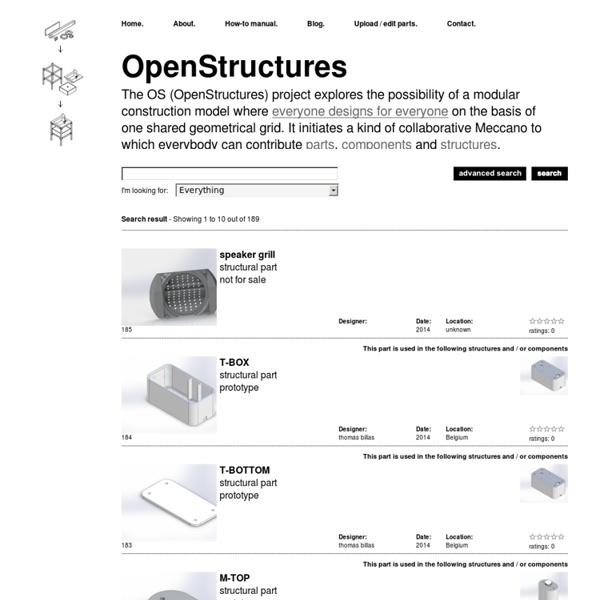
How to Make Everything Ourselves: Open Modular Hardware A modular system unites the advantages of standardisation (as parts can be produced cheaply in large amounts) with the advantages of customisation (since a large diversity of unique objects can be made with relatively few parts). Modularity can be found to a greater or lesser extent in many products (like bicycles and computers) and systems (like trains and logistics), but the best examples of modular systems are toys: LEGO, Meccano, and Erector (which is now the brand name of Meccano in the US). LEGO, Meccano and Erector are composed of relatively few elementary building blocks, which can be used to build various objects. The parts can then be disassembled and re-used to build something completely different. Apart from the elementary buildings blocks, these manufacturers have produced many more specific building blocks, which are less versatile, but further increase customisation possibilities. Grid Beam, Bit Beam, Open Beam, Maker Beam and Contraptor OpenStructures Circulation of Parts
FabHub - Digital Fabrication Hub E3D Unveils Most Affordable 3D Printer Hotend Yet, The E3D Lite6 — Priced Under $32 When it comes to 3D printers, one of the most important, as well as expensive components on any FFF or FDM machine is the hotend. After all, the hotend is what transforms your filament into the molten hot plastic as it is released onto the build platform. A faulty hotend equates to terrible print results. When it comes to hotend manufacturing, there are few companies, if any, who have garnered the respect in the industry as E3D has. The company, based in Oxfordshire, England, has proven themselves time and time again with anything from their incredibly well engineered V6 hotend to their multi-nozzle Kracken or Chimera hotends. Typically a hotend will run anywhere from around $45 all the way up to over $175, depending on its capabilities. “We designed Lite6 to be a low cost hotend for robust easy printing for everyday filaments, for temperatures up to 240 degrees C and moderate printing speeds,” explained Sanjay Mortimer, E3D Director and R&D/Community Manager.
Machines: Global Village Construction Set | Open Source Ecology The Global Village Construction Set (GVCS) is a modular, DIY, low-cost, high-performance platform that allows for the easy fabrication of the 50 different Industrial Machines that it takes to build a small, sustainable civilization with modern comforts. We’re developing open source industrial machines that can be made at a fraction of commercial costs, and sharing our designs online for free. We are developing a lifesize, scalable, modular LEGO construction set. The GVCS in itself consists of many other Construction Sets – as we build not individual machines, but construction sets of machines. As an example, the Fabrication Construction Set component can be used to build any of the other machines. Our goal is lifetime design, and low maintenance so only a few hours of maintenance per year are required to keep any machine alive. We have built the first machine in 2007 – the Compressed Earth Brick Press. In 2014, our status of completion for the machines is:
3datdv | Blog from the 3D at DV Challenge team Cults ・ Buy and sell 3D models for 3D Printer Lite6 - A high quality, low cost HotEnd for everyone Posted On: 2015-04-01 13:32:47 ; Read: 403 time(s) Introduction We know that not everybody needs the all-metal high-temperature performance of an E3D-v6. We’ve come to realise that there exists a need for a hotend that is reliable, and puts out great prints, but meets the budget of those who are just getting started in 3D printing. Lite6 is our answer to that need. By adopting a PTFE lined, “Mostly Metal” design we’re able to meet what we think is a really awesome price point of £21.50, for a fully inclusive kit with electronics. Lite6 Assembled Lite6 does not supersede v6 - more compliments it, think of Lite6 as v6’s little brother. E3D-Lite6 v.s E3D-v6 Features: Aimed at printing everyday materials. Lite6 cannot offer the same high-temperature performance as E3D-v6, which means that you can’t print higher-performance engineering plastics like Nylon, Polycarbonate, and ColorFabb Carbon-Fiber XT. Some nice E3D-Lite6 prints in PLA and ABS A range of versions for most users. "... New, Lower Price
CNC Panel Joinery Notebook I’ve been collecting clever ways of slotting flat stock together since I first read Nomadic Furniture back in 1999, well before the advent of the accessible hobby-class CNC tools that today make manufacturing parts like these pretty easy. Now, the world is full of people designing models, project enclosures, sculpture, furniture, and all kinds of other cool stuff to be assembled from parts made on laser cutters and CNC routers. I keep expecting a definitive book or website to emerge that covers the “bag of tricks” in an organized way, but so far, I haven’t found it. Maybe this article can serve as a jumping-off point. In presenting this material, I want to first acknowledge my respect for the world’s established and ancient traditions of joinery. I may abuse some terms, without meaning to, and I am glad to be corrected by those who are in the know about traditional joinery. To simplify things, at first, I’m only considering joints between two panels. Laser vs. Biasing Cross (“X”) Joints
Resin Casting: Going from CAD to Engineering-Grade Plastic Parts Synthetic polymers play a role in almost every single commercially manufactured item on the planet. Plastics are not just ubiquitous, but extremely versatile: some of them are incredibly stretchy, while some are hard as nails; some are crystal clear, and others come in all colors of the rainbow; some can survive extreme temperatures, and yet others can stop a bullet mid-flight. When you think about all this, it’s hard to believe that even for hobbyists well-accustomed to 3D manufacturing, engineering-grade plastics are still taboo. Oddly enough, there is no reason why things need to be that way. Fabricating patterns for single-part molds If you follow the usual advice for replicating hand-made parts, you will be instructed to coat or submerge the original item in a flexible material, such as alginate or silicone rubber. This process works, but has a number of drawbacks, especially if you want to get predictable results – and want to get them fast. Producing negative molds Good question!
FabLab Maastricht video interview - PlugnMake FabLab Maastricht specializes in 3D printing research. Its aim is to make both tools and materials as affordable as possible. To do that, they avail themselves of the collaboration with companies, universities and research centers. 21-year-old Floris Hoff managed to build his own company, byflow, thanks to the experience acquired within the FabLab. byflow is a foldable 3D printer with interchangeable nozzles, which allows you to print a wide range of materials through a user-friendly interface. Frits Hoff, manager of FabLab Maastricht, told us about the research lines conducted in the Lab, and about the adopted policies of financing and sharing. Could you tell us about FabLab Maastricht and its value for the community? FabLab Maastricht started 4 years ago with not enough money, like a normal FabLab. Finally, we received some funding, from European Union, but also from the local and national government. Now, we are a professional FabLab doing research in affordable 3D printing.
Ramps1.4 Introduction Ramps is short for reprap Arduino mega pololu shield, it is mainly designed for the purpose of using pololu stepper driven board (similar to 4988 driven board). Ramps can only work when connected to its mother board Mega 2560 and 4988/DRV8825. Owning to its stability in operation and great compatibility with most 3Dprinter (all reprap-model such as pursa i2 and i3). The combination of Ramps1.4+MEGA2560+A4988/DRV8825 is becoming a mainstream of DIY 3D printer control board. Features 1. 2. 3 MOSFET 3 MOSFET are applied to the heater/ fan and thermistor circuit. 4. 5. 6. 7. 8. 9. 10. 11. 12. 13. 2 stepper motor for Z axis in parallel. Overview and Hardware Weight: 68g Size: 102mm*60mm Software Compiling environment: Arduino IDE Firmware: Marlin PC software: Printrun, Repetier-Host Source Printrun Repetier-Host Arduino IDE Arduino IDE Marlin Arduino 1.0.1 for Mac Interface Interface Layout Interface specifications Jumper Instruction Step size of stepper driver (A4988) Development Environment setting
20 Amazing Creations You Can Make With 3D Printing - Hongkiat If you can print in 2D, can you print in 3D? Well, the technology is already here. You can print out 3-dimensional objects based on a working template, and they aren’t just for show. They actually work! Manufacturers can provide you with a template where you can print a broken part of a machinery, let’s say, a screw, rather than order then wait for a replacement to come in. Alternatively, you can make a model replica of an expensive car, like a 1960 Aston Martin DB5 in a 1:3 scale then crash and burn it for entertainment, like how the makers of the James Bond flick, Skyfall did. (Image Source: The Register) 3D printing is made possible by fusing layers upon layers of materials made from durable plastics and metals based on a template, designed with a 3D Computer Aided Design (CAD) software. With this technology, and a 3D printer, you can create designs or print 3D models of just about anything under the sun, provided you have the templates. 1. 2. 3D Printed Acoustic Guitar 3. 4. 5. 9. 11.