

6.3. This journal article addresses the issue of b. This paper discusses the positive and National Science Foundation (NSF) Discoveries - Redefining Adaptation, the Study of How Populations Grow and Survive - US National Science Foundation (NSF) DiscoveryRedefining Adaptation, the Study of How Populations Grow and Survive Researcher also engages educators and students in an open forum June 27, 2013 How do organisms adapt over time? For example, "did a giraffe's neck get longer because there were thousands of mutations each resulting in a millimeter increase?" Marx's research focuses on adaptation, the process by which populations improve in their ability to grow and survive. Understanding how adaptation works in smaller populations is important because many scenarios--from new infections to cancer--involve small numbers of cells. "Many current therapeutic approaches aim to reduce population sizes of pathogens in order to thwart their eventual success," Marx says. Until recently, many scientists held the classic Darwinian view that adaptation occurs gradually through a series of small changes, he says. "If you change the population size, three things are supposed to happen," he says. Investigators Christopher Marx
GPS%2520Tracking%2520Privacy%2520Article Journal of Technology Law and Policy June, 2006 Article Peter Caldwell [FNa1] Copyright (c) 2006 Journal of Technology Law and Policy; Peter Caldwell *40 I. GPS technology is not new, but in the recent past, it has become so widespread that it now affects most everyone's lives. Yet, because of the intimate, locational nature of GPS data, these technologies have engendered privacy questions which beg closer examination, particularly due to the potential law enforcement (or other government) exploitation of GPS locational information. The first portion of this Article will therefore closely examine the rules, uses, and potential applications of sections 12 and 23 alone, without regard to GPS technology. Since there is no Florida case law directly addressing the question of GPS-cellular devices under sections 12 or 23, the following analysis depends partially on legal predictions. *41 II. Much like the U.S. A. On the other hand, there is some authority which modifies this general rule. B.
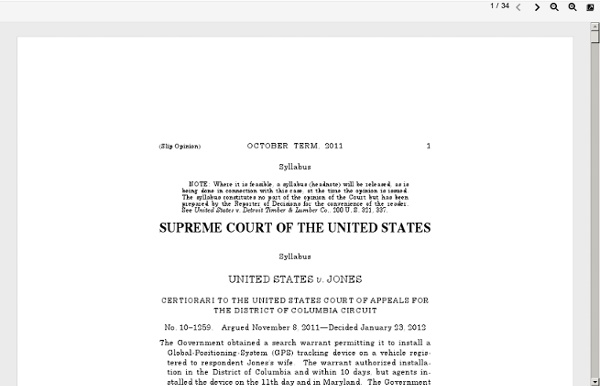
b. This case is about the warrantless use of a 7.3. This Supreme Court of the United States b. This is the site for the office of the 5.3. Flicking your index finger up to scroll Telecommunications Information Privacy Code This code applies specific rules to telecommunications agencies to better ensure the protection of individual privacy. The code addresses the telecommunications information collected, held, used, and disclosed by telecommunications agencies. For telecommunications agencies the code takes the place of the information privacy principles. Telecommunications Information Privacy Code 2003 including Amendment No 3 (consolidated edition as at 1 August 2004). (Amendment No 2 (Temporary) operated over the period 1 November 2003 to 31 July 2004 and is set out in an appendix. Telecommunications Information Privacy Code - general information.
Smartphone Wars Apple sues Samsung for patent infringement. In response, Samsung files international countersuits on patents of its own. Courts around the world grant preliminary injunctions to each company on a number of their claims, while United States and European Union government agencies investigate allegations of antitrust violations . What’s going on here? Let’s start with the shiny new weapon that Apple added to its arsenal in June of last year: a patent on the original iPhone , the paperwork for which had been in the works since December of 2007. Flicking your index finger up to scroll through an address book? Apple has additionally based a significant portion of its legal battle against Samsung on similarities in design between the companies’ respective device families. Adding fuel to the fire, Samsung filed numerous countersuits hinging on its ownership of patents in standardized technologies like 3G and UMTS communications protocols. So what does this all mean for consumers?
b. This interesting TED talk gives insight into GPS Act | Priorities | U.S. Senator Ron Wyden Geolocation Privacy and Surveillance (“GPS”) Act While technology – like cell phones, smart phones, lap tops and navigation devices – continues to make it increasingly easy to track and log the location of nearly every American, federal laws have failed to keep pace, meaning there are no clear rules governing how law enforcement, commercial entities and private citizens can access, use and sell that data. With this in mind, a bipartisan coalition led by Senator Ron Wyden (D-Ore.), Rep. Jason Chaffetz (R-Utah) and Senator Mark Kirk (R-Ill.) have reintroduced the Geolocation Privacy and Surveillance Act (GPS Act) in the House and Senate which will require law-enforcement to obtain a warrant before acquiring geolocation information of an American. The bipartisan legislation creates a legal framework designed to give government agencies, commercial entities and private citizens clear guidelines for when and how geolocation information can be accessed and used. Section-by-Section Summary Sen.