

Gustavsbergs Konsthall TUMULT Exhibition Matlida Haggärde, Report from within, 2013, photo Magnus Natschki How – Do – Know 31.1.2014 – 27.4.2014 Charlotta Bellander, Johan Bjärntoft, Lo Eklöw, Matilda Haggärde, Li Liang In the spring of 2014 we are presenting five craft artists who have either recently completed the master’s programme at HDK, the School of Design and Crafts at Gothenburg University, or who are currently enrolled in the programme. The exhibition will focus on ceramic processes and the way in which experience of these processes is used in developing an artistic identity. The five craft artists present different approaches and results based on a profound exploration of the possibilities offered by the material – in this case clay. Zandra Ahl, Family Outlet, © Zandra Ahl FAMILY OUTLET 5.10.2013 – 5.1.2014 Zandra Ahl This autumn, Gustavsbergs Konsthall presents Family Outlet, a new solo exhibition by Zandra Ahl. Is it possible to question prejudice and xenophobia with jewellery? Kakan Hermansson, from "Girls Club"
designfortheworld.org (Designophy - Resource, www.designophy.com) Design for the World is an international humanitarian organisation whose objective is to match the skills and commitment of volunteer designers with the needs expressed by disadvantaged populations and the organisations that serve them worldwide. Design for the World unites graphic designers, industrial designers and interior and architectural designers around one common idea: voluntary design for people in need. Design for the World has developed its website to present the organisation and its activities. The aim of the site is also to create a communication channel for designers wanting to contribute to social and humanitarian causes, and between those designers and the organisations that could use their help. Some parts of the website, such as the online gallery where people can show their projects related to design for people in need, and the project board, where people can collaborate on projects through an interactive webspace, will soon be published. Language(s): English
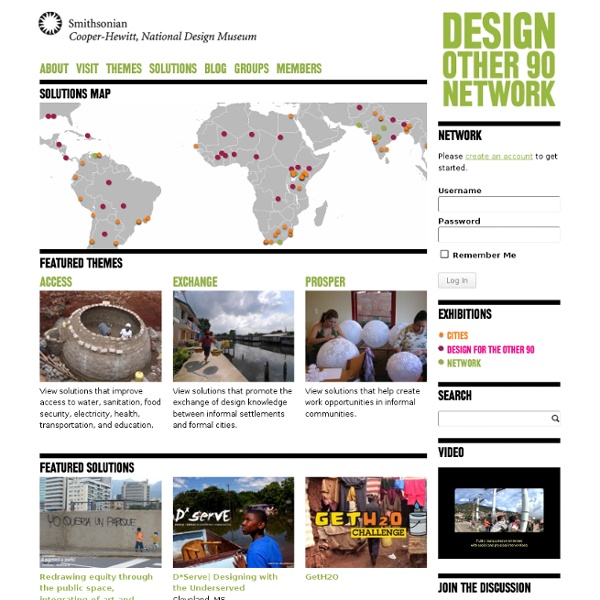
Il design dell'altro 90% | SocialDesignZine Viviamo immersi in un mondo di design. Tutto quello che ci circonda è stato pensato, progettato e realizzato secondo i principi del design. Poche volte capita di considerare che la comunità dei designer focalizza la quasi totalità della propria azione progettuale per il solo 10% più ricco della popolazione mondiale. Il restante 90% degli abitanti di questo pianeta non ha semplicemente le risorse per permettersi di acquistare alcun tipo di prodotto. Design for the other 90%, presenta le iniziative progettuali nate tra i designer per sviluppare soluzioni a basso costo per soddisfare alcuni di questi bisogni primari. Una mostra che ci fa riflettere su valore politico del design e delle possibilità che questo ha di rendere più vivibile l'esistenza alla stragrande maggioranza di uomini e donne di questo mondo.
Scientists team-up with designers at new exhibition - myScience / science wire Mad Hatter’s nuclear themed tea party Leading scientists at the University of Sheffield have used artistic flair to showcase the impact of future scientific developments, as part of a pioneering new exhibition in London, which kicked-off yesterday (Monday 15 March 2010. In a groundbreaking new partnership, a group of leading science researchers from the University collaborated with a designer from the Royal College of Art, in a bid to visualise the potential impact of scientific developments. The results are being showcased in the IMPACT! exhibition at the Royal College of Art between 16 and 21 March 2010, which offers a powerful insight into how today´s research might transform people´s experience of the world. Taking the form of a `Mad Hatter´s tea party,´ the display features placemats mapping sites of potential new nuclear reactors, upon which dinner plates showcase quirky benefits of nuclear power. The IMPACT!
About Architecture for Humanity Architecture for Humanity is a registered 501(c)3 nonprofit founded in 1999. We are building a more sustainable future through the power of professional design. By tapping a network of more than 50,000 professionals willing to give their time and expertise to help those who would not otherwise be able to afford their services, we bring design, construction and development services where they are most critically needed. Each year 100,000 people directly benefit from structures designed by Architecture for Humanity. Design is important to every aspect of our lives. Thoughtful, inclusive design creates lasting change in communities by: Design is the ultimate renewable resource. Architecture for Humanity brings people who care about sustainable development together. Design Advocates 55,000 newsletter subscribers, 500+ professional affiliations globally Local Chapters 58 chapters in 16 countries with more than 13,100 professional volunteers Curry Stone Design Prize - Vision Award 2013
Ethica » Blog Archive » Art Biotech In basso una recensione al libro “Art Biotech”. Su alcuni dei problemi evidenziati dall’arte biotech, mi permetto di rinviare al mio “L’arbitrarietà del corpo umano”: Art BiotechRecensione di Cristina Trivellin e Martina Coletti[da: Testo originariamente pubblicato sulla rivista d’arte contemporanea D’Ars, n.190, Ottobre 2007] Art Biotech esce in Italia come primo testo che affronta le problematiche proposte da una nuova pratica artistica chiamata “bioarte” (o “arte biotecnologia” o “arte genetica”), e intende porsi come approfondimento teorico al catalogo della mostra “L’Art Biotech”, curata da Jens Hauser e svoltasi a Nantes nel 2003, che rappresenta una delle primissime mostre di “arte biotecnologica”. Una prima evidente distinzione con le precedenti forme d’arte si impone proprio a partire dall’oggetto preso in considerazione dalla bioarte.
Worldchanging | Evaluation + Tools + Best Practices Terms and Conditions Only 21 years old and above is eligible for loan application. To preserve the confidentiality of all information you provide to us we maintain the following Privacy Principles. We only collect personal information that we believe to be relevant and required to understand your financial needs. By clicking "Submit" and providing your personal data, you consent to Credit Hub Capital contacting you via the telephone and email for the loan application purpose. We will only use any information collected as minimally as possible, mainly to assist us in customising and delivering loan packages that are of interest to our customers. We will not make unsolicited requests for customer information through email or the telephone, unless customers initiate contact with us. We have established strict confidentiality standards for safeguarding information on our customers.
Adhocracy | Istanbul Design Biennial One of the two exhibitions at the Istanbul Design Biennial is Adhocracy, hosted in the Galata Greek Primary School’s 2,300 square metres. Reuniting over 60 projects by 120 designers, architects, “Adhocracy”, curated by Joseph Grima in collaboration with an international curatorial team, surveys the contemporary design scene in the wake of a wave of social and technological revolutions that have transformed the realm of design in recent years. The exhibition argues that rather than in finished products, the maximum expression of design today is to be found in processes—systems, tools, networks and platforms that involve users in the process of definition of the end product. The exhibition charts the migration of the epicentre of production from the factory floor to back to the craftsman’s workshop.
open architecture network Action! Design over Time The Museum of Modern Art announced Action! Design over Time, a new installation of the contemporary section of The Philip Johnson Architecture and Design Galleries, beginning on February 5, 2010. Organized by Paola Antonelli, Senior Curator, and Patricia Juncosa-Vecchierini and Kate Carmody, Curatorial Assistants, Department of Architecture and Design, The Museum of Modern Art, the installation brings together some 85 examples from the collection that reveal the dynamic and evolving nature of objects, providing a deeper understanding of contemporary design. Objects are not still, and yet design is often appreciated in terms of its static presence - both aesthetic and functional - in any given instant, without much consideration of the process of its making, trajectory in time, life cycle, or relationship with people. The design firm Freedom Of Creation has taken rapid manufacturing into the realm of textiles.
ENSCI Paris DESIS Lab Posted by Christophe on Monday, January 16, 2012 · 2 Comments ENSCI Paris DESIS Lab The course will explore scenarios of local development based on collaborative services bridging social innovations and public innovations. The suburban area of Saclay, 20 kilometres South-West from Paris has been chosen to host a high level R&D Campus with universities, research labs, high-tech companies, etc… This top-down development project expect 100 000 researchers and related infrastructures to settle down in what is now a mix of agricultural land and suburb, to live there or commute from Paris… The goals of the course are to explore current initiatives developed on the field, potentials brought by the participating actors and co-develop with them scenarios focusing sustainable way of living, quality of life, integration and collaboration within the new mix of populations. Scenarios de Vie Durable Campus de Saclay Services Collaboratifs entre innovation Sociale et Innovation Publique