

Kanji 1ere année - Gauche : SA hidari - Centre : CHUU naka - Dessous : GE KA… - Kanbanji, un kanji par soir Samedi 2 juin 6 02 /06 /Juin 20:00 Exemples 左翼 sayoku gauche politique [gauche - aile]* 左手 hidarite main gauche [gauche - main] 左様なら sayounara au revoir, adieu Remarques * on utilise aussi le mot 左党 satou, lit. parti de gauche. Ce caractère signifiait autrefois "aider avec des outils". Ne pas confondre avec...佐 aide右 droite Ordre des traits par The Kanji Cafe Vendredi 1 juin 5 01 /06 /Juin 20:00 Exemples 真ん中 mannaka milieu [vrai - n - centre] ~中 chuu pendant 中学校 chuugakkou collège [centre - étude - école] 中国 chuugoku la Chine [centre - pays] 一日中 ichi nichi juu toute la journee [un - jour - pendant] Etymologie Peut-être un cercle autour d'un piquet, une flèche dans un cercle, voire tout simplement la représentation de la notion de centre, le trait traversant le carré par le milieu. Jeudi 31 mai 4 31 /05 /Mai 20:00 Remarques 下りる est aussi écrit 降りる. Le trait supérieur figure la ligne du sol, le reste étant dessous. Ne pas confondre avec...
capncosmo: Taking the Kanji Kentei - A Guide Or, how I learned 900 kanji in less than a year. So! Today we are going to talk about the thing I've devoted the last ~9 mo. to AND SO CAN YOU: The Japan Kanji Aptitude Test, or Kanji Kentei (日本漢字能力検定) Wait! Why You Should Consider Taking the KanKenThere are a lot of really good reasons to take the KanKen. #1 You learn kanji This is pretty obvious, but it's important nonetheless to point out that as a learner of Japanese, the number one most positive benefit is that you learn kanji and how to use them. #2 You learn about kanji The bits of the test that aren't about practical usage require you to know things about kanji, like radicals and stroke order and stuff like that. #3 You learn to interact with Japanese in an organic way Obviously everything for the KanKen is totally in Japanese, and is laid out the same way it would be in a Japanese grade school. How to PrepareSo I've convinced you, have I? #1 Choose your level So! #2 Learn the Kanji Kanji Gakushuu Steps So you know the kanji! #4 Review
Nihongo Zokugo Jisho Japanese Language Books Nihongo These books are not for sale here.Cover prices are shown for reference.Title links are to listings at Amazon. 252 Japanese Language Booksalphabetical by title (Texts are from introductions, prefaces, covers, etc.) 1 1 2 5 9 A B C D E F G H I J K L M N O P R S T U V W Y Titles Authors Publishers Types 2 1 2 5 9 A B C D E F G H I J K L M N O P R S T U V W Y Titles Authors Publishers Types 5 1 2 5 9 A B C D E F G H I J K L M N O P R S T U V W Y Titles Authors Publishers Types 9 1 2 5 9 A B C D E F G H I J K L M N O P R S T U V W Y Titles Authors Publishers Types A 1 2 5 9 A B C D E F G H I J K L M N O P R S T U V W Y Titles Authors Publishers Types B 1 2 5 9 A B C D E F G H I J K L M N O P R S T U V W Y Titles Authors Publishers Types C 1 2 5 9 A B C D E F G H I J K L M N O P R S T U V W Y Titles Authors Publishers Types D 1 2 5 9 A B C D E F G H I J K L M N O P R S T U V W Y Titles Authors Publishers Types Collected by Steve Trussel Return
Aha! Sensei – Japanese Lessons | Learn Japanese, period. Tangorin.com Japanese Dictionary Guide japonais de Tae Kim pour la grammaire japonaise Ce guide est également disponible dans divers autres formats et langues : Fichier Zip | Presentation en 1 seule page HTML | Format PDF | Version avec cadres Deutsch | English | Español | Français | Bahasa Indonesia | Italiano | Português | Русский | Suomi | Türkçe | 한국어 Voir qui travaille sur la Traduction de ce guide.
Kanji Facts | KANJIDAMAGE Bushu (部首) are the smallest units (we call them "radicals"). They are like letters of the alphabet, but there's over 200 of them. Just like English letters, radicals don't have any real meaning. Kanji (漢字) are single words, made of radicals. Jukugo (熟語) are compound words: Just like English, several kanji compose a jukugo. I'll go on about these 3 in unrelenting detail later. Guys like ...are like the ABSOLUTE RADICALS (no pronunciation, never kanji by themselves), except that they DO HAVE MEANING. is associated with sickness. Here's the mind-blower: All kanji, even complex ones, can be radicals- if they wind up inside a bigger kanji! A more common example would be the kanji for water and tree (水 and 木). Often, these simple-kanji-which-are-used-in-bigger-kanji are ALSO symbolic radicals - kanji with a tree in them have to do with wooden things, kanji with fire in them are about fire, etc. Remember what I said earlier about "half the difficulty of Japanese is how it is taught?" 丹 屯 斤 杉 后 履
JLPT Study :: View topic - Genki Resources I just thought I'd share this with this with everyone. When I was going through Genki I, I found these links to be very helpful in reinforcing all the vocabulary and kanji that I have learned. These are webpages that contain activities that are based on the Genki books. Ganbatte! Kanji The last and most notorious aspect of the Japanese written language is Kanji, which are Chinese characters adapted for Japanese. Most words in Japanese are written in Kanji even though they are still pronounced with the Japanese phonetic sounds represented by Hiragana and Katakana. Stroke Order When learning Kanji, it is very important to learn it with the proper stroke order and direction from the beginning in order to avoid developing any bad habits. The simpler characters called radicals are often reused as components in larger characters. One good general rule of thumb is that strokes usually start from the top-left corner toward the bottom-right. Kanji in Vocabulary There are roughly over 2,000 characters used in modern Japanese so you can imagine that memorizing them one-by-one as you might for syllabaries such as Hiragana does not work very well. An effective strategy for mastering Kanji is learning them with new vocabulary within a larger context. Kanji Readings Example
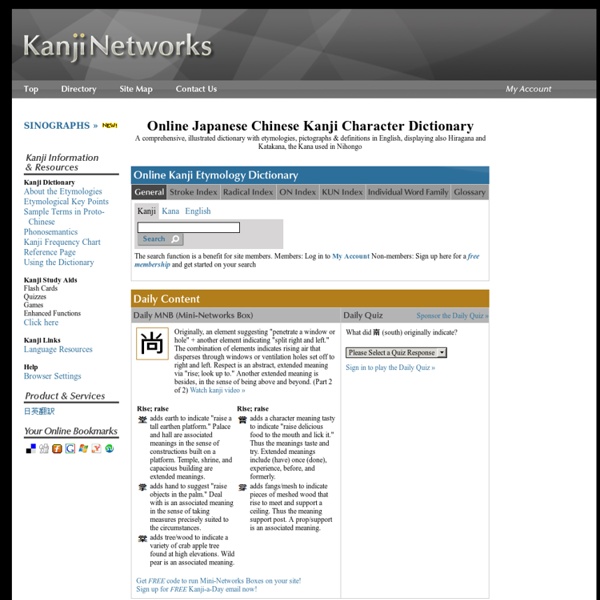
A comprehensive, illustrated dictionary with etymologies, pictographs & definitions in English, displaying also Hiragana and Katakana, the Kana used in Nihongo by alsdia Dec 19
this is the best site for Kanji. by montibo Nov 27