

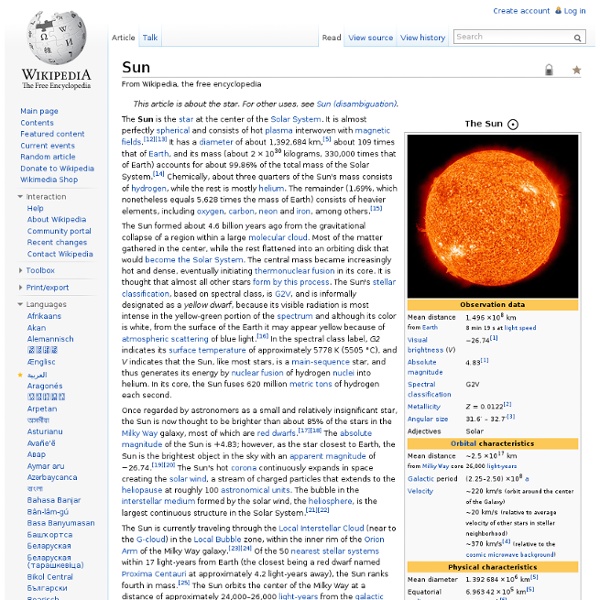
How the Sun Works" When’s the last time you gazed upward and marveled at the mysterious, life-giving force that is the sun? If you believe the whole staring-at-the-sun-makes-you-go-blind thing (which is actually true), you’re probably not doing a whole lot of sun-gazing. But it’s a real marvel: The sun warms our planet every day, provides the light by which we see and is necessary for life on Earth. It can also cause cell death and make us blind. All of this, and our sun is just a plain old average star, by universal standards. So, how close is the sun? If the sun is in the vacuum of space, how does it burn? In this article, we'll examine the fascinating world of our nearest star. The sun has "burned" for more than 4.5 billion years. We say the sun burns, but it doesn’t burn like wood burns.
Phobos Phobos (systematic designation: Mars I) is the larger and closer of the two natural satellites of Mars. Both moons were discovered in 1877. Phobos has dimensions of 27 × 22 × 18 km,[1] and is too small to be rounded under its own gravity. Its surface area is slightly less than the land area of Delaware. Phobos does not have an atmosphere due to low mass and low gravity.[10] It is one of the least reflective bodies in the Solar System. Spectroscopically it appears to be similar to the D-type asteroids,[11] and is apparently of composition similar to carbonaceous chondrite material.[12] Phobos's density is too low to be solid rock, and it is known to have significant porosity.[13][14][15] These results led to the suggestion that Phobos might contain a substantial reservoir of ice. The unique Kaidun meteorite is thought to be a piece of Phobos, but this has been difficult to verify since little is known about the detailed composition of the moon.[25][26]
10 Best Writing Prompts for High School English Students By the time students walk in the door of our secondary ELA classrooms, they’re not exactly new to writing assignments. They’ve done autobiographies. Short stories. 1. There are a lot of amazing TED Talks out there that students love. 2. If you’re looking for some unusual, short and sweet writing options, check out John Spencer’s Creative Writing Prompts for Students playlist. 3. What teenager doesn’t harbor some (not so) secret crush? 4. We’ve all sat in the audience of a graduation and wondered what we would talk about if we were on stage speaking. 5. Students always perk up for an authentic audience and a connection to the real world. 6. When you try the fold and pass, you’re guaranteed to end up with some very surprising stories. This writing assignment is not for the faint of heart! 8. If you’ve never heard NPR’s old radio series “This I Believe,” it’s a great listen. 9. 10. Seriously. What are your favorite writing prompts for high school?
Solar images at SDAC Click on any of the following thumbnail images for the most recent, full-resolution solar image of each type in the SDAC archive. The time and date of each image is below the image description. All times are in coordinated Universal Time (UTC). Images from the Solar Dynamics Observatory (SDO) Atmospheric Imaging Assembly (AIA) A Note on Color Tables The color tables used to display AIA images here are the ones used to display similar bandpasses for SOHO EIT and STEREO EUVI images. Color tables for the 94, 131, and 335 Å bandpasses are still under development. Images from the Solar Dynamics Observatory (SDO) Helioseismic and Magnetic Imager (HMI) Images from other sources Return to the home page for the SDAC.
Neptune Neptune is similar in composition to Uranus, and both have compositions which differ from those of the larger gas giants, Jupiter, and Saturn. Neptune's atmosphere, while similar to Jupiter's and Saturn's in that it is composed primarily of hydrogen and helium, along with traces of hydrocarbons and possibly nitrogen, contains a higher proportion of "ices" such as water, ammonia, and methane. Astronomers sometimes categorise Uranus and Neptune as "ice giants" in order to emphasise these distinctions.[10] The interior of Neptune, like that of Uranus, is primarily composed of ices and rock.[11] It is possible that the core has a solid surface, but the temperature would be thousands of degrees and the atmospheric pressure crushing.[12] Traces of methane in the outermost regions in part account for the planet's blue appearance.[13] In contrast to the hazy, relatively featureless atmosphere of Uranus, Neptune's atmosphere is notable for its active and visible weather patterns. History Naming
Bac fiche français : le théâtre classique – Bac 2018 – Toutpourlebac.com Les trois unités – Vraisemblance et bienséance – Critiques Au XVIIe siècle, les doctes entreprennent de «codifier» le théâtre et tout particulièrement la tragédie. C’est principalement après la «querelle» du Cid (1636), qui opposa partisans d’un théâtre réglementé et tenants d’une création de liberté, que s’est constitué un ensemble de règles inspirées, pour la plupart, de La Poétique d’Aristote (IVe siècle av. J. Le développement de la pièce classique doit obéir au principe d’unité défini par Boileau (Art poétique, 1674) : «Qu’en un lieu, en un jour, un seul fait accompli tienne jusqu’à la fin le théâtre rempli». L’UNITE D’ACTION Elle vise à supprimer les intrigues secondaires et à concentrer l’intérêt dramatique autour d’une action unique. L’UNITE DE TEMPS Elle resserre les faits et les limite à vingt-quatre heures. L’UNITE DE LIEU Elle résulte des deux premières. LA VRAISEMBLANCE Elle veut que s’impose l’impression de vérité.
Mercury Mercury is gravitationally locked and rotates in a way that is unique in the Solar System. As seen relative to the fixed stars, it rotates exactly three times for every two revolutions[b] it makes around its orbit.[13] As seen from the Sun, in a frame of reference that rotates with the orbital motion, it appears to rotate only once every two Mercurian years. An observer on Mercury would therefore see only one day every two years. Because Mercury's orbit lies within Earth's orbit (as does Venus's), it can appear in Earth's sky in the morning or the evening, but not in the middle of the night. Also, like Venus and the Moon, it displays a complete range of phases as it moves around its orbit relative to Earth. Although Mercury can appear as a very bright object when viewed from Earth, its proximity to the Sun makes it more difficult to see than Venus. Internal structure Internal structure of Mercury: 1. Mercury's density can be used to infer details of its inner structure. Surface geology
Me shooting a bow Milky Way Stars and gases at a wide range of distances from the Galactic center orbit at approximately 220 kilometers per second. The constant rotation speed contradicts the laws of Keplerian dynamics and suggests that much of the mass of the Milky Way does not emit or absorb electromagnetic radiation. This mass has been given the name “dark matter”.[22] The rotational period is about 240 million years at the position of the Sun.[9] The Galaxy as a whole is moving at a velocity of approximately 600 km per second with respect to extragalactic frames of reference. Appearance[edit] The Milky Way has a relatively low surface brightness. A fish-eye mosaic of the Milky Way arching at a high inclination across the night sky, shot from a dark sky location in Chile Size and mass[edit] A photograph of galaxy NGC 6744, considered by scientists to greatly resemble the Milky Way Galaxy Schematic illustration showing the galaxy in profile Stars and planets[edit] Structure[edit] Galactic quadrants[edit]
Archery A Rikbaktsa archer competes at Brazil's Indigenous Games Master Heon Kim demonstrating Gungdo, traditional Korean archery (Kuk Kung), 2009 Archer in East Timor History[edit] The bow seems to have been invented in the later Paleolithic or early Mesolithic periods. The oldest indication for its use in Europe comes from the Stellmoor (de) in the Ahrensburg valley (de) north of Hamburg, Germany and dates from the late Paleolithic, about 10,000–9000 BCE. Bows and arrows have been present in Egyptian culture since its predynastic origins. Classical civilizations, notably the Assyrians, Persians, Parthians, Indians, Koreans, Chinese, Japanese and Turks fielded large numbers of archers in their armies. Archery was highly developed in Asia. Mounted archery[edit] Central Asian tribesmen (after the domestication of the horse) and American Plains Indians (after gaining access to horses)[6] became extremely adept at archery on horseback. Decline of archery[edit] Eighteenth-century revival[edit]
Asteriod Belt The asteroid belt (shown in white) is located between the orbits of Mars and Jupiter. History of observation[edit] In an anonymous footnote to his 1766 translation of Charles Bonnet's Contemplation de la Nature,[8] the astronomer Johann Daniel Titius of Wittenberg[9][10] noted an apparent pattern in the layout of the planets. If one began a numerical sequence at 0, then included 3, 6, 12, 24, 48, etc., doubling each time, and added four to each number and divided by 10, this produced a remarkably close approximation to the radii of the orbits of the known planets as measured in astronomical units. This pattern, now known as the Titius–Bode law, predicted the semi-major axes of the six planets of the time (Mercury, Venus, Earth, Mars, Jupiter and Saturn) provided one allowed for a "gap" between the orbits of Mars and Jupiter. Neither the appellation of planets, nor that of comets, can with any propriety of language be given to these two stars ... Origin[edit] Formation[edit] Evolution[edit]