

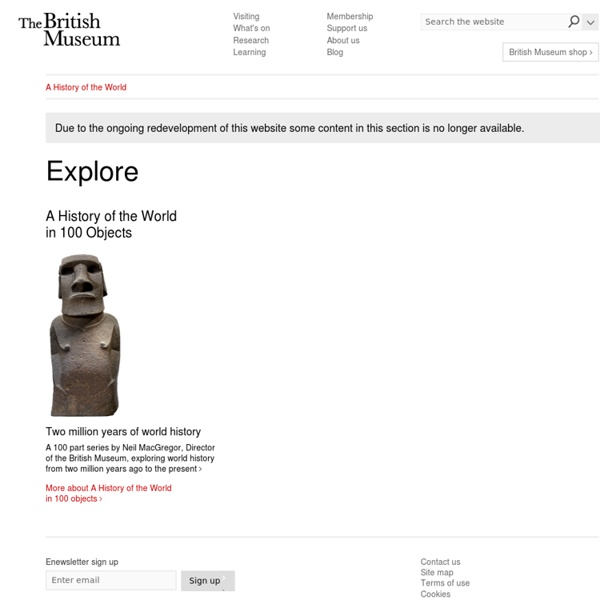
British Museum shop online Polynesia The islands of the eastern Pacific are known as Polynesia, from the Greek for ‘many islands’. They lie across a vast stretch of ocean from Hawaii in the north, to New Zealand in the south and Easter Island in the east. The western Polynesian islands of Fiji and Tonga were settled approximately 3,000 years ago, whilst New Zealand was settled as recently as AD1200. In the past, Polynesians were skilled navigators and canoe builders, creating double-hulled vessels capable of travelling great distances. Their societies were hierarchical, with the highest ranking people tracing their descent directly from the gods. Today, Polynesian culture continues to develop and change, partly in response to colonialism. The Polynesian collections at the Museum date back to the earliest contact with European explorers and missionaries.
Site officiel du musée du Louvre Visit us Entry is free (There is a charge for some temporary exhibitions) Opening times Last Friday of the month open until 22.30 for Lates, excluding December. The Museum is open every day, including Sundays and bank holidays, but closed 24-26 December. The Museum's step-free entrance is on Exhibition Road. Keep up to date at NHM_Visiting on Twitter Visiting our Museum at Tring? For your security, most areas of the Museum are protected by CCTV. On entry to the Museum your bags and other personal items will be inspected. We apologise for any inconvenience caused. What's on From the latest gallery highlights, daily activities and films to special exhibitions and events, find out what’s on for visitors. Getting here There are many ways to reach us. Temporary exhibitions Explore nature, science, conservation and artistic interpretation in our temporary exhibitions. Booking Find out about booking information for our events and exhibitions. Galleries Floor Plans Parents' survival guide Bringing the kids? Access guide
Aztecs (Mexica) During the twelfth century AD the Mexica were a small and obscure tribe searching for a new homeland. Eventually they settled in the Valley of Mexico and founded their capital, Tenochtitlan, in 1345. At the beginning of the sixteenth century it was one of the largest cities in the world. Warfare was extremely important for the Mexica people and led them to conquer most of modern-day central and southern Mexico. They controlled their huge empire through military strength, a long-distance trading network and the tribute which conquered peoples had to pay. Stone sculpture in the British Museum collection reflects the Mexica's complex religious beliefs and the large pantheon of gods they worshipped. Craftsmen also worked in gold, turquoise mosaic and feathers. Hernán Cortés and his small Spanish army arrived in 1519 and overthrew the Mexica ruler Moctezuma Xocoyotzin with relative ease. *The people and culture we know as 'Aztec' referred to themselves as the Mexica (pronounced 'Mé-shee-ka').
Dalí y el mito de Narciso Dalí y el mito de Narciso Rosa Maria Maurell i Constans Periódico El Punt, 25 de diciembre de 2005 De todas las versiones del mito de Narciso, la más conocida es la de las Metamorfosis de Ovidio, según la que Narciso es hijo de la ninfa Liríope y del río Cefiso. Al nacer, el adivino Tiresias predice a su madre que éste tendrá una larga vida “si no llega a conocerse”. De joven es objeto de deseo de numerosos jóvenes de ambos sexos por su belleza, pero él los rechaza a todos. Entre sus pretendientes, la ninfa Eco se enamora perdidamente pero él no le hace caso y, desesperada, se retira a un lugar solitario donde de ella sólo queda su voz. Némesis, recogiendo la súplica de una de sus víctimas, logra que Narciso, en un día caluroso, paseando por un lugar donde hay una fuente, se incline a beber y se enamore de la imagen que ve allí reflejada, la suya. Según Dalí, son el primer poema y el primer cuadro obtenidos totalmente mediante la aplicación integral de su método paranoico-crítico.
Magic Worlds V&A Museum of Childhood Opening times 10.00 to 17.45 daily Admission is free Exhibitions and displays The Museum's exhibitions and displays explore a broad range of subjects relating to childhood, from design, photography and fashion, to play and social issues. Home» What's on» Exhibitions and displays Confiscation Cabinets Until 1 June 2014. Read more Are You Sitting Comfortably? Until 24 August 2014. Read more Daydreams and Diaries: The Story of Jacqueline Wilson 5 April - 2 November 2014. Read more Forthcoming exhibitions Find out what's coming up at the Museum. Read more Past exhibitions and displays Find out about some of the exhibitions and displays you may have missed at the Museum, from 2003 to present. Read more Touring exhibitions Find out about exhibitions for hire and what's coming to a venue near you. Read more Related content Related images from the collections Search the Collections home Shop online... Buy Visit us What's on About us
Ancient Egypt Towards the end of the fourth millennium BC several independent city-states were unified to form a single state, marking the beginning of over 3,000 years of pharaonic civilisation in the Nile Valley. Fertile earth left behind after the yearly Nile flood provided the basis for Egypt’s agricultural prosperity, a key factor in the longevity of the civilisation. Impressive monuments were erected in the name of kings, from monumental temples for the gods to the pyramids marking the burials of rulers. The British Museum collection includes statuary and decorated architecture from throughout pharaonic history, often inscribed with hieroglyphs. Many other aspects of ancient Egyptian culture are represented: coffins and mummies of individuals, but also furniture, fine jewellery and other burial goods. Texts preserved on papyrus help reveal the complex administration of the country, but also include magical, medical and mathematical works and poetry.
Winter Wonderland 2011 - Official Website Méridien de Greenwich Un article de Wikipédia, l'encyclopédie libre. Emplacement du méridien de Greenwich (ligne rouge verticale) sur un planisphère Le méridien de Greenwich est le méridien qui sert de référence internationale de longitude, d'où son nom de « méridien origine ». Description[modifier | modifier le code] Histoire[modifier | modifier le code] Le choix du méridien de Greenwich comme point de référence pour la longitude est complètement arbitraire, aussi différents méridiens ont été utilisés par le passé : ↑ History of the Prime Meridian -Past and Present [1] [archive] Zones traversées[modifier | modifier le code] Matérialisation du méridien à l'observatoire de Greenwich Depuis le pôle Nord jusqu'au pôle Sud, le méridien de Greenwich traverse les régions et pays suivants : Notes et références[modifier | modifier le code] Voir aussi[modifier | modifier le code] Méridien