

PythonBooks - Learn Python the easy way ! (1) Processing Geomerative Tutorial. Part 1. | Free Art Bureau A beginners tutorial to using the Geomerative Library developed by Ricard Marxer. Part 1. Original tutorial written by Mark Webster & published 18/09/2011. This is an introductory step by step tutorial to using the Geomerative Library. It includes basic information about the function of various methods and classes within the library and should be of particular help to graphic designers and artists who wish to work with fonts and text. All sketches provided have full comments explaining important aspects of the library. >>> You can download all the necessary files for this tutorial here. We will be doing a second part of tutorials for the Geomerative library very soon. Working with the Geomerative Library. 1). a_Geo_Font_01 Open up this first sketch which shows the most basic structure for displaying text with Geomerative. In Processing, we use the PFont class to work with fonts. Once we have all these in place we can simply call our text using draw(). NB. 2). b_Geo_Font_02 2).TypoGeo_Random
st - A place for geeks to share what they've done, who they did it with and connect with great companies Processing.js Incremental Delaunay Triangulationby Jeonggyu Lee An interactive implementation of incremental Delaunay Triangulation algorithm. My Life Aquaticby David Leibovic, Sunah Suh A shared aquarium Source code Circle of Fifthsby Shelley Marshall Create, transpose, and change a chord progression by using the circle of fifths, and play the progression. 2011 Advent Calendarby Nikolaus Gradwohl An advent calendar built with Processing.js 3D Sketchesby Andor Salga A collection of 3D sketches by Processing.js' 3D developer PJS in CoffeeScriptby David Guttman A tutorial showing how to write Processing.js sketches in CoffeeScript, a language that is compiled into Javascript Flight of the Navigatorby The Mozilla #audio team Fight of the Navigator is a demo showcasing the power of WebGL and Audio API Pew Pewby Nightmare Retro Asteroids clone written in Processing.js Flockingby Harry Brundage The math behind flocking algorithms coaltrace.js byTrevor Bedford Evolutionary simulation. Twitter Flowby Sandro Paganotti AFL Flagsby P5Pby Fizz
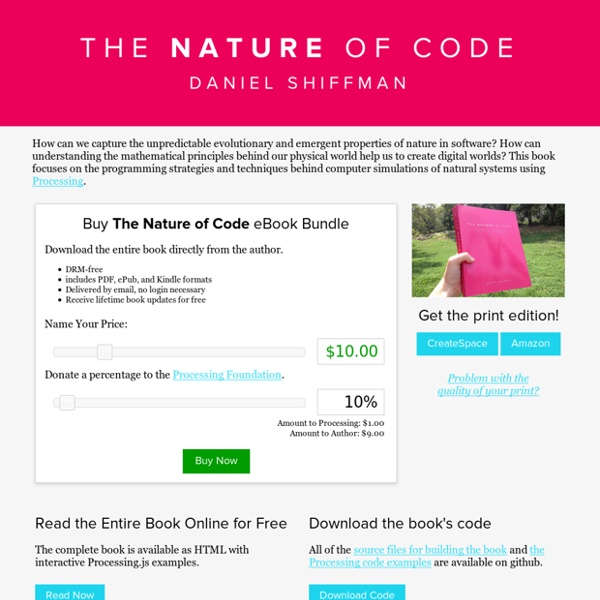
Online Javascript Editor The Nature of Code Hello! By browsing the table of contents on your left, you can read the entire text of this book online for free, licensed under a Creative Commons Attribution-NonCommercial 3.0 Unported License. Start reading the introduction now! If you like this book, please consider supporting it via the links below: Please submit corrections to the book on my Nature of Code GitHub repo. Thanks everyone! Copyright © 2012 by Daniel Shiffman This work is licensed under the Creative Commons Attribution-NonCommercial 3.0 Unported License. All of the book’s source code is licensed under the GNU Lesser General Public License as published by the Free Software Foundation; either version 2.1 of the License, or (at your option) any later version. This book was generated by the Magic Book Project. Editor Shannon Fry Illustrations Zannah Marsh Cover Design David Wilson Interior Design Web Site Design Steve Klise Editorial and Design Assistant Evan Emolo Magic Book Lead Developers Rune Madsen, Steve Klise Magic Book Researchers
/chapter: Limpression / Processing Pour l'instant, nous avons travaillé sur l'écran en générant des images et des animations. Nous allons maintenant nous intéresser aux possibilités qu'offre Processing en matière d'impression : nous allons créer un document PDF (Portable Document Format) contenant des formes géométriques vectorielles, document qui pourra ensuite être imprimé sur du papier ou un autre médium. Mode direct Dans ce premier exemple, nous allons générer 500 cercles aléatoirement et les dessiner dans un document PDF, qui sera sauvé dans notre dossier de travail. import processing.pdf.*; size(400, 400, PDF, "Cercles.pdf"); for (int i = 0; i < 500; i++) ellipse(random(width),random(height), 50, 50); exit(); Comment fonctionne ce programme ? Avec ce mode direct de tracé, puisque nous dessinons directement dans le document et non plus sur l'écran, nous n'avons plus besoin de la fenêtre de visualisation de Processing. Le document généré au format pdf se trouve dans le dossier de sketch de votre application.
How to Pick the Right Programming Language Adron Hall is the lead developer of cloud solutions at New Relic. During the course of every coding project, a software developer must make dozens of decisions. Sometimes this involves solving a problem unique to a particular domain space or a particular architectural issue. Other times it’s about which language is best for a job. That is actually one of the most critical pieces of getting a project right. Too often, languages are applied to a problem space where another language would be better. Financial Sector The financial sector benefits from a number of languages. Another key need in the financial sector is languages that benefit from object-oriented paradigms with strong architectural patterns backed by a lot of guidance from the organizations around the languages. Top Languages: Scala, Java, and C# Agency, Media, Advertising, and Design With the overall design processes needed in creative work, languages that can prototype fast are in high demand. Top Languages: Java and C#
Codes - GENERATIVE GESTALTUNG 2016-03-15RT @bndktgrs: 幸せなコーディング! Launched: Our #GenerativeDesign book has also a 🇯🇵 website now!👍 [Link] Cheers @BugNews! Learn Code The Hard Way -- Books And Courses To Learn To Code Processing Pour l'instant, nous avons travaillé exclusivement dans l'environnement de Processing. Nous tapons des lignes de code et nous les exécutons depuis l'interface par le bouton Run. À présent, nous allons voir que Processing intègre deux manières d'exporter notre programme pour le distribuer. L'une, à destination du web, permet d'exposer son animation en ligne, visible sur une page dans un navigateur. Une fois que votre programme fonctionne et que vous êtes satisfait du résultat, vous pouvez générer un applet, objet intégrable à une page web et lisible par votre navigateur internet habituel. L'opération effectuée, Processing ouvre automatiquement un dossier applet dans l'explorateur de fichiers de votre ordinateur. index.html est la page web générée par Processing. loading.gif est une icône utilisée lors du chargement de l'applet dans la page web. Attention! La fenêtre Export Options suivante devrait s'ouvrir. Platforms permet de sélectionner la plateforme. VI-C-1. VI-C-2. VI-C-3. VI-C-4.
Top 10 Programming Languages to Learn in 2014 Updated on May 5, 2014 Having spent more than 5 years in software development and the computer programming arena, one of the most common questions I am asked is: This is a question that is asked by beginners, as well as experts. As with many important questions, the answer is not simple. There are many factors that should be taken into account while deciding a programming language to learn. Technology evolves in matter of weeks and by the time you become expert in a particular software technology, it can already be considered obsolete. In addition to that, another interesting aspect of programming that I noticed is that not only programmers and software engineers are interested in learning new programming languages, but people from totally different walks of life are also into it. Now back to the top 10. 1. I vividly remember that the first programming language course that I had in my university was of C language. 2. 3. Java was developed by James Gosling, in 1990 at Sun Microsystems. 5.
Welcome to RoboMind.net, the new way to learn programming