

Digital Kindergarten: 1:1 iPad use in Full Day Kindergarten Background This is the first year of 1:1 iPads in my kindergarten classroom. In October 2010 I received one to use with my class of 26, and by the end of May 2011 I had 11 and my class had dropped down to 22 children. I absolutely loved that half the class could be working on the iPads completely independently, at various levels, while I worked with the other half of the kids. The ability level of the children in last years class was more varied than typical. I begged and pleaded until I was assured I would most likely have a class set of iPads for the 2011-2012 school year. Getting started On the fourth day of school I introduced iPads to my class of 20 kindergartners. At the end of the day several kids started to put their iPad into backpacks- I had to explain that they were for class only- my, how their faces fell. Sometimes I noticed children playing an app that utilized a skill I usually teach later in the year, such as telling time to the hour, or addition and subtraction.
Highlights Hoe kunnen onderwijs en opleiding de EU-strategie ter bevordering van groei en werkgelegenheid schragen en hoe kunnen zij met name bijdragen aan het verminderen van de jeugdwerkeloosheid? Dat zijn de voornaamste punten die de Raad op 10 februari heeft besproken. © Fotolia.com Het aantal werklozen in de EU is zeer hoog. Veel ministers waren van mening dat een belangrijk middel ter verbetering van de link tussen de wereld van het onderwijs en die van het werk is gelegen in het versterken van de praktische elementen in onderwijs- en opleidingsprogramma's. Een aantal ministers maakte gewag van inspanningen in hun land om, in samenwerking met de sociale partners, voor aanzienlijk meer stages en leerplaatsen voor jongeren te zorgen. Tot slot benadrukte een groot aantal lidstaten dat de beschikbare middelen uit de EU-fondsen en ‑programma's moeten worden gebruikt om meer jongeren aan werk of een opleiding te helpen en hun mobiliteit te verbeteren. Meer informatie: Persmededeling Openbaar debat
What I Wish I’d Done Before Deploying iPads to 735 Middle Schoolers, Part 2 | Terice T. Schneider's Digital Home We planned. We met to go over the plans. We talked. What we didn’t do was address some of the simple day-to-day things that we never thought would be an issue. When offering professional development to teachers on integrating iPads, give them training on a management system like Texas’s Project Share from Epsilen (which is releasing an App soon), Edmodo, or Schoology or even eBackPack. Teachers also want to know how to deliver content to their students. Everyone agreed that the better way to do this would have been to choose one, train how to use it and stick with it for a year. Finally, give your teachers clear expectations, not only of the iPad use in the classroom, but of how classroom management should look. We had an expectation that the iPads would be used multiple times a week if not daily. Some tips we used for classroom management are: “Apples UP!” I hope these tips will help those of you deploying iPads next year.
48 iPad Apps That Teachers Love Apple’s iPad and other tablet computers have certainly been garnering ardent support from the edtech community. Gadget geek teachers love the thousands of apps available to give their courses a multimedia edge, and students love how so many reach out to different learning styles. For the connected classroom, the following stand out as either great supplements to various lessons or essential, time-saving streamlining strategies. Art and Music Language, Reading, and Writing Math and Science Organization, Productivity, and Learning Mimi Ito - Weblog: When Youth Own the Public Education Agenda Originally posted on the Huffington Post. I've devoted my career to researching how young people take up new technologies like computers, mobile phones, and the Internet and make them their own. If we pay attention to what young people do when they are socializing and having fun with these new media, it's clear that they are both highly engaged and learning a great deal. For most young people, however, this is about learning how to get along with their friends, what it takes to get a date, or how to get to the next level in Halo, and not the kinds of academic learning and civic engagement that schools are concerned with. As a parent and educator who is also an anthropologist committed to appreciating youth perspectives, I stand at the cusp of two different learning cultures--one that is about youth-driven social engagement and sharing, and the other that is embodied in educational institutions' adult-driven agendas.
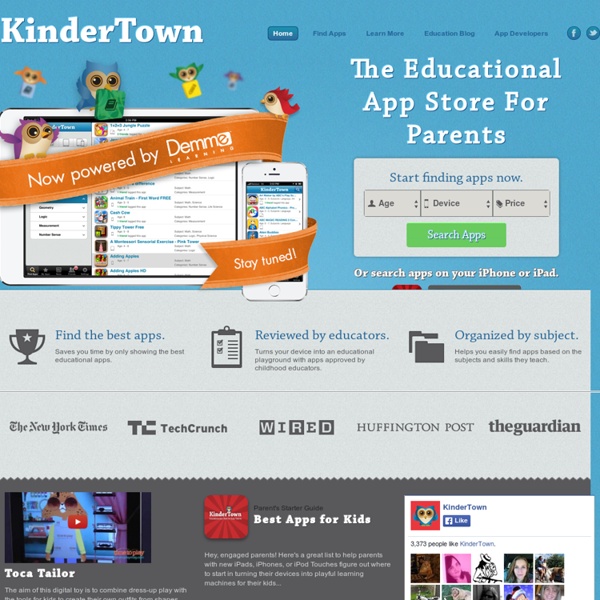
15 Great Resources for Educational Apps for Teachers, Parents and Educators Now that mobile learning is advancing in a quicker pace than we ever expected and that our students and kids are embracing more and more mobile devices in their life, we are left with no other alternative but to swim with the torrent. It is the onus of our responsibility to teach our students how to educationally benefit from this influx of mobile technology We need to equip them with apps that can help them learn and become confident learners. Fortunately enough, in this age of wired comunication and cloud based connections nothing is hard to get anymore. There are now several platforms designed specifically to meet teachers and students needs in using mobile devices in education. These websites are, most of the time, created and run by educators and provide reviews of awesone apps to use for learning. I have compiled a list of these resources for you to bookmark and access whenever you want to look for a certain app to share with students. 1- Educational technology and Mobile Learning
At Davos, the ‘skills gap’ is on the guest list As the world’s movers and shakers head to Davos, Switzerland, this week for the annual meeting of the World Economic Forum, the International Labour Organization has issued a gloomy report on employment – just in time to focus minds at Davos even more sharply on the global jobs crisis. “The jobs crisis continues unabated, with one in three workers worldwide – or an estimated 1.1 billion people – either unemployed or living in poverty,” said Juan Samovia, the ILO’s director-general. The annual ILO publication highlights the fact that globally, young people are nearly three times as likely as adults to be unemployed. The global youth unemployment rate, at 12.7 per cent, remains a full percentage point above the pre-crisis level. Of those aged 15-24, 74.8 million were unemployed in 2011, an increase of more than 4 million since 2007. Editor of the Education for All Global Monitoring Report and of the World Education Blog
Web sites that review education apps Apps. Lots and lots and LOTS of apps. Half a million and counting in Apple’s App Store… As iPads and iPod Touches become more prevalent in schools, educators often are overwhelmed by the sheer size and diversity of the apps ecosystem: How do I know which apps are good for my kids? Is there an app out there that will help my students with this learning goal? Thankfully, others have stepped up to help educators curate apps that have learning value. iOS Education App Reviews and Web Sites The list focuses on sites dedicated specifically to education apps, not sites that include apps and other educational technology resources as well. Does your school organization have a systematic way of sharing excellent learning apps with educators and/or parents? [Continuing what I hope will be a month-long wave of resources for school leaders and the programs that prepare them…] Image credit: Time for Apps, Bigstock
Explosive Growth in Education Apps Digital Tools Teaching Strategies Flickr:Flickingerbrad By Carly Shuler, Joan Ganz Cooney Center In 2007, when the iPhone made its debut, there was little doubt that it would revolutionize the mobile phone industry. Less than five years later, more than a quarter of all parents have downloaded apps for their children to use, according to a Common Sense Media study. Today’s children will benefit if apps become an important force for learning and discovery. 1. Over 80% of the top selling paid apps in the Education category of the iTunes Store target children.In 2009, almost half (47%) of the top selling apps targeted preschool or elementary aged children. 2. Apps for toddlers/preschoolers are the most popular age category (58%), and experienced the greatest growth (23%).General early learning is the most popular subject (47%), and there are signiicantly more general early learning apps than the second most popular subject (math, 13%). The App Explosion 3. 4. 5. Address the app gap. Related