

Avoiding Plagiarism Summary: There are few intellectual offenses more serious than plagiarism in academic and professional contexts. This resource offers advice on how to avoid plagiarism in your work. Write-Around for Collaborative Student Thinking as Part of Presearch and Topic Development Last year Language Arts teacher Sean O’Connor was one of our first teachers to help us pilot written conversation strategies that we had learned about from Harvey Daniels. After attending a Reading the City institute with Daniels, Nancy Steineke (among other notable literacy leaders) this past January, Sean returned even more energized about the possibilities of written conversation strategies for inquiry and learning. He decided to incorporate and modify the write around learning structure as part of the pre-search process for his AP Literature students who were beginning a literary research paper; not only did he utilize the LibGuide we created for the assignment, but he wanted to use our Learning Studio area in our library as the space for the written conversations come to life. After two days of some initial pre-search, students came to the Learning Studio with some general themes or topics in mind. Sean tells us the game plan he designed to facilitate their next steps: Like this:
The Complete Educator’s Guide to Using Google Reader Love it!? Hate it!? Doesn’t really matter what you think of the new Google Reader interface….. Women’s History By Phil Nast, retired middle school teacher and freelance writer Found In: language arts, social studies, PreK-2, 3-5 The National Women's History Month theme for 2017 is "Honoring Trailblazing Women in Labor and Business". Examine the changing cultural perceptions of women in society and honor their contributions to all aspects of life in the following lessons and activities. Fake websites, Spoof websites, science spoofs, commercial fake sites Introduction to fake websites Librarians and educators need to be able to illustrate to students and users alike that websites cannot always be trusted to provide truthful and accurate data. This page provides examples of websites that are full of lies, inaccuracies or false information - either for amusement or for more worrying reasons. The list does not include phishing sites however; these are intended to fool a person into believing that they are visiting a legitimate bank site for example; there are already plenty of links to these online already. Fake websites - scientific and commercial All of the following websites are, to the best of my knowledge fake sites, spoof sites or parodies of 'real' sites.
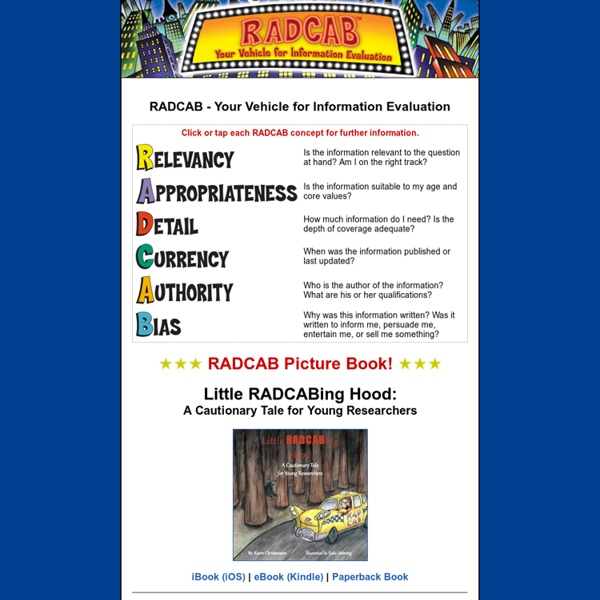
Digital Credibility: 13 Lessons For the Google Generation - 13 Digital Research Tools And The Credibility Lessons They Teach by TeachThought Staff This post is promoted by Noet, makers of Encyclopedia Britannica Noet Edition and the free research app for the classics, who asked us to talk about the credibility of information research in a digital world. We thought, then, that it might make sense to focus on digital tools and resources that highlight the idea of credibility. And because credibility and research are such important digital concepts–or really, data and thinking concepts, actually–we itemized each tool as lesson in and of itself. The Google Generation has a universe of information, right there on a little pinch-and-zoom screen.
Save The Pacific Northwest Tree Octopus Help Save The ENDANGERED From EXTINCTION! The Pacific Northwest Tree Octopus Encyclopedias, Wikipedia and Times Topic Pages: Research Resources and Ideas Ángel Franco/The New York TimesA set of the Encyclopaedia Britannica on the shelves of the New York Public Library. Go to related article » Last week, Encyclopaedia Britannica announced that, after 244 years, it was going out of print. That inspired us to collect and update our resources and ideas around how and where to research, and to pose questions for students about searching for and using information in the digital age. Let us know what you do to teach your students best practices for research. Thinking About Where and How You Research
5 Quick Resources for Writing Research Papers Posted June 27, 2016 in Insights & Research | Read Comments Tags: Databases | Long before their fingers hit the keyboard, students and scholars writing research papers must consider the rules for evaluating, using and citing sources. EBSCO’s support site is full of handy, downloadable resources to help students not only conduct research properly, but also understand library terminology to enhance their research experience. Kate Chopin: A Re-Awakening [ About the Program | Interviews | Chronology ] [ Electronic Library | Additional Resources | Credits ]
Kate Chopin, 1851-1904 Chopin, Kate 1851-1904, Writer. Although Katherine O'Flaherty Chopin was a native of St. Louis (born 8 February 1851) and spent barely 14 years in Louisiana, her fiction is identified with the South. Kate Chopin: A Re-Awakening—Chronology A chronology of key events in Kate Chopin's life. 1850Kate Chopin (Katherine O'Flaherty) born on February 8 to Thomas O'Flaherty, an Irish immigrant, and Eliza Faris, a Creole. 1855Kate's father dies in a rail accident. Kate begins school at Academy of the Sacred Heart in St.