

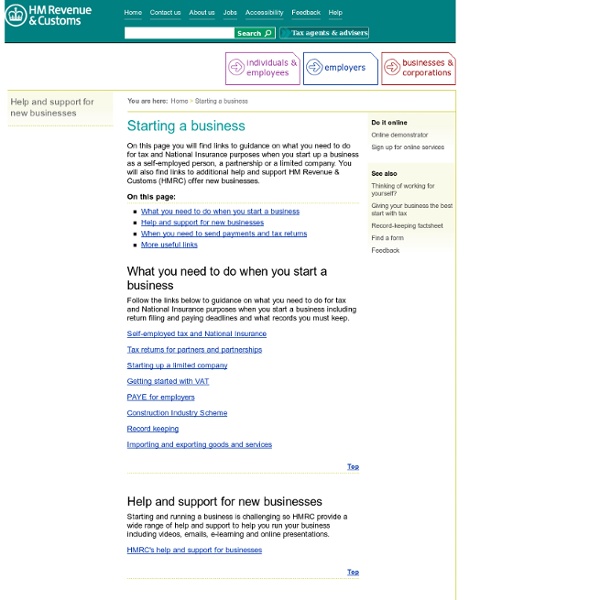
VAT registration You must register for VAT with HM Revenue and Customs (HMRC) if your business turnover is more than £81,000. You can register voluntarily if it’s below this, unless everything you sell is exempt. When you register, you’ll be sent a VAT registration certificate. your VAT number when to submit your first VAT Return and payment your ‘effective date of registration’ - this is the date you went over the threshold, or the date you asked to register if it was voluntary Your VAT responsibilities From the effective date of registration you must: charge the right amount of VAT pay any VAT due to HMRC submit VAT Returns keep VAT records and a VAT account You can also reclaim the VAT you’ve paid on certain purchases made before you registered. While you wait You can’t charge or show VAT on your invoices until you get your VAT number. You should increase your prices to allow for this and tell your customers why.
Top tips for setting up your own business | MoneySupermarket Published: 20 October 2011 Topic: News,Money,Business Finance Rising unemployment is prompting increasing numbers of people to go it alone and set up their own businesses. Latest figures show that unemployment in the UK has now reached a 17-year high, with the number of people out of work rising by 114,000 to 2.57 million in the three months to August. With many predicting that jobless numbers could rise further, it's little wonder that the number of self-employed people in the UK has now topped four million. However, while being your own boss gives you the flexibility to work when and where you want, there are drawbacks you need to consider before becoming self-employed. These include not having a regular set income, as well as not having paid holidays or access to a company pension scheme into which an employer makes contributions. Work out how you are going to structure your business There are three main ways you can set up your business. Funding your business Set up a business bank account
NI - The Basics You pay National Insurance contributions to build up your entitlement to certain state benefits, including the State Pension. The contributions you pay depend on how much you earn and whether you're employed or self-employed. You stop paying National Insurance contributions when you reach State Pension age. On this page: Who pays National Insurance? You pay National Insurance contributions if you're an employee or self-employed and you're aged 16 and over, as long as your earnings are more than a certain level. State Pension age is 65 for men born before 6 December 1953 and 60 for women born before 6 April 1950. Some people also pay voluntary National Insurance contributions. aren't working and are not claiming state benefits haven't paid enough National Insurance contributions in a year to count for the State Pension or other long term state benefits live abroad and want to maintain your state benefits entitlement Find out about to changes to the State Pension age (Opens new window) Top
How to set up your own company for less than £1,000 By Andy Yates, HuddlebuyUPDATED: 16:43 GMT, 11 January 2012 This is Money has teamed up with Huddlebuy.co.uk, Europe’s largest group buying site for entrepreneurs and businesses, to launch a great new weekly column. Each week we give you exclusive top tips and share secret savings. So if you are involved in a business, if you are an entrepreneur or would-be entrepreneur, a start-up, a home worker or consultant…read on and start saving money right away. This week we are looking at how to set up a fully fledged business for less than £1,000. Going online: Getting a website address is pretty cheap now The challenge is on – how to set up a fully fledged business for less than £1,000! We have all dreamt at one time or another of owning and growing our own business. I banged on about this so much to the Huddlebuy team they threw down the gauntlet – and challenged me to prove I could set up a fully fledged business for less than £1,000. 1. 2. Getting a website address is pretty cheap now. 3. 4.
Income Tax allowances On this page: Top The Personal Allowance reduces where the income is above £100,000 - by £1 for every £2 of income above the £100,000 limit. Income Tax rates, allowances and tax bands for 2008-09 to 2010-11 (Opens new window) Income Tax rates and taxable bands * The 10 per cent starting rate applies to savings income only. The rates available for dividends are the 10 per cent ordinary rate, the 32.5 per cent dividend upper rate and the dividend additional rate of 42.5 per cent (the dividend additional rate is 37.5 per cent from 2013-14). More useful links Find out more about Personal Allowance Find out more about Income Tax Introduction to tax allowances and reliefs Taxable and non-taxable income at a glance
Tax return deadlines and penalties There are some key dates each year when you must send in your Self Assessment tax return and make payments. It's important that you're aware of these dates. If you miss them you may have to pay interest and penalties. On this page: Do you need to fill in a tax return? HM Revenue & Customs (HMRC) will contact you, usually in April or May, if they already know that you need to fill in a tax return. You'll receive a letter which explains when you'll need to send your tax return back. If HMRC hasn't contacted you, but you think you may need to complete a tax return, follow the link below to check. If HMRC asks you to complete a tax return but you think you no longer need to, let HMRC know as soon as you can. Find out if you need to complete a tax return Telephone or write to HMRC Top Deadlines for sending in your tax return 31 October: paper returns If you send a paper tax return it must reach HMRC by midnight on 31 October. There are very few exceptions. 31 January: online returns Example 31 January
Tax reliefs About this information This document deals with tax reliefs. However, it doesn't cover tax reliefs on work-related expenses or tax reliefs for self-employed people. For more information about the main types of tax reliefs you can claim as an employee, see the HM Revenue and Customs website at: www.hmrc.gov.uk. For more information about tax reliefs for self-employed people, see the HM Revenue and Customs website at: www.hmrc.gov.uk. Back to contents What are tax reliefs As a taxpayer, if you spend money on certain outgoings, the amount you spend can be deducted from your total income and you will therefore pay less tax. Tax relief on pension payments You can get tax relief on pension payments you make into a company (occupational) pension, personal pension or stakeholder pension, as long as HMRC has approved the pension scheme. When you retire, you may choose to take part of your pension as a tax-free lump sum. Tax relief on rental income from property Tax relief on life insurance Citizens Advice
Income tax What is income tax Income tax is a tax on income including: earnings from employment, including benefits in kind such as a company carearnings from self-employmentmost pensions income, including state, occupational and personal pensionssome social security benefitsinterest on most savingsincome from shares (dividends)rental incomeincome from a trust. Not all types of income are taxable. For more information about which kinds of income are taxable, see Taxable and non-taxable income. You won't usually have to pay tax on all your income, even if it is all taxable, because you will be entitled to a certain amount of income tax free in each tax year. There is no minimum age at which you become liable to pay income tax. Back to contents How income tax is calculated To calculate roughly how much income tax is payable for a particular tax year, use the following steps. Step 2 Check whether you can claim tax relief for any money you have spent out over the year. 20% X £11,000 is £2,200. Tax reliefs