

John Backus: Apple After Steve Jobs: The Perfect Case Study for Entrepreneurs As a VC, I felt compelled to write my first blog for Huffington Post inspired by one of the greatest entrepreneurs of our time: Steve Jobs. He was a brilliant inventor. His creations left an indelible mark on the world. And he left some important lessons to entrepreneurs on how to win in business. While some weren't blown away with this week's debut of the latest iPhone, and Tim Cook has some big shoes to fill, Steve Jobs left him with a powerful and intricately designed global operation that will be tough to break. Let me explain by using the iPad as one example. Apple did something that no other hardware manufacturer has come close to replicating. On top of this, Jobs created three ecosystem advantages, which are difficult or impossible for Samsung, Dell, HTC, RIM, HP or even Amazon to meet. First is Apple's distribution model. Second is the app economy. Third, is media. And along comes Amazon. Amazon and Amazon alone can replicate Apple's ecosystem advantages. Why? My forecast?
Biz-Tech 3.0 - IT Careers - Where Were You When You Heard the News About Steve Jobs? By Tony Kontzer We collectively experience certain sad moments in history that will remain forever embedded in our memories, associated indelibly with whatever activity we were engaged in when we first heard the news. Today was just such an experience. I was packing up my gear at Oracle's OpenWorld conference in San Francisco, just moments after CEO Larry Ellison abruptly walked off stage at the conclusion of his keynote, when the journalist next to me uttered an ominous "no way." After a few frenzied moments trying to verify, we saw Twitter posts from Time Magazine, Ars Technica, and blogger Robert Scoble, and we knew it was true. As I walked out of the conference at Moscone Center, I noted how many of the people around me were carrying little pieces of Jobs around with them--an iPhone or an iPod here and a MacBook Pro or iPad there. I never had the opportunity to meet Jobs, so I don't have a lot of personal insight into the man.
Faistacom : promotion et diffusion de communiqués de presse gratuits, e-reputation, buzz et communication web Flashback to Apple’s 1980 IPO - Deal Journal By Shira Ovide and James Oberman Getty Images When Apple had its IPO in December 1980, it was middle-of-the-paper news for The Wall Street Journal. When Steve Jobs took Apple public in 1980, his company lagged behind Tandy Corp. in sales of personal computers, and Massachusetts regulators deemed the IPO “too risky” for state residents. Today, in the wake of Steve Jobs’s death, he left behind a company valued at $350 billion, and Apple is admired as a tech innovator and for its amazing growth. We dug into the archives for The Wall Street Journal’s story on December 12, 1980, the day of Apple’s hotly anticipated IPO. Apple made less than $100 million from selling stock to the public — or what Apple makes now in roughly eight hours of sales. Perhaps the best detail in the Journal’s story was that Massachusetts regulators prohibited individual investors in the state from buying Apple IPO shares.
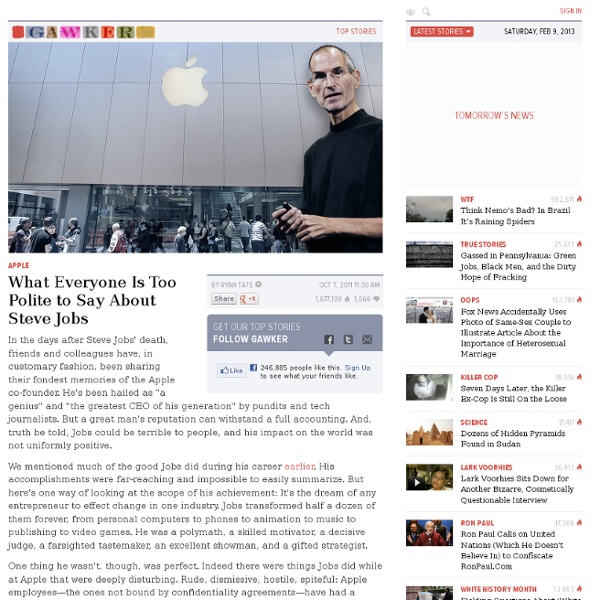
Steve Jobs owned 100 black turtlenecks, according to upcoming Walter Isaacson biography | The Cutline Jobs in 2007. (AP/Markus Schreiber) Commentators and tech-minded eulogists have dissected Steve Jobs' life and legacy since his death last week. Among the most widely discussed Jobs-related icon: the Apple CEO's signature black turtlenecks. Sales of the $175 mock turtleneck that Jobs wore more than doubled in the hours after he died, according to St. So just how many turtlenecks did Steve Jobs own? According to Walter Isaacson's biography on Apple's former chief, which is being rushed to publication later this month, Jobs had "about a hundred" of the Issey Miyake-designed shirts stacked in his closet. Gawker has the excerpt: He also came to like the idea of having a uniform for himself, both because of its daily convenience (the rationale he claimed) and its ability to convey a signature style. Jobs initially wanted Miyake to design a vest for all Apple employees to wear. Other popular Yahoo! Steve Jobs
Comment créer une newsletter efficace Vous êtes nouveau et vous aimez ce blog ? Inscrivez-vous à notre Flux RSS pour ne rien rater de nos prochaines actus. Merci de votre visite! Comment créer une newsletter vraiment efficace pour développer vos ventes ? Bien sûr le taux de transformation d’une newsletter se situe entre 0,05 et 1% pour les meilleures. Bien sûr, créer une newsletter, demande du temps, de l’organisation et surtout une base de prospects qualifiés. Pourquoi créer une newsletter est-il plus efficace ? Avant toute chose, s’il suffisait d’une dernière preuve pour finir de vous convaincre, demandez-vous pourquoi les gros du secteur, envoient toujours des newsletters à leurs clients, si la technique était vraiment vouée à l’échec ? Maintenant, que vous êtes convaincu de la réelle valeur d’une newsletter, attaquons-nous au vrai problème, qui n’est pas de créer une newsletter, mais de la rendre intéressante et surtout efficace pour votre business. Comment créer une newsletter ? Parlons d’abord de l’aspect graphique.
Steve Jobs: Pixar's John Lasseter, Ed Catmull Remember Former CEO Steve Jobs purchased The Graphics Group from Lucasfilm in 1986, soon renaming it Pixar and changing its mission from hardware sales to creating groundbreaking animation. Its films would go on to win a trophy case worth of Oscars, including the last four Awards for Best Animated Feature, and entirely remake the field of animation. With Jobs' passing on Wednesday, John Lasseter and Ed Catmull, his colleagues at Pixar from the very beginning, released a statement paying tribute to his loss. Steve Jobs was an extraordinary visionary, our very dear friend and the guiding light of the Pixar family. Earlier on Wednesday, Disney CEO Bob Iger paid tribute to Jobs, who became the company's single biggest shareholder and a member of its Board of Directors when Disney bought Pixar.
Dennis Ritchie: The Shoulders Steve Jobs Stood On | Wired Enterprise Dennis Ritchie (standing) and Ken Thompson at a PDP-11 in 1972. (Photo: Courtesy of Bell Labs) The tributes to Dennis Ritchie won’t match the river of praise that spilled out over the web after the death of Steve Jobs. But they should. And then some. “When Steve Jobs died last week, there was a huge outcry, and that was very moving and justified. On Wednesday evening, with a post to Google+, Pike announced that Ritchie had died at his home in New Jersey over the weekend after a long illness, and though the response from hardcore techies was immense, the collective eulogy from the web at large doesn’t quite do justice to Ritchie’s sweeping influence on the modern world. “Pretty much everything on the web uses those two things: C and UNIX,” Pike tells Wired. “It’s really hard to overstate how much of the modern information economy is built on the work Dennis did.” From B to C Dennis Ritchie built C because he and Ken Thompson needed a better way to build UNIX. Apple, Microsoft, and Beyond
La pub va devoir baisser d'un ton Bientôt la fin du son plus fort quand la pub arrive à l'écran: à l'issue de plusieurs années de concertation entre diffuseurs, annonceurs et producteurs, la Conseil supérieur de l'Audiovisuel (CSA) a fixé une limite à l'intensité sonore à la télévision. Le CSA a détaillé lundi les mesures qui s'appliqueront à toutes les chaînes, visant à ce que le son diffusé par les spots publicitaires ne soit pas différent de celui des autres programmes. "En fait ce n'est pas le volume sonore qui est différent mais les caractéristiques du son qui le font apparaître plus fort", a souligné Michel Boyon, président du CSA lors d'une conférence de presse. Cette différence est notamment le fruit d'une technique d'enregistrement: la compression dynamique qui augmente d'une certaine manière "l'épaisseur" des sons. Il a fallu des années de travail et une concertation associant notamment diffuseurs, annonceurs, producteurs et experts du son pour élaborer une méthodologie et des instruments de mesure.
The Tao of Steve There I was, watching the Phillies-Cardinals game with Mike Montero at a pub near my apartment, feigning interest, all the time checking the Twitter feed, when I saw an alert from WSJ: Steve Jobs is dead. I will remember that very minute – bottom of the fifth, Game four. Suddenly, everything went out of focus. I could hear the blood pounding my head; tears welled up in my eyes. It is perhaps the only time that I didn’t care for the news; I didn’t want to write that story. Why doesn’t the world realize that my Elvis is dead! Every generation has its heroes. For many of us who live and die for technology and the change it represents, he was an example of what was possible, no matter how the chips were stacked against you. Mac, iPod and iPhone — they are like Silicon Valley’s Harry Potter, Luke Skywalker and E.T. — magical, memorable and life-changing. Steve was my secret muse. P.S.
Public pays tribute to Steve Jobs at Apple stores | Apple From one coast to the other, ordinary men and women bowed their heads in tribute to a man who changed the technology world in extraordinary ways. Not long after hearing the newsthat Apple co-founder Steve Jobs had died , people at Apple stores stopped to share their reactions. "He was kind of like this generation's John Lennon," said Frank Arico, 58, a software developer visiting San Francisco for the Oracle OpenWorld conference this week. It was a theme that got repeated in conversations with people who knew Jobs as a larger-than-life pop culture icon but felt the loss on a deeper, surprisingly personal level. "Everything that I've made that is important to me was made on some sort of Apple product," said Doc Pop, a 34-year-old iPhone developer who makes camera applications standing near the downtown San Francisco Apple outlet. "I don't think (Apple) will have someone who has had so much direct influence. "It's really sad. I have the MacBook Pro and iPad 2 in my (hotel room)," he said.
Le service public à la dérive, une télévision décérébrée LE MONDE | • Mis à jour le | Par Dominique Fournier, ancien directeur des programmes et de l'antenne de TV5 et ancien directeur délégué de l'action culturelle à France Télévisions Il y a une vingtaine d'années, un animateur de la chaîne qui s'appelait encore Antenne 2 obtint le Sept d'or de la meilleure émission culturelle ; au moment de prononcer le traditionnel discours de remerciement, celui-ci, pour manifester son mécontentement vis-à-vis de la politique éditoriale mise en place par le président de l'époque, déposa à terre son trophée en déclarant que, symboliquement, c'était l'endroit où se trouvait désormais le service public. Aujourd'hui, l'ex-animateur, Frédéric Mitterrand, devenu ministre de la culture et de la communication, est étrangement silencieux. La révolution numérique de la fin du siècle précédent a changé la donne : elle a permis une multiplication considérable des chaînes et des réseaux de diffusion. Au su des responsabilités que M.
Steve Jobs and the Beautification of Capitalism - Jeffrey A. Tucker "One might say that Steve Jobs democratized beauty and thereby earned for himself and his company a kind of Teflon coating from the green-eyed monster." The day that Steve Jobs resigned from Apple, hosannas for his life's work and accomplishments erupted (and rightly) from every corner of the earth (or the blogosphere, in any case). He was universally hailed as a genius. He was praised for changing and upgrading our lives in so many ways. It's all true. Every entrepreneur in society deserves such praise, and it is also correct to single out Steve Jobs, because his company seemed to push civilization a bit further down the road to progress with mind-blowing consumer products that allow us to do everything from play musical instruments to video talk with people halfway across the world in real time. Still, there's something odd here. And why can't the universal adulation of Jobs be extended universally? Does the theory sound implausible? But I would say there's something to it.