DSLR Bokeh Tutorial « robertsdonovan.com
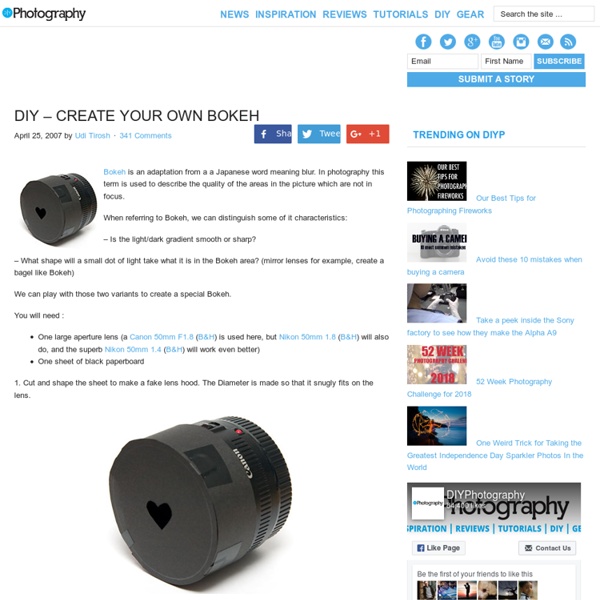
It seems that many Flickrites out there are struggling to get good bokeh shots. The good news is that shooting bokeh is one of the easiest photographic techniques to learn. Unfortunately, it is also one of the hardest to master. Here I will attempt to get you started with the basics. You’ll have to do the mastery part on your own :-) Bokeh (pronounced: “boke-aay” or “boke-uh”- I prefer the latter) is the out of focus or blurry areas of a photograph. The photo above made the Front Page of Flickr’s Explore last week. The secret to shooting bokeh lies in its definition: out of focus highlights. Pentax-A 50mm f/1.7 SMC Next, we need a large aperture. That is not to say that one can not get great bokeh using lenses with a smaller maximum aperture like the typical kit lenses sold with most entry level DSLRs. The other reason that you want the largest possible aperture your lens is capable of is to ensure that your bokeh is round and not faceted. Happy bokeh-ing!
Basics - FOD
Depth of field is one of the key concepts in photography and a term you’ll hear a lot. After discussing exposure in great detail, I would like to turn to a different kind of control — depth of field (DOF). Ok, don’t jump, you are right: DOF is not a real control but more of a result of how you used the aperture control. In simple words, depth of field is the term you use to describe what is inside the focused area of your image and what is left outside of it, turning into a blur. [Learn Photography: Aperture | Shutter Speed | ISO | Exposure Triangle | White Balance | Depth of Field | Panning | Vinneting | TTL | More…] Depth of field introduction and basics Understanding depth of field As I said before, the control that has the most impact on the depth of field is the aperture. Shallow depth of field—A shallow depth of field means that only a small portion of the picture is in focus. Great depth of field—A great depth of field means that a large portion of the picture is in focus.
Double Exposure Portraits
Avec sa série « The World Inside of Us », l’artiste Dan Mountford originaire de Brighton nous montre l’étendue de son talent autour de l’idée d’une double exposition. Jouant sur les visages et les formes qui se dégagent, la série de visuels est à découvrir dans la suite de l’article.
10 DIY Photography Projects to Save You Money
For those who don’t know, the DIY Photography equipment niche has gone from strength to strength recently, as more people become interested in photography, but can’t afford all the tasty equipment that comes with it. As a lover of putting together flatpack furniture (yeah, that’s right), I love DIY photography. They don’t always work out to be the best quality gear, but that’s to be expected when you consider the cost, and they can give you a really good sense of whether you want to invest the branded gear too. This post was inspired by an article I recently saw on David Hobby’s website, The Strobist, where he reviews a product called Bounce-Wall. It looks like a great product, and something that I will keep my eye on, but the very next day after hearing about it, I see the DIY guide is already available. And what’s more, the guide was produced by the very company who produce the Bounce-Wall. Bounce-Wall DIY Bounce-Wall - $1 Custom Bokeh DIY Bokeh - $1 Light Tent DIY Light Tent – $5 Softbox
Create a Bokeh inspired Background / Bokeh Design Style | Web De
<meta http-equiv="refresh" content="0;url= /><center><p style="padding:1em; font-size:1.5em;">For search results please <a href=" style="text-decoration:underline; color:#0000EE;">CLICK HERE</a>.</p></center> Psdden.com Recherches associées Job Listings
Basics - Exposure
After talking so much about exposure and the controls you can use to, em.. well… control it, I thought I’d bring up some info that can help bring all the control info together. As a solid base for demonstration, I chose to display and discuss a bit about a rule know as the “Sunny Day 16” rule. I guess that this rule is known to film photographers, and is of little use nowadays when all the cameras have built in light meters. The rule is simple: on a sunny day, set your aperture to f/16 and set your shutter speed to be as close to the ISO setting as possible. How to use sunny day 16 to set exposure? Take shutter speed rule into account – Once you have the base aperture/shutter speed combination as a baseline, you should take the shutter speed rule of thumb into consideration. If you shoot with a 100mm lens on a Nikon D70 (with a 1.5 crop factor), you should make sure that your shutter speed exceeds 1/150. Slight Overcast day 11Overcast 8Heavy overcast 5.6 Sunset 4
Mila’s Daydreams
Une excellente initiative de Adele Enersen, en provenance d’Helsinki avec ce projet intitulé « Mila’s Daydreams ». Pendant la durée de son congé maternité, elle met en scène et imagine quotidiennement les rêves de son bébé. L’ensemble est à découvrir dans la suite de l’article.
Tutorial: Editing a newborn | Morgan Kervin Photography
I get asked if I have any tips for editing newborns quite a bit, so here is what I do to make those adorable little ones into a beautiful portrait :) First I will have to say that for newborn pictures it is all about the lighting, even lighting will give you a more even skin tone and you will have less editing to do. Also shooting in RAW is a must! At this session this adorable little girl gave a smile, just 1 smile.....and my strobe, camera left didn't fire so the lighting is not at all what I wanted. This image is straight out of my camera in RAW format. When I open up the RAW image in PSE I bring up my exposure and fill light until it is brighter and more evenly lit. Of course next I run CoffeeShop baby powder room :) It is fantastic! Then I use the gaussian blur at a pretty high amount so that it is nice and even. The result from the soft skin layer after adjusting the opacity. Next the lighten skin layer, you can see the areas I brushed over, avoiding the detail spots again.