

Rebreather For diving with a rebreather, see rebreather diving. A rebreather is a breathing apparatus that absorbs the carbon dioxide of a user's exhaled breath to permit the rebreathing (recycling) of the substantially unused oxygen content of each breath. Oxygen is added to replenish the amount metabolised by the user. This differs from open-circuit breathing apparatus, where the exhaled gas is discharged directly into the environment. Rebreather technology may be used where breathing gas supply is limited, such as underwater or in space, where the environment is toxic or hypoxic, as in firefighting, mine rescue and high altitude operations, or where the breathing gas is specially enriched or contains expensive components, such as helium diluent or anaesthetic gases. Rebreather technology is used in many environments: This may be compared with some applications of open circuit breathing apparatus: General concept[edit] As a person breathes, the body consumes oxygen and produces carbon dioxide.
Breathing A schematic view of the human respiratory system. In addition to removing carbon dioxide, breathing results in loss of water from the body. Exhaled air has a relative humidity of 100% because of water diffusing across the moist surface of breathing passages and alveoli. When a person exhales into very cold outdoor air, the moisture-laden atmosphere from the lungs becomes chilled to the point where the water condenses into a fog ("seeing the breath"). Mechanics[edit] In Mammals, breathing in, or inhaling, is due to the contraction and flattening of the diaphragm, a domed muscle that separates thorax and abdomen. Diaphragm, Intercostal Muscles, Scalenes, Pectoralis Minor, Serratus Anterior, Sternocleidomastoid, Levator Costarum, Upper Trapezius, Latissmus Dorsi, and Subclavis. Eight are used for forced expiration:[4] Internal intercostal, Obliquus Internus, Obliquus Externus, Levator Ani, Triangularis Sterni, Transversalis, Pyramidalis, and Rectus Abdominus. Control of breathing[edit]
Breathing gas Air is the most common and only natural breathing gas. Other gases, either pure gases or mixtures of gases, are used in breathing equipment and enclosed habitats such as SCUBA equipment, surface supplied diving equipment, recompression chambers, submarines, space suits, spacecraft, medical life support and first aid equipment, high-altitude mountaineering and anaesthetic machines.[1][2][3] Most breathing gases are a mixture of oxygen and one or more inert gases.[1][3] Other breathing gases have been developed to improve on the performance of air by reducing the risk of decompression sickness, reducing the duration of decompression stops, reducing nitrogen narcosis or allowing safer deep diving.[1][3] A safe breathing gas for hyperbaric use has three essential features: it must contain sufficient oxygen to support life, consciousness and work rate of the breather.[1][2][3]it must not contain harmful gases. Common diving breathing gases[edit] These common diving breathing gases are used:
Exhalation Exhalation (or expiration) is the flow of the respiratory current out of the organism. In humans it is the movement of air out of the bronchial tubes, through the airways, to the external environment during breathing. This happens due to elastic properties of the lungs, as well as the internal intercostal muscles which lower the rib cage and decrease thoracic volume. As the thoracic diaphragm relaxes during exhalation it causes the tissue it has depressed to rise superiorly and put pressure on the lungs to expel the air. During forced exhalation, as when blowing out a candle, expiratory muscles including the abdominal muscles and internal intercostal muscles generate abdominal and thoracic pressure, which forces air out of the lungs. Exhaled air is rich in carbon dioxide, a waste product of cellular respiration during the production of energy, which is stored as ATP. Exhalation & Gas Exchange[edit] Spirometry[edit] Spirometry is used to measure lung function. Brain Involvement[edit]
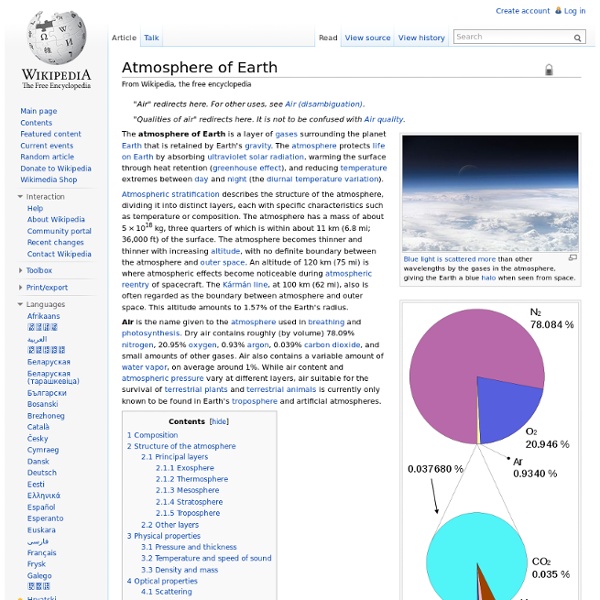
Carbon dioxide Carbon dioxide (chemical formula CO2) is a naturally occurring chemical compound composed of 2 oxygen atoms each covalently double bonded to a single carbon atom. It is a gas at standard temperature and pressure and exists in Earth's atmosphere in this state, as a trace gas at a concentration of 0.039 per cent by volume.[1] The environmental effects of carbon dioxide are of significant interest. History Carbon dioxide was first liquefied (at elevated pressures) in 1823 by Humphry Davy and Michael Faraday.[8] The earliest description of solid carbon dioxide was given by Adrien-Jean-Pierre Thilorier, who in 1835 opened a pressurized container of liquid carbon dioxide, only to find that the cooling produced by the rapid evaporation of the liquid yielded a "snow" of solid CO2.[9] Chemical and physical properties Structure and bonding The carbon dioxide molecule is linear and centrosymmetric. In aqueous solution The hydration equilibrium constant of carbonic acid is (at 25 °C). . Uses
Oxygen Blue white glow from an oxygen discharge tube. Oxygen is an important part of the atmosphere, and is necessary to sustain most terrestrial life as it is used in respiration. However, it is too chemically reactive to remain a free element in Earth's atmosphere without being continuously replenished by the photosynthetic action of living organisms, which use the energy of sunlight to produce elemental oxygen from water. Another form (allotrope) of oxygen, ozone (O 3), strongly absorbs UVB radiation and consequently the high-altitude ozone layer helps protect the biosphere from ultraviolet radiation, but is a pollutant near the surface where it is a by-product of smog. At even higher low earth orbit altitudes, atomic oxygen is a significant presence and a cause of erosion for spacecraft.[7] Oxygen is produced industrially by fractional distillation of liquefied air, use of zeolites with pressure-cycling to concentrate oxygen from air, electrolysis of water and other means. Characteristics
Inhalation Inhalation (also known as inspiration) is the flow of air into an organism. It is a vital process for all human life. In humans it is the movement of air from the external environment, through the airways, and into the alveoli. Other muscles that can be involved in inhalation include:[1] Hyperaeration[edit] Hyperaeration or hyperinflation is where the lung volume is abnormally increased, with increased filling of the alveoli. It causes one form of overexpansion of the lung. See also[edit] References[edit]
Carbon monoxide Carbon monoxide (CO) is a colorless, odorless, and tasteless gas that is slightly less dense than air. It is toxic to humans and animals when encountered in higher concentrations, although it is also produced in normal animal metabolism in low quantities, and is thought to have some normal biological functions. In the atmosphere, it is spatially variable and short lived, having a role in the formation of ground-level ozone. Carbon monoxide consists of one carbon atom and one oxygen atom, connected by a triple bond that consists of two covalent bonds as well as one dative covalent bond. Carbon monoxide is produced from the partial oxidation of carbon-containing compounds; it forms when there is not enough oxygen to produce carbon dioxide (CO2), such as when operating a stove or an internal combustion engine in an enclosed space. In biology, carbon monoxide is naturally produced by the action of heme oxygenase 1 and 2 on the heme from hemoglobin breakdown. History[edit] Toxicity[edit]
Blackdamp Blackdamp (also known as stythe or choke damp) is an asphyxiant, reducing the available oxygen content of air to a level incapable of sustaining human or animal life. It is not a single gas but a mixture of unbreathable gases left after oxygen is removed from the air and typically consists of nitrogen, carbon dioxide and water vapour. The suffix damp is believed to derive from the German word for vapours ("Dampf"). Sources[edit] Blackdamp is encountered in enclosed environments such as mines, sewers, wells, tunnels and ships' holds. Hazards[edit] In addition to the danger inside the mine, blackdamp can be "exhaled" in large quantities from mines (especially long-abandoned coal mines with few outlets for escaping gas) during sudden changes in atmospheric pressure, potentially causing asphyxiation on the surface.[1] Disasters[edit] Modern flame safety lamp used in mines, manufactured by Koehler The gas mixture has been responsible for many deaths among underground workers, especially miners.
Nitrox Typical Nitrox cylinder marking Use[edit] Enriched Air Nitrox diving tables, showing adjusted no-decompression times. Enriched Air Nitrox, nitrox with an oxygen content above 21%, is mainly used in scuba diving to reduce the proportion of nitrogen in the breathing gas mixture. There is anecdotal evidence that the use of nitrox reduces post-dive fatigue,[7] particularly in older and or obese divers; however a double-blind study to test this found no statistically significant reduction in reported fatigue.[1][8] There was, however, some suggestion that post dive fatigue is due to sub-clinical decompression sickness (DCS) (i.e. micro bubbles in the blood insufficient to cause symptoms of DCS); the fact that the study mentioned was conducted in a dry chamber with an ideal decompression profile may have been sufficient to reduce sub-clinical DCS and prevent fatigue in both nitrox and air divers. Terminology[edit] Choice of mixture[edit] Production of nitrox[edit] South Africa[edit] USA[edit]
Heliox Heliox is a breathing gas composed of a mixture of helium (He) and oxygen (O2). Heliox has been used medically since the 1930s, and although the medical community adopted it initially to alleviate symptoms of upper airway obstruction, its range of medical uses has since expanded greatly, mostly because of the low density of the gas.[1][2] Heliox is also used in saturation diving and sometimes during the deep phase of technical dives.[3][4] Medical uses[edit] In medicine heliox may refer to a mixture of 21% O2 (the same as air) and 79% He, although other combinations are available (70/30 and 60/40). Heliox generates less airway resistance than air and thereby requires less mechanical energy to ventilate the lungs.[5] "Work of Breathing" (WOB) is reduced. It does this by two mechanisms: increased tendency to laminar flow;reduced resistance in turbulent flow. Heliox has a similar viscosity to air but a significantly lower density (0.5 g/l versus 1.2 5g/l at STP). Diving uses[edit] See also[edit]