

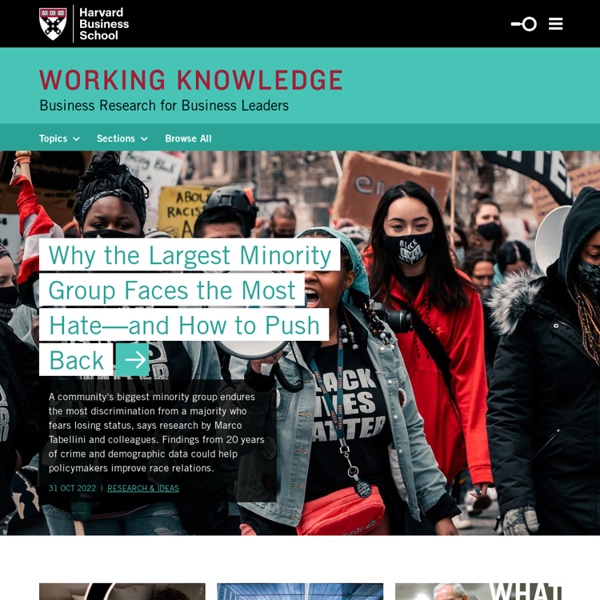
Articles About Marketing General Information Academic Programs Alumni Faculty & Research Recruit Resources Close Harvard Business School Browse By: Topic Industry Geography Marketing 257 Results Encouraging Niche Content in an Ad-Driven World Research by Feng Zhu and Monic Sun explores how advertising drives bloggers to shift their writing to subjects that will grab more eyeballs—namely, the stock market, celebrities, and salacious behavior. A Brand Manager’s Guide to Losing Control Social media platforms have taken some of the marketing power away from companies and given it to consumers. How Grocery Bags Manipulate Your Mind People who bring personal shopping bags to the grocery store to help the environment are more likely to buy organic items—but also to treat themselves to ice cream and cookies, according to new research by Uma R. Busting Six Myths About Customer Loyalty Programs Low-margin retailers argue they can't afford customer loyalty programs, but is that true? The Art of American Advertising Thales S. Benjamin G.
Minnesota NOW Home TechCrunch Hiring is Obsolete May 2005 (This essay is derived from a talk at the Berkeley CSUA.) The three big powers on the Internet now are Yahoo, Google, and Microsoft. Average age of their founders: 24. Like everything else in technology, the cost of starting a startup has decreased dramatically. The less it costs to start a company, the less you need the permission of investors to do it. The most interesting subset may be those in their early twenties. Market Rate I once claimed that nerds were unpopular in secondary school mainly because they had better things to do than work full-time at being popular. Or more precisely, I think few realize the huge spread in the value of 20 year olds. Till now the problem has always been that it's difficult to pick them out. It's hard to judge the young because (a) they change rapidly, (b) there is great variation between them, and (c) they're individually inconsistent. What's an especially productive 22 year old to do? The market is a lot more discerning than any employer.
IDEAS: Economics and Finance Research There are no such things as “Insights” I was recently asked to put together some “insight generation” exercises for a training workshop. This is pretty standard fare for a planning director, the person who ‘owns the insights.’ Creative briefs now often feature sections that are titled something like, “What’s the key insight?” – into which, the planner dutifully fills in some text in order to earn her wages. For some reason, on this particular request, I just completely stalled out. I often, at conferences and in client meetings, or with other planners, remark on how “insights” is another crime against the English language that Adland has perpetrated upon corporate culture. Insight isn’t a noun in the sense that a car or a nickel or a pen are nouns. And this is where it all goes to hell. Planning is about Insights? Insight is a capacity to gain accurate and deep understanding of a person or thing. But the work product of these processes isn’t ‘an insight’. The Rise of Storytelling But we don’t hold out much hope of that. Coda
Healthcare Marketing Blogs: The List Dan Dunlop is president of Jennings, a North Carolina-based branding and advertising agency specializing in healthcare marketing. Dan is a sought after speaker for national and regional conferences on topics of healthcare marketing, advertising and branding. He has served on the faculty of the Healthcare Marketing Strategies Summit, the annual conference of the Society for Healthcare Strategy & Market Development (SHSMD), the Forum on Customer Based Marketing (CBM), the annual conference of Carolinas Healthcare Public Relations & Marketing Society (CHPRMS), the annual conference of the Virginia Society for Healthcare Marketing and Public Relations, the annual conference of the Illinois Society for Health Marketing and Public Relations, the annual educational symposium of the New England Society for Healthcare Communications (NESHCo) and the Educational Conference of the Association of American Medical Colleges. This blog represents Dan's views and not necessarily those of his employer.
Börse - Börsenkurse - Finanzen - Aktienkurse - Aktien How to Start a Startup March 2005 (This essay is derived from a talk at the Harvard Computer Society.) You need three things to create a successful startup: to start with good people, to make something customers actually want, and to spend as little money as possible. And that's kind of exciting, when you think about it, because all three are doable. If there is one message I'd like to get across about startups, that's it. The Idea In particular, you don't need a brilliant idea to start a startup around. Google's plan, for example, was simply to create a search site that didn't suck. There are plenty of other areas that are just as backward as search was before Google. For example, dating sites currently suck far worse than search did before Google. An idea for a startup, however, is only a beginning. Another sign of how little the initial idea is worth is the number of startups that change their plan en route. Ideas for startups are worth something, certainly, but the trouble is, they're not transferrable.