

CBN System - Placing the world of color at your fingertips John Taylor Gatto John Taylor Gatto[1] (born December 15, 1935[2]) is an American author and former school teacher with nearly 30 years of experience in the classroom. He devoted much of his energy to his teaching career, then, following his resignation, authored several books on modern education, criticizing its ideology, history, and consequences. He is best known for the underground classic "Dumbing Us Down: the Hidden Curriculum of Compulsory Schooling", and his magnum opus "The Underground History of American Education: A Schoolteacher’s Intimate Investigation Into the Problem of Modern Schooling". He was named New York City Teacher of the Year in 1989, 1990, and 1991, and New York State Teacher of the Year in 1991.[3] Biography[edit] Gatto was born in the Pittsburgh-area steel town of Monongahela, Pennsylvania. He worked as a writer and held several odd jobs before borrowing his roommate's license to investigate teaching. Main thesis[edit] What does the school do to children? Bibliography[edit]
Color Wheel, Color Circle, & Color Relationships Color Worqx A color wheel (also referred to as a color circle) is a visual representation of colors arranged according to their chromatic relationship. Begin a color wheel by positioning primary hues equidistant from one another, then create a bridge between primaries using secondary and tertiary colors. Color Terminology Primary Colors: Colors at their basic essence; those colors that cannot be created by mixing others. Secondary Colors: Those colors achieved by a mixture of two primaries. Tertiary Colors: Those colors achieved by a mixture of primary and secondary hues. Complementary Colors: Those colors located opposite each other on a color wheel. Analogous Colors: Those colors located close together on a color wheel. Active & Passive Colors The color wheel can be divided into ranges that are visually active or passive. Advancing hues are most often thought to have less visual weight than the receding hues. Color relationships Continue tutorial, view: Complementary Colors
Ticket to Dreams Coloring Book by Karolina Kubikowska | Coloring Queen Fans of Polish tattoo artist Karolina Kubikowska and the coloring book creator that wowed us with her first coloring book Po drugiej stronie snu (still in my “to do” stack but you may have seen it in my Coloring Book Collection videos) might be interested in her second coloring book, Ticket to Dreams. Some colorists may recognise the cute little bunny above from the new Ticket to Dreams Coloring Book that was recently used by the artist and her publisher for a coloring contest. Ticket to Dreams features a variety of animals all in Karolina’s distinctive style. You will notice that, this time, Karolina has an English title for her coloring book. Quick Summary: Ticket to Dreams coloring book is spiral boundThe paper has thicker paper so that you can use watercolors on it weighing in at 250gmImages have been printed on BOTH sides of the paperThere are 3 images at the rear of the book printed on single sided paperA blotter page has been included to test out your mediums The short answer is no.
The Fundamentals of Color Theory Color theory is both the science and art of using color. It explains how humans perceive color; and the visual effects of how colors mix, match or contrast with each other. Color theory also involves the messages colors communicate; and the methods used to replicate color. In color theory, colors are organized on a color wheel and grouped into 3 categories: primary colors, secondary colors and tertiary colors. So why should you care about color theory as an entrepreneur? Color theory will help you build your brand. Understanding color – People decide whether or not they like a product in 90 seconds or less. 90% of that decision is based solely on color. Color is perception. When you’re strolling down the soft drink aisle scanning the shelves filled with 82 million cans and bottles and trying to find your six-pack of Coke, what do you look for? People decide whether or not they like a product in 90 seconds or less. 90% of that decision is based solely on color. Why should you care?
Ugra/FOGRA Media Wedge - Medienkeil CMYK bvdm, Fogra und zipcon laden ein: Online Print Symposium Seien auch Sie auch dieses Jahr wieder in München dabei, wenn am 15. / 16. Mai 2014 das zweite Symposium zu diesem zukunftsträchtigen Thema stattfinden wird. Alle Einzelheiten finden Sie unter: www.online-print-symposium.de Download des Programmhefts als PDF Dr. Große Verdienste (nicht nur) für die Standardisierung Dr. Anmelden und Frühbucherrabatt sichern: Anwenderforum UV-Druck Seien auch Sie auch dieses Jahr wieder in München dabei, wenn am 29. / 30. Alle Einzelheiten finden Sie demnächst hier ... Neuer Fogra-Forschungsbericht: Kriterien für die farbverbindliche Softproof-Bewertung in der Tagesproduktion Diesen neuen Bericht laden Sie als Fogra-Mitglied (nach dem Login) kostenlos herunter. Abstrakt, Download und Bestellmöglichkeit Wir suchen für sofort eine(n) PhyTA - Physikalisch-technischen Assistent(in) Detailiertes Angebot (PDF) Gleich anmelden: Immer auf dem neuesten Stand!
Why Schools Don't Educate I accept this award on behalf of all the fine teachers I've known over the years who've struggled to make their transactions with children honorable ones, men and women who are never complacent, always questioning, always wrestling to define and redefine endlessly what the word "education" should mean. A Teacher of the Year is not the best teacher around, those people are too quiet to be easily uncovered, but he is a standard-bearer, symbolic of these private people who spend their lives gladly in the service of children. This is their award as well as mine. We live in a time of great school crisis. Our school crisis is a reflection of this greater social crisis. I've noticed a fascinating phenomenon in my twenty-five years of teaching - that schools and schooling are increasingly irrelevant to the great enterprises of the planet. Our form of compulsory schooling is an invention of the state of Massachusetts around 1850. Now here is a curious idea to ponder. It's not enough.
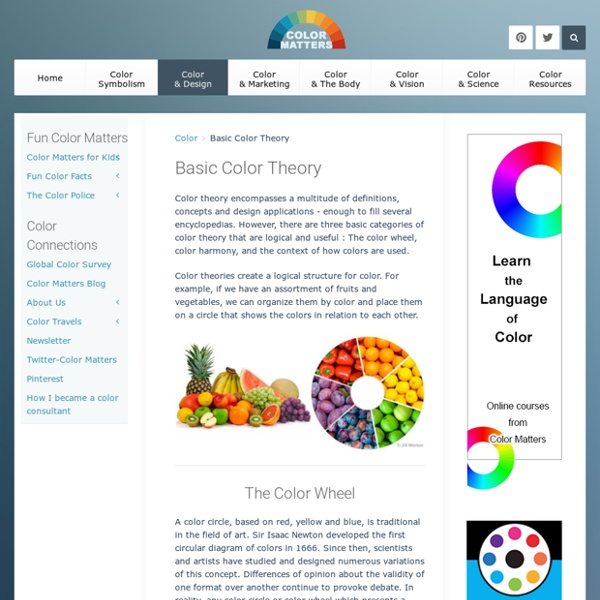
Basic color schemes: Color Theory Introduction With colors you can set a mood, attract attention, or make a statement. You can use color to energize, or to cool down. By selecting the right color scheme, you can create an ambiance of elegance, warmth or tranquility, or you can convey an image of playful youthfulness. Colors affect us in numerous ways, both mentally and physically. Being able to use colors consciously and harmoniously can help you create spectacular results. The Color Wheel The color wheel or color circle is the basic tool for combining colors. The color wheel is designed so that virtually any colors you pick from it will look good together. Traditionally, there are a number of color combinations that are considered especially pleasing. ColorImpact is designed to dynamically create a color wheel to match your base color. Primary, Secondary and Tertiary Colors In the RYB (or subtractive) color model, the primary colors are red, yellow and blue. Warm and cool colors The color circle can be divided into warm and cool colors.
Colored Pencils-Blank RCW Pigment and Color Numbers for all other media. RCW#1.00.1 Light Chrome Yellow Light, Lead Chromate, PY-34 RCW#1.00.1 Light, Yellow Light Hansa, Arylamide, PY3, Translucent RCW#1.00.2, Nickel Titanate Yellow PY53 RCW#1.00.3, Hansa Yellow, Monoazo Yellow, PY-74, Translucent RCW#1.0.1, Cadmium Zinc Sulfide, PY35, Opaque RCW#1.0.2, Cadmium Lemon, PY35, Opaque RCW#1.0.3, Bismuth Yellow PY184 RCW#1.0.5, Aureolin, Potassium Cobaltinitrite, PY40, Translucent RCW#1.2, New Gamboge, Indian Yellow, Anthrapyrimidine PY108, Translucent. RCW#1.4, Wm Gold ocher - Azo Yellow, Monoazo Yellow, PY-151, Translucent RCW#1.6, Indian Yellow-Brown Lake Extra, Dioxine Nickel Complex, Synthetic Iron Oxide, PY153 or PY150, PY42, transparent. RCW#1.6.1, Indian Yellow Gr/s, Nickel Chelated Azo PG10F, transparent. RCW#5.7, Italian burnt Sienna PBr7, Translucent RCW#5.10, Burnt Umber Brown, Natural Earth, Hydrated Iron Oxide, PBr7, Translucent RCW#8.0, Irgazine Red PR254, Opaque
Fine art in advertising can backfire -- ScienceDaily Throughout the ages, fine art has been accorded a special significance and recognized as a powerful communication tool. Art has been used to sell everything from products to politics to religion. But art can be stripped of its special status if used carelessly by advertisers, according to a new study by researchers from Boston College and the University of Houston. If the artwork is viewed as a product-relevant illustration, then consumers no longer view it as art. Suddenly, they can take a critical view of its message, according to the new study, which will appear in a forthcoming issue of the journal Personality and Social Psychology Bulletin. "Art is valued for its own sake," said Henrik Hagtvedt, a marketing professor in the Carroll School of Management at Boston College. Art may thus lose its unique powers of communication, Hagtvedt and colleague Vanessa M. One study conducted by Hagtvedt and Patrick involved a wine tasting at a bar.
BabelColor - A bidirectional color translator Better Than Free <A HREF=" Widgets</A> Issue 53 - 01 | Better Than Free By Kevin KellyPublished Dec. 4, 2008 12:47 a.m. "The Internet is a copy machine. Yet the previous round of wealth in this economy was built on selling precious copies, so the free flow of free copies tends to undermine the established order. I have an answer. When copies are super abundant, they become worthless. When copies are super abundant, stuff which can't be copied becomes scarce and valuable. Well, what can't be copied?" Download About Kevin Kelly | Kevin Kelly is Senior Maverick at Wired magazine. Request Processed
Step by Step Colored Pencil Demonstration Here is a great step by step colored pencil demonstration by artist Veronica Winters. During this video tutorial, Veronica will share lots of tips and techniques for creating a stunning colored pencil drawing. Veronica uses colored paper for her drawings as it speeds up the drawing process and makes her drawings appear brighter and more vibrant. She uses smooth paper that doesn’t have much tooth to it. She is working from a reference photo that she took in Italy. She begins with a drawing that she lays out using a graphite 2HB Pencil. She uses a ruler in certain areas of her drawing to create straight lines. I don’t want to give too much away, so be sure and watch this interesting colored pencil demo video below. If you are interested in learning more about Prismacolor Colored Pencils as well as purchasing them online at a discounted price, follow this link for a video discussion and demonstration from the folks over at Dick Blick.