

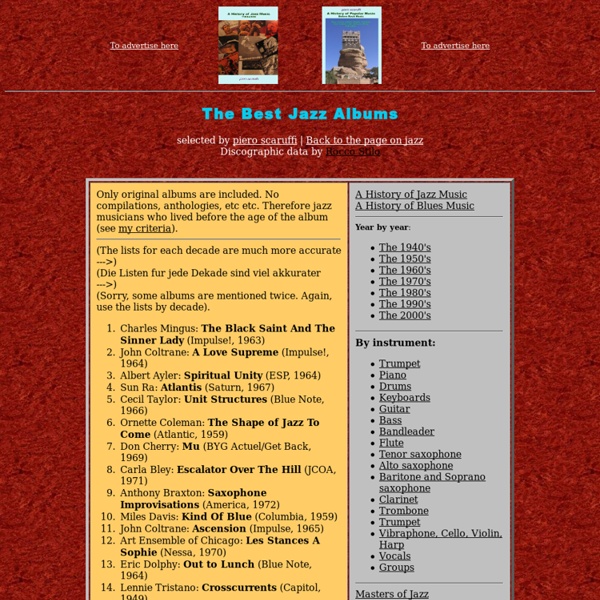
Le Free Jazz dans tous ses états - Liste de 30 albums My Name Is Albert Ayler (1963) Album de Albert Ayler Sortie : 1963. Free jazz, jazz et hard bop. 6 morceaux. Au répertoire, des standards, le langage commun à tous les jazzmen, de bons vieux saucissons usés jusqu’à la corde, Bye bye black bird, Billie’s bounce, Summertime, On green Dolphin Street, joués et réjoués (ces mêmes thèmes que les jeunes néo-boppers s’amusent à interpréter très sérieusement en costume Armani). Ils sont ici déjoués, déconstruits, décortiqués. 100 Greatest Jazz Albums RateYourMusic - Best Jazz Albums The Jazz Resource - Best Jazz Albums Jazz music is a wonderful artform that is a true window into the human spirit. The best jazz albums can be listened to time and time again and with each listen it's possible to hear something new in the music. Much consideration has gone into these lists and they are a great place for jazz fans to discover some of the finest masterpieces from the jazz era. If you are learning to play jazz, then listening is essential to progress. Top 25 Jazz Albums part 1 and part 2 - This is a list of the 25 most influential and popular jazz albums of all time. Best Jazz Albums 2013 part 1 and part 2 Here are the best jazz albums of 2013 showing that jazz is alive and flourishing today. 15 Jazz Albums for Musicians While not necessarily being the most popular jazz albums of all time, musicians will find these albums useful for studying or just to listen to some amazing jazz recorded on tape. Return to The Jazz Resource Home Page
Time Out - A history of jazz in Paris Found in the vaulted stone cellars of the ancient city centre, Parisian jazz clubs are mythical places that have hosted many of the 20th century's biggest names in music. From jazz's origins as part of a cultural, musical and political revolution in America, today the music is celebrated worldwide from the streets to the most exclusive clubs. In Paris, the movement began with the scandalous singer Joséphine Baker, who did interesting things with bananas and the Charleston, and brought jazz to the cabaret bars of Pigalle during Paris's Années Folles during the 1920s and 30s. Duke Ellington rencontre Django Reinhardt At the start if the Second World War in 1939, Duke Ellington discovered Django Reinhardt – the first jazz manouche player, already acclaimed in Paris – playing in Pigalle's cabaret clubs. Seven years later, Ellington offered to produce Reinhardt in New York, encouraging a wave of jazzmen to head for the French capital, and bebop fever was born in Paris.
Rolling Out - 20 greatest jazz albums of all time Sat., Apr. 6, 2013 12:45 PM EDT Jazz is often called the one truly American artform. Unfortunately, for a generation reared on pop music; R&B, rock, dance pop and hip-hop may be a lot more ubiquitous. Nevertheless, jazz remains the genre of refined style, the genre of unfiltered expression, the genre of defiant artistry; and names like Miles Davis, Max Roach, Duke Ellington, Charles Mingus, John Coltrane and Charlie Parker continue to resonate generations after their music was recorded and released because fans often turn to jazz when looking for an alternative to more commercially-driven musical spheres. But many have no idea where to start. Jazz, even more than other, more commercially-oriented genres, has a wide range of variations. But for a genre that can be notoriously restless, there tends to be something for everyone–if you’re willing to look.
Jazz History Database New Yorker - 100 Essential Jazz Albums While finishing “Bird-Watcher,” a Profile of the jazz broadcaster and expert Phil Schaap, I thought it might be useful to compile a list of a hundred essential jazz albums, more as a guide for the uninitiated than as a source of quarrelling for the collector. First, I asked Schaap to assemble the list, but, after a couple of false starts, he balked. Such attempts, he said, have been going on for a long time, but “who remembers the lists and do they really succeed in driving people to the source?” Add to that, he said, “the dilemma of the current situation,” in which music is often bought and downloaded from dubious sources. Schaap bemoaned the loss of authoritative discographies and the “troubles” of the digital age, particularly the loss of informative aids like liner notes and booklets. What follows is a list compiled with the help of my New Yorker colleague Richard Brody. What follows is a list compiled with the help of my New Yorker colleague Richard Brody.
Jazz History Time Line Pre-1850 Though jazz and classic blues are really early twentieth-century black music innovations, certain characteristics found in jazz do have their roots in much earlier musical traditions. Call and response, improvisation, the appropriation and reinvention of elements from Western art music: black music in the twentieth-century has never held a monopoly on these musical practices. There was one condition that had to be met for a black tradition unique to North America to develop. But the North American variation and reinvention of African tradition in the early nineteenth-century was not monolithic. Despite the fact that the vast majority of blacks lived in the South, there were some freemen and women in the North. Though the minstrel show declined in popularity during the 1860s, blackface has retained a unique place in American culture. Some form of music shaped by the black experience in the United States had appeared in both the South and the North by the time of the Civil War.
Paul Scaruffi - A History of Jazz Music Bibliography (in order of relevance): Gioia, Ted: "The History of Jazz" (Oxford Univ Press, 1997) Shipton, Alyn: "New History of Jazz" (2001) Southern, Eileen: "The Music of Black Americans" (Norton, 1971) Gridley, Mark: "Jazz Styles" (Prentice Hall, 1991) Hardy, Phil & Laing Dave: "Faber Companion to 20th Century Popular Music" (Faber, 1990) Clarke, Donald: "Penguin Encyclopedia of Popular Music" (Penguin, 1989) Hodeir, Andre: "Hommes et Problemes du Jazz" (Flammarion, 1954) Polillo, Arrigo: "Jazz" (Mondadori, 1975) Roberts, John-Storm: "Black Music of Two Worlds" (1972) Lord, Tom: "The Jazz Discography" (Lord Music Reference, 2007) Discography: Jazzdisco Biographies: Almost a Preface Most books on the history of jazz music, even the ones published very recently (see the bibliography), tend to devote 80-90% of the pages to jazz before the Sixties, and then to quickly summarize (with countless omissions) the last 40 years. This is now a dangerous book. piero scaruffi, 2006 Notes Disclaimer