

From Toy to Tool: Cell Phones in Learning Emerging video lecture trend turns traditional teaching methods upside-down Ashley Landguth, Eleanor Brock and Caroline Hood, from left, work out chemistry problems with plastic models during Keith Sanders' honors class, which is part of the flipped classroom model at Girls Preparatory School. To learn more about the flipped classroom model, visit www.flippedclassroom.com. With a flipped classroom model, students watch prepared video lessons before coming to class, leaving more class time for students to clarify and apply concepts. In doing so, teachers say they’re putting more responsibility on students to come to class prepared, but they’re also making each class period more valuable. Two Colorado high school science teachers are said to have started the instructional model to make their classes more interactive. Follow us on Twitter for the latest breaking news As soon as the final student trickles in, Keith Sanders’ honors chemistry class is ready to get to work building molecule models. “It was just a race through the curriculum,” he said.
The Flipped Class Blog Experimentation Is The New Planning Technology is a bitch. It affects every industry, often in ways that are difficult (if not impossible) to anticipate. There’s always the possibility that a Napster or a Netflix or a Wikipedia will arrive to completely disrupt your business or industry. So it makes sense to have some kind of system that allows you to continually develop options and explore possibilities, so that when the day of disruption does arrive, it finds you ready with a few alternatives in hand. Let’s Be Deliberate: Real Strategy Emerges An evolving portfolio of strategic experiments gives the management team more choices, which means better odds that some of the choices will be right. Management theorist Henry Mintzberg makes a distinction between deliberate and emergent strategy. Deliberate strategy is goal-oriented. A Portfolio Of Experiments Diversity breeds creativity--ecosystems are richest where habitats and species overlap. In 2005, Google set a formula for distributing its engineering efforts: 70-20-10.
How the Flipped Classroom Is Radically Transforming Learning Editor's Note:Posts about the flipped class on The Daily Riff beginning in January 2011 have generated over 240,000 views to-date - thanks contributors and readers . . . See our other links related to the flipped class below this guest post. Since this post was written, Bergmann and Sams have released their book, Flip your Classroom: Reach Every Student in Every Class Every Day. Do check it out. - C.J. How the Flipped Classroom was Born by Jonathan Bergmann and Aaron Sams In 2004, we both started teaching at Woodland Park High School in Woodland Park, Colorado. "And how the Flipped Classroom changes the way teachers talk with parents And then one day our world changed. Flipping Increases Student Interaction One of the greatest benefits of flipping is that overall interaction increases: Teacher to student and student to student. Since the role of the teacher has changed, to more of a tutor than a deliverer of content, we have the privilege of observing students interact with each other.
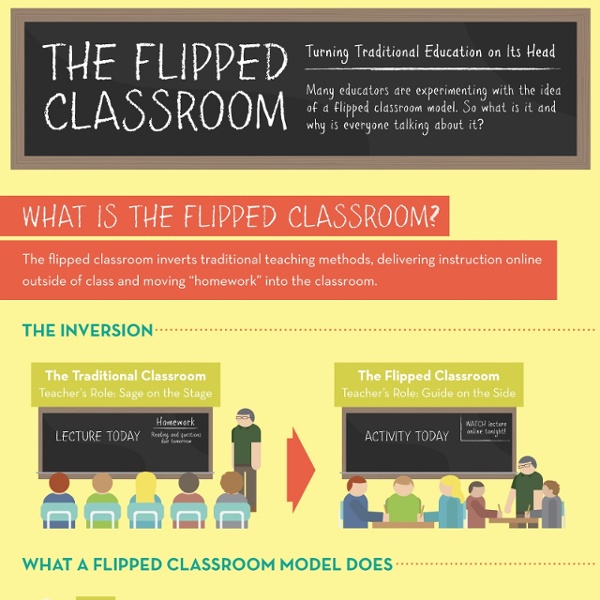
Five Best Practices for the Flipped Classroom Ok, I'll be honest. I get very nervous when I hear education reformists and politicians tout how "incredible" the flipped-classroom model, or how it will "solve" many of the problems of education. It doesn't solve anything. It is a great first step in reframing the role of the teacher in the classroom. It fosters the "guide on the side" mentality and role, rather than that of the "sage of the stage." It also creates the opportunity for differentiated roles to meet the needs of students through a variety of instructional activities. 1) Need to Know How are you creating a need to know the content that is recorded? 2) Engaging Models One of the best way to create the "need to know" is to use a pedagogical model that demands this. 3) Technology What technology do you have to support the flipped classroom? 4) Reflection 5) Time and Place Do you have structures to support this? I know I may have "upset the apple cart" for those who love the flipped classroom.
The product design sprint: a five-day recipe for startups At Google Ventures, we do product design work with startups all the time. Since we want to move fast and they want to move fast, we’ve optimized a process that gets us predictably good results in five days or less. We call it a product design sprint, and it’s great for getting unstuck or accelerating projects that are already in motion. I’ve planned and run over 100 of these sprints, first with teams at Google and now with startups in the Google Ventures portfolio. To give you an idea of what one looks like, here’s a project we did with CustomMade: Over the next several posts, I’ll be sharing a DIY guide for running your own design sprint. Before the sprint: Prepare Get the people and things you need. Day 1: Understand Dig into the design problem through research, competitive review, and strategy exercises. Day 2: Diverge Rapidly develop as many solutions as possible. Day 3: Decide Choose the best ideas and hammer out a user story. What doesn’t work about brainstorming The magic of constraints
Flipped Classroom How flipping works for you Save time; stop repeating yourself Record re-usable video lessons, so you don't have to do it again next year. Let students take control of their learning Not all students learn at the same pace. Spend more time with students Build stronger student-teacher relationships, and promote higher level thinking. Other teachers are doing it, you can too Stacey Roshan found that the traditional classroom model wasn't cutting it for her AP students, so she flipped her class. Watch Stacey's Story Crystal Kirch started using videos as instructional tools in her class but soon realized the real value of flipping lectures was being able to spend more face-to-face time with students. Read Crystal's Story Tools You Can Use
Présentation | Classe Inversée Ce site a pour but d’expliquer le concept de classe inversée à tous les professeurs qui souhaitent avoir un réel impact auprès de leurs élèves et qui veulent connaitre les meilleures méthodes pour développer une ambiance de classe motivante et décontractée. Exemple de classe inversée Ce concept connait un succès grandissant : de plus en plus de professeurs à travers le monde modifient leur façon de “faire la classe” pour passer à un modèle plus pratique et plus humain. Ce modèle part d’une idée très simple : le précieux temps de classe serait mieux utilisé si on s’en servait pour interagir et travailler ensemble plutôt que de laisser une seule personne parler. La classe inversée : plus qu’une méthode, une philosophie Professeur guidant un groupe de travail Il s’agit donc davantage d’une philosophie que d’une méthode à proprement parler. Un modèle plus humain Les interactions deviennent plus conviviales Les avantages de ce modèle sont multiples, mais le principal est la liberté qu’il procure.
Khan Academy Literature Review « Kim_Bathker Educational Technology in a Flipped Classroom Setting Kim Bathker Introduction The rise of technology in the classroom opened up new doors for educators, who saw the potential for computer use and the incorporation of multimedia elements to engage and motivate students. This literature review reported that technology had been harnessed to implement the inverted, or flipped, classroom model and that, by extension, the flipped classroom methodology might increase student motivation and comprehension. The Flipped Classroom Model Though it was popularized by the much-publicized work of Bergmann, Sams and Khan, the flipped classroom model was first described by Baker in 2000. Though Lage, Platt, and Treglia (2000) coined the classroom model “inverted,” rather than flipped, their methodology was essentially the same as Baker’s (p. 32). Bergmann and Sams’s classroom experiment gained the attention of many in the education community, including Khan of the Khan Academy. Conclusion References