

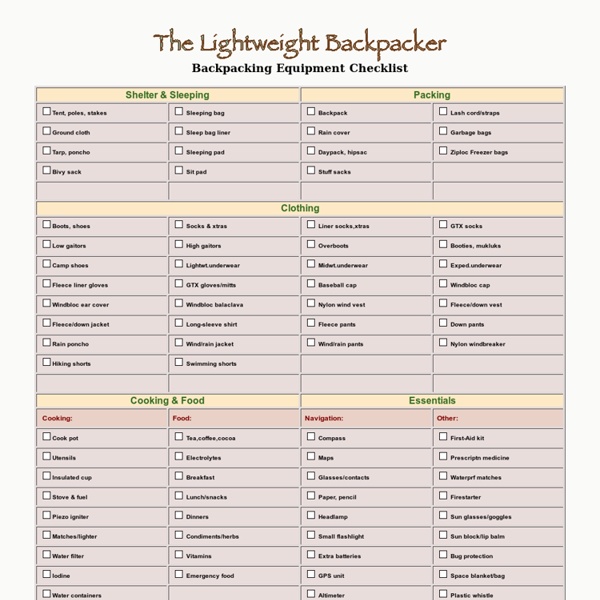
Camping Checklist – Camping List Preparation is essential for any outdoor adventure. Having the necessary supplies and equipment can make a difference in your overall enjoyment and experience. Checklists are a great tool to help with your organization. Your camping list will vary according to the type of camping and activities you have planned, the places you are going, the time of year and the length of your trip. Add or remove items to suit your individual needs. Please email us with any other items that you would include in your camping checklist. By popular request, we’re now offering a printer friendly camping checklist! Shelter __Tent __Ground cloth/tarp __Extra stakes __Shade tarp/poles/rope/stakes __Axe or hammer __Mat for tent entrance __Dust pan/brush Bedding __Sleeping bag __Sheets/blankets __Pillow __Air mattress/sleeping pad/cot/tarp __Air pump __Repair kit for air mattress __Utility bags for storage Cooking Clothes Personal Miscellaneous Basic First Aid Kit Additional First Aid Tips
Paracord Carabiner Spool This was a project I'd tried a couple of years ago that wasn't working like I wanted at the time, so it's been on the unfinished 'to do' list too long. This time I ended up with a much better working model. The paracord is zigzag spooled(like you may find with cordage you buy from store that comes on a spool) onto the PVC pipe over the carabiner. With the carabiner held in hand or secured to gear, the cord can be pulled off and quickly deployed from the free spinning spool. The biner I used is an Omega Locking D Carabiner that I've had for almost 20 years, that has a tubular formed body compared to some that have odd shaped cross sections. I had some leftover 1/2" diameter PVC pipe, to use for the spool, stored in the garage from a light tent project several years ago. I fit the two parts around the carabiner and used gaffer/duct tape to wrap around them and secure them back together. Earlier in the year, a friend made me some smaller bead sized metal tubular spools with flared ends.
Butchering Homegrown Rabbits For Meat | BeSurvival.com Rabbits are an excellent small livestock to get started with. Even if you don’t have the ability to move to the country, you can still gain many valuable skills by raising a few rabbits in your backyard. For info on raising rabbits check out my previous post, Raising Rabbits For Tough Times. I have found butchering rabbits to be much quicker than butchering chickens because a rabbits skin is extremely loose. Because of their small size, rabbits are easy to handle and easy to butcher. Below is a great video that shows the entire process from slaughter to finished meat. Mangan's 10 Essentials for Happy Hiking Most of these aren’t essential for survival; they’re essential to me for having a good time on on a hike. (The official survival essentials are listed at the end) 1. It’s not just a matter of carrying enough water — you need access to more if you run out. That means two things: a) letting your water supply determine your hike length (turning back when it’s half-gone, for example); and b) having a plan for running dry. There’s a whole industry built around keeping you hydrated. Availability of water is as integral to a hike plan as distance, elevation gain and altitude. Water should never be far from your mind … but you don’t want to be in a situation where it’s all you think about, though, because that usually means you’re all out. 2. The most basic risk of hiking is getting lost. It doesn’t really matter what kind of map you have, so long as it tells you where to turn to get back where you came from. 3. The fabric closest to your feet has the most impact on them. 4. It’s worth considering.
Making Campfire Twists Twists are incredibly easy to make. They are unleavened bread as they contain no yeast or sourdough culture. It costs about 30p (60c? but we're in rip of Britain, so probably cheaper in the states) to make about 12 twists Ingredients: 500g Self raising flour 3 Tablespoons of sugar 300-500ml of water Optional: Jam! Equipment: Measuring Jug (though can be done less scientifically by guessing) Mixing bowl - pretty much impossible to get away without. Additional notes: Twists can be made under a hot grill, but they're best over a proper 'cooking' fire which consists of embers, like in the picture below (glowing bits of wood). Home Purchase trail maps, hiking guides, trail-related books and more from our online store. Featured Item: PATC Cabins Book 2013 NEW REVISED 2013 EDITION: PATC Cabins for rent in the Mid-Atlantic region are detailed in this beautiful book loaded with color photos of the PATC cabins. There is a page for each of the 40 cabins with a cabin photo, location, cabin amenities, and includes a section about hikes and things to do in the immediate area. PATC volunteers contribute tens of thousands of hours of volunteer service every year.
Zen Backpacking - Ultralightweight Backpacking Packing List Contact: Ultralightweight Backpacking Packing List For backpacking, less is more. Traveling ultralight means that you carry just enough to stay alive and have move easily since you only carry a feather weight pack. Instead of figuring out what you can do without, sit down and figure out what you must have and can't do without. Reexamine your list and determine what you can do to replace two items with a single item and how you can make each item or system lighter. The amount of gear needed for 1 weeks is the same for 3 months. Please feel free to link to this site so that others can find it. Zen Backpacking <a href=" Backpacking</a>
WoodGas Stove WoodGas Stove A few ideas about a stove developed by Ray Garlington Late September 2003, Ray developed a page on a new "batch-loaded, inverted down-draft gassifier" stove. This type of stove has quite a following, but most of the versions are not designed well for the backpacker. Ray's design is just about optimal for the hiker. Garlington Wood Gas Stove I did a little experimenting with the stove in the first weekend of the month. I was interested in fitting everything together. Instead of the pot support designed by Ray, I use four bent wires. Ray's page is quite clear about how to pack the stove with sticks and light it. This is what my testing stove looks like, except that when I use it, it has a tin foil windscreen around it. A few other notes: I found, after reading Ray's instructions again, that it works better to fill the can about half full of pencil diameter (7 mm) sticks and about half full of sticks no more than 2 mm across. For the gearheads: Weight of components: Flyfisher Home