How To Start Using Google Apps In Education
As teachers, our plates are perpetually and impossibly full. The idea of adding one more component – such as incorporating technology into instruction – can seem daunting to say the least. In my own attempts to incorporate technology into my practice, Google has been the most valuable tool I have found thus far. Why use Google Apps? Google provides a multitude of Apps that can be accessed through multiple mediums – computer, smartphone, or tablet. These apps are all free and come with varying levels of privacy ranging from completely public on the web to limited only through sharing with specific contacts. So how can I use Google Apps in my teaching? To showcase the management advantage of Google Apps, I will highlight an example of how I use Google Apps in my own instruction. To do this, I first created a folder in my Google Drive (you can think of this like a storage space on the internet versus on the hard drive of your computer) titled ‘Civics’. Maybe not right now…
An Overview of How to Design Instruction Using Critical Thinking Concepts
The Logic of Instructional Design Instructional design involves two deeply interrelated parts: structures and tactics. In this article we focus on structures. Structures involve the "what" of the course: What am I going to teach? Tactics involve the "how": How am I going to teach so as to make the structures work? Five Important Structural Determinations That Set the Stage for Everything Else We suggest that for every course you teach, there are five defining dimensions you should carefully think through. your concept of the course, the general plan for implementing that concept, the requirements the students must meet, the grading policies in the course (when applicable), and performance profiles (that correlate with the grade levels). The students, in other words, should know from the beginning what in general is going to be happening in the course, how they are going to be assessed, and what they should be striving to achieve. Back to top
50 Awesome Ways to Use Skype in the Classroom | Teaching Degree.org
Written By: Jillian Terry Skype is a free and easy way for teachers to open up their classroom and their students to a world way beyond their campus. With Skype, students can learn from other students, connect with other cultures, and expand their knowledge in amazing ways. Teachers and parents can also benefit from Skype in the classroom. Promoting Education These great ideas are all about teaching students in dynamic ways. See Me, Hear Me: Skype in the Classroom. Promoting Community Using Skype in the classroom can promote communities within a school or globally. Inclusion — helping a classmate join the classroom from home. Skype Ideas for Teachers and Parents Teachers and parents can benefit from Skype in the classroom, too. Professional development. Resources for Getting Started and Using Skype Find out how you can take advantage of Skype with the advice below. Using Skype in the Classroom (or just learning how to use it!). Finding Others Using Skype ePALS.
21 Reasons To Use Tablets In The 21st Century Classroom
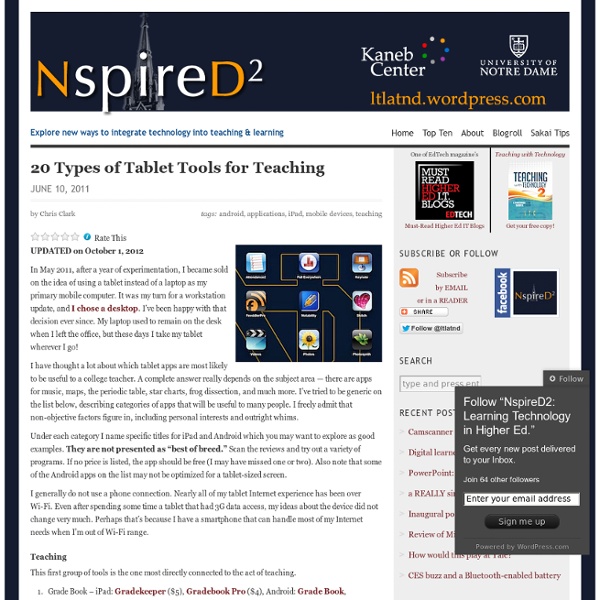
21 Reasons To Use Tablets In The 21st Century Classroom by Julie DeNeen, opencolleges.edu.au When I was a kid, I dreamt about our school desks as computer screens. How cool would it have been to be able to draw, write, and learn directly onto my own computer? As the years went on, people theorized that laptops would take over the classroom, but the price of these devices was too high for a 1 to 1 ratio. It never quite caught on in lower grade schools. Now, it is the age of the tablet. Yet, some educators are still skeptical. 1. In a subject like art, people might think, “How could a tablet be useful? It is, but what about an app that helps with color matching and combination, or tools for interior design where the child can map out their project in concept before getting to work? And how about access to Google’s Art Project? 2. App developers have continually surprised the public with the complexity of tools they are able to create for tablets. 3. 4. 5. 6. 7. 8. 9. 10. 11. 12. 13. 14. 15.
Brainstorm
A guest post by Donald Lazere. “Baby Logic”: The Disdained Discipline in American Colleges Several recent studies identifying the weak spots in both American K-12 and college education, like Richard Arum and Josipa Roksa’s Academically Adrift, the Common Core State Standards Initiative of the National Governors’ Association, and Martha Nussbaum’s Not for Profit, lament the lack of learning in critical thinking and argumentation. Yet none of these studies that I have seen discuss at any length the disciplinary and curricular context in which these subjects are, or should be, taught; nor are they very specific about delineating their content. A movement to implement critical thinking courses peaked around l980, when Chancellor Glenn Dumke announced the requirement of formal instruction in critical thinking throughout the nineteen California State University campuses, serving some 300,000 students. Return to Top
Teaching
Tablets and Apps: How to ensure impact on teaching and learning (1 of 5) – The Big Picture
Tim Scratcherd (the School House Partnership) and I were recently asked to write a report for the Oxford Education School Improvement Series on the use of Tablets and Apps. The purpose of this report is to provide practical support and guidance for school leadership teams who are considering the purchase of tablet devices. The report is aimed at school leaders and teacher in England but the ideas within the report are transferable to other parts of the world. With permission from Oxford I’ll be duplicating some of the report on olliebray.com over the next week. Part One - Tablets and Apps: How to ensure impact on teaching and learning – The Big Picture In many countries across the world we will move to ubiquitous 1:1 (one computer per child) learning environments within the next 5-10 years and it is highly likely that tablet technology will be at the heart of these deployments. The Place of ICT in Schools ICT and the National Curriculum ICT and School Inspection What the research tells us
Finding Talent Is No. 1 Global Issue, CEOs Say - DiversityInc.com
The critical question of where to find and how to effectively manage talent tops the priorities of 1,201 business leaders from more than 69 countries, who were surveyed as part of PricewaterhouseCoopers’ annual global CEO survey. PricewaterhouseCoopers (PwC) is No. 1 on The 2012 DiversityInc Top 50 Companies for Diversity list. The survey report finds that strategies for managing talent are the No. 1 concern for the CEOs over the next year, followed by approach to managing risk, investment decisions and organizational structure following mergers and acquisitions. In recent years, with the global recession, profit and investment were top priorities, but that is changing. “This really is the biggest business concern around the world … growth is going to be very uneven and there is concern about the diversity of different pools,” says Ed Boswell, who leads PwC’s U.S. The PwC report notes that in almost all markets, women represent substantially less of the workforce than men.