

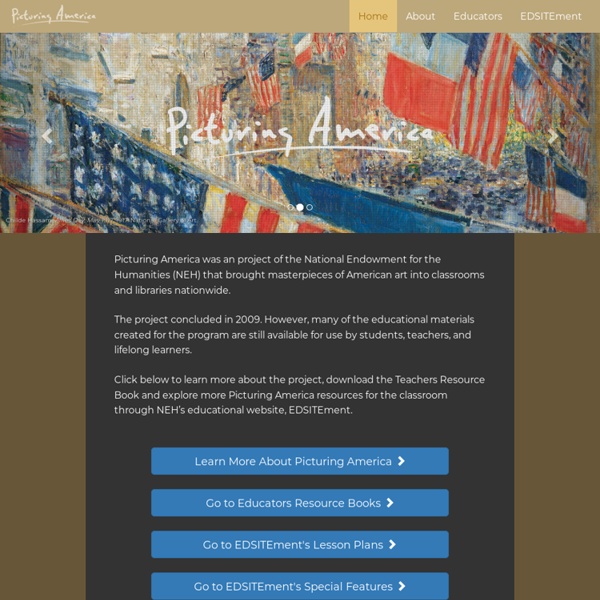
https://picturingamerica.neh.gov/
Inicio Biblioteca Digital Mundial Welcome - The Flow of History Cartoons for the Classroom :: AAEC - Association of American Editorial Cartoonists Congress clears way to sue Saudis Teachers: Download the lesson and print it out for use in your classroom. (PDF format) Common Core State Standard RL.CSS.2/4 Grades 6-12: Students determine the meaning of political cartoons through the analysis of their literal, symbolic and figurative meanings of the elements the artist used and their effect. Finally, students determine the purpose of the cartoon and how it relates to current issues through discussion questions. NOTE: You'll need the free Adobe Acrobat Reader to use these files.
Mandala Thangka painting of Manjuvajra Mandala The term is of Sanskrit origin. It appears in the Rig Veda as the name of the sections of the work, but is also used in other religions and philosophies, particularly Buddhism. In various spiritual traditions, mandalas may be employed for focusing attention of practitioners and adepts, as a spiritual guidance tool, for establishing a sacred space, and as an aid to meditation and trance induction. In common use, mandala has become a generic term for any diagram, chart or geometric pattern that represents the cosmos metaphysically or symbolically; a microcosm of the universe. Hinduism[edit] Religious meaning[edit] A yantra is a two- or three-dimensional geometric composition used in sadhanas, puja or meditative rituals. Many situate yantras as central focus points for Hindu tantric practice. Despite its cosmic meanings a yantra is a reality lived. Political meaning[edit] Buddhism[edit] Early and Theravada Buddhism[edit] Tibetan Vajrayana[edit] Practice[edit]
Partners The Museum of Online Museums (MoOM) Exceptional exhibits are highlighted each quarter. Selections from previous seasons are archived here. Please consider joining our MoOM Board of Directors won't you? You'll receive some nice swag and can lord it over your less civic-minded friends. While even the most daring critic would find it difficult to describe computer viruses as "art," there's a certain bizarre artistry mixed among the prankster-ism and the outright cruelty of their creators. Back in the day my brand was the TDK SA 90, although the Maxell XLII would do in a pinch. Between 1979 and 2010 Sony sold 400 million Walkmen and the compact design and engineering of these mechanically complicated and ingenious devices still feels relevant. Amsterdam's Rijksmuseum has embraced the web like no other major arts institution. 150,000 works are beautifully scanned and available for "patrons" to search, download, remix, and pretty much do with whatever they like.
UH - Digital History American Indians in Children's Literature (AICL): Resources for Evaluating Tlingit Content in TOUCHING SPIRIT BEAR Teachers and librarians looking for resources to evaluate the Tlingit content in Touching Spirit Bear can use the items listed below. These resources will be updated whenever I find additional material. Please keep in mind there is a lot of material available about Native peoples, much of it prepared by people without the insight or expertise to interpret it accurately. As such, a lot of that material is biased. Visit these sites. On page 19 of Mikaelsen's Touching Spirit Bear, he refers to the "at.oow." Dauenhauer, Nora Marks, and Richard Dauenhauer, Haa Tuwunaagu Yis, for Healing our Spirit: Tlingit Oratory (Seattle: University of Washington Press, 1990.) deLaguna, Frederica, Under Mount Saint Elias: The History and Culture of the Yakutat Tlingit, Smithsonian Contributions to Anthropologu, Vol. 7 (Washington: Smithsonian Institution Press, 1990). Emmons, George Thornton, The Tlingit Indians (Seattle: University of Washington Press, 1991). Olson, Wallace M.
Workable Peace | CBI - Consensus Building Institute Workable Peace is an innovative secondary school curriculum, teaching, and learning project that integrates the study of intergroup conflict and the development of crucial civic and social skills into social studies and humanities classes. Workable Peace provides teachers with academically rigorous training on teaching history and intergroup conflict, and provides extensive curriculum materials and resources. Using a unique combination of content and skill activities, Workable Peace enables students to learn about conflict in ways that enliven the imagination, awaken moral reasoning, and impart social and civic skills that they can use throughout their lives. A decade in development and classroom testing, Workable Peace was developed by the Consensus Building Institute (CBI) and the Program on Negotiation at Harvard Law School. The Seven Workable Peace Curriculum Units Include: “Workable Peace is a program that really does work! Clients and Partners
Education The Bostonian Society offers a range of educational resources, including lesson plans, primary documents and school programs. To schedule a school program or a visit to the Old State House Museum, please check out Group Visits and Programs. Essay Contest Win a FREE Boston Duck Tour and a Visit to the Old State House for Your Class To promote an appreciation for our state's history, The Bostonian Society and Boston Duck Tours sponsor a yearly essay contest for greater Boston area school children in grades 5-8. The topic for the 2015 essay contest is Boston's Maritime History In 1716, the first lighthouse in the 13 colonies was built on Little Brewster Island. Feel free to contact Jim Healy at Boston Duck Tours if you have any questions about the essay topic. The Bostonian Society operates the Old State House as an historic site and museum. Boston Massacre Primary Documents Boston Massacre Game Click here to play the game
First Shots of War - American Memory Timeline- Classroom Presentation For some months, people in the colonies had been gathering arms and powder and had been training to fight the British, if necessary, at a moment's notice. The Continental Congress had approved of preparations for defensive fighting, in case the British made an aggressive move. But General Thomas Gage, commander of British troops in Boston, had been cautious. Gage received orders to arrest Sam Adams and John Hancock, rumored to be near Lexington. When British regulars (known as redcoats because of their uniform jackets) arrived at Lexington the next morning, they found several dozen minutemen waiting for them on the town's common. Whatever the truth of who fired the first shot, the patriots were first to get their version of the events out to the American public. At one end of the continuum of opinion were such men as Sam and John Adams of Massachusetts and Richard Henry Lee of Virginia who already favored independence.
Using Historical Footage (Middle School) Central Question What is the film’s argument and how is it made? What was the relocation and internment like for Americans of Japanese descent? Abstract This example includes materials for helping middle school students understand the necessity of sourcing and asking questions of nonfiction film. “The Japanese Relocation” was produced by the Office of War Information in 1942 to explain and defend Japanese internment to the American public. Additional primary sources complicate and challenge the film’s portrayal of the event, and reiterate the necessity of sourcing historical accounts. Film Clip: Japanese Relocation. Partial Transcript [opening narration]: Historical Thinking Focus: Sourcing, Closely reading film Essay About This Topic On December 7, 1941, Japan bombed the Pearl Harbor military base in Hawaii, killing more than 2,000 U.S. military personnel. From March 1942 to 1946, the U.S. On December 18, 1944, in Korematsu v. About this Clip Student Ideas
Gain a deeper appreciation of our country's history and character through the study and understanding of its art. by nda_librarian Apr 28