

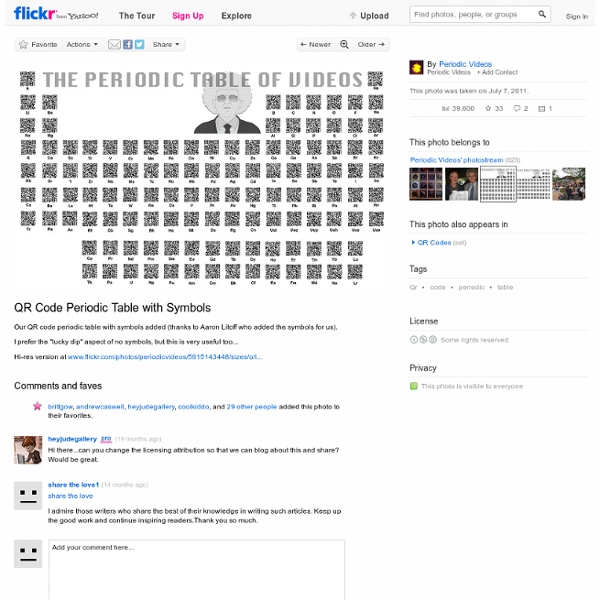
Database of Periodic Tables There are hundreds of periodic tables in web space, but there is only one comprehensive database of periodic tables & periodic system formulations. If you know of an interesting periodic table that is missing, please contact the database curator: Dr Mark R Leach. Harrington Periodic Tables So we start this effort tabula rasa (without preconceived ideas). 1) All atoms have a default "common denominator" structure at 270 mass units, irrespective of the element under discussion. Top of Page KAS Periodic Table The KAS periodic table reproduces and depicts the nuclear properties of chemical elements. The Segre Chart is based on the number of protons, Z, and the number of neutrons, N. Location that remains near the Neutron Dripline of element. Read more here, here and here. Sensu or Fan Periodic Table By NAWA, Nagayasu – A Japanese schoolteacher and periodic table designer – a "Sensu" or fan periodic table: URENCO Periodic Table Clock Face Periodic Table In 2014 Prof. Triadic Networks © Mark R.
Mindmapping, concept mapping and information organisation software Articles This is the start of a historical survey of visual mapping. It kicks off with one well-known classic example, and follows up with a very interesting map that has more recently come to my attention. I've written about origins of mind mapping before, but now I'm assembling samples. I've also mentioned elsewhere (see the comments) that I'd like to get samples of Idea Sunbursting that Dr. Perusek wrote to me about. I preserved it in Freezepage when Google closed down Knol. There's a lot to like in the (unrestrained!)
About Us - FAQ Don’t see the answer you’re looking for? Or are you a designer, animator, or journalist looking to partner with Visually? Our team is standing by! What are data visualizations? Data visualizations represent numerical data in a visual format. What are infographics? Infographics are images created to explain a particular idea or dataset. What are interactive data visualizations? Interactive data visualizations allow a user to explore a dataset for themselves. What are motion graphics? Motion graphics are often very similar to infographics. How are these visuals created? Data visualizations can be created by a variety of software/programs, both those designated for data visualization and those that are not. Can I trust all these visualizations? Most visualizations can be trusted, but think critically about them and how they represent the data. What can I do with these visualizations? Visualizations can be useful in our day-to-day lives, for educational purposes or just for pure entertainment.
2. Engaging with communities Chapter 2: Engaging with Communities Community understanding of children’s learning The wider world of family and community is a fundamental part of the early childhood curriculum and is mutually supportive of the well being of whānau/families, local communities and neighbourhoods. Making children’s learning experiences visible ensures that parents and whānau gain an understanding of those learning experiences, which in turn empowers children to become self-directed learners. Families should be part of the assessment and evaluation of the curriculum as well as of children’slearning and development. During the research process, many services investigated methods that were incorporated into the curriculum. forging, enhancing and maintaining links with the family/whānau and the wider world, in order to make children’s learning visiblegiving children increasing opportunities to see themselves as valued members and contributors of their community. The projects Outcomes More than just play Outcomes
Chemistry | 5.112 Principles of Chemical Science, Fall 2005 | Video Lectures | Lecture 26: Molecular Orbital Theory Hello Hello I’m David McCandless, a London-based author, writer and designer. I’ve written for The Guardian, Wired and others. These days I’m an independent data journalist and information designer. I’m interested in how designed information can help us understand the world, cut through BS and reveal the hidden connections, patterns and stories underneath. My pet-hate is pie charts. Our mission Myself, and the rest of the crack team here at Information is Beautiful, are dedicated to distilling the world’s data, information and knowledge into beautiful, interesting and, above all, useful visualizations, infographics and diagrams. Who funds us? This site is entirely funded by sales of images, posters and books. Stay in touch @infobeautiful (just infographics)@mccandelish (details of my tawdry life too)This site’s RSS Web FeedFacebook email: pa [dot] david [dot] mccandless [AT] Gmail [dot] com. Want to know more? » I created the Helicopter Game, the most addictive game on the internets.
Méthode corrective pour aborder les gros problèmes de discipline Voici une méthode corrective spécifique en dix étapes que l'on peut appliquer à n'importe quelle forme d'inconduite. Cette méthode incorpore les éléments d'un certain nombre d'approches et elle se présente sous forme de suite logique de gestes que l'enseignant, l'ensignante et la direction de l'école peuvent poser. Au cours de ce processus, la responsabilité individuelle de l'élève est portée au maximum. 1. 2. 3. 4. 5. Ainsi, on élabore un plan de changement que les deux parties acceptent de respecter. 6.CONTRAT DE COMPORTEMENT ÉCRIT : Préparez un contrat de comportement écrit avec l' élève : - Identifiez clairement le comportement à acquérir 7.CONSQUENCES LOGIQUES : Appliquez immédiatement les conséquences logiques après I'inconduite : - Offrez un choix : cesser le mauvais comportement ou accepter les conséquences 8.RETRAIT DE L' ÉLÈVE : Si l'inconduite se poursuit, le retrait de l'élève est l'étape suivante. 10. PedagoNet
letsgetengaged - home