Best interactive iPad books of 2011 for kids of all ages - iPhone app recommendations - Lisa Caplan All of these best iPad books for kids use digitization to enhance the reading experience, not divert attention from it. Where there are frills, I prefer to see them focus on education instead of playtime. There are great books for pre-schoolers but also for older kids, a somewhat under-served sector. And, for those aimed at school-aged readers, I primarily looked for educational offerings, since there are iBooks, eBooks and digital comics for fiction fans. Here are eight amazing iPad reading apps for kids from 2011. Another Monster at the End of This Book… Starring Grover & Elmo ($3.99) This classic Sesame Street book is a sequel to The Monster at the End of This Book. The Fantastic Flying Books of Morris Lessmore ($4.99) This adaptation from the short film which shares its name, was the most delightful surprise of the year. Auryn - The Little Mermaid ($0.99) The prose is the original by Hans Christian Andersen, so what’s not to love? There’s No Place Like Space!
BBC Learning English | Pronunciation Tips Teaching English Pronunciation I've met teachers who believe "there's no point in teaching English pronunciation as it cannot be taught. Talented students pick it up - the rest don't." English coursebooks make the same point with their silence. Apart from a few exercises on word stress or individual sounds - and then only in the better books - they ignore pronunciation. Despite the above comments, I know from my own experience that clear pronunciation can be taught - and that when it is taught the students listening will improve too. I want to be clear that I'm not trying to make my learners sound like the Queen of England or the President of the United States - or even like me. What needs teaching? In teaching English pronunciation the students generally need work in several areas. Individual Sounds - Background Teaching English pronunciation involves a giving a lot of listening practice at the beginning. Remember that sounds and letters are different. Individual Sounds - ESL Pronunciation Activities Word Stress
Adrian’s Pron Chart Blog Pronunciation Activities Minimal Pairs Click here to see a selection of ideas to practise minimal pairs (words which differ in only one sound, such as "cat" and "cut"). There is also a minimal pairs list here if you want some ideas to use with the activities. Sss, zzz and shhh Click here for an activity to practise the sounds sss, zzz and shhh which can be a problem for most nationalities. Homophones Click here for a worksheet to practise identifying and distinguishing between the spellings of 16 common homophones Short Vowels (a, e, i, o and u) handout. A short lesson plan to practise short vowel sounds. Long Vowels (a, e, i, o and u) handout. A short lesson plan to practise long vowel sounds (magic 'e'). Er, or and ah (/ɜ:/ /ɔ:/ and /ɑ:/) activities. Activities to introduce "er", "or" and "ah" sounds, with spelling hints and lots of follow-on practice. Pronunciation of words with "CH" Some ideas for lessons to practise the /tʃ/, /ʃ/ and /k/ pronunciation of the letters 'ch'. Ear and Air - pronunciation of /ɪə/ and /eə/
Kid Safe Browsers for iPad and iPhone by Natalie Parents know that it’s not safe to allow children unrestricted access to the internet. You wouldn’t let little Jimmy run around all willy-nilly in a strange city and you surely wouldn’t allow anything of the sort in cyberspace, right? The issues with internet access and children come in many forms. With the growing popularity of internet access to mobile devices like the iPad, iPhone and iPod Touch, monitoring internet activity isn’t so easy as plopping the computer in the living room and keeping a watchful constant eye over young shoulders. Fortunately, the tech world has heard the rally cries of concerned parents and a number of kid-safe browsers are available to allow your child internet access in a safe manner. Quintura KidsPrice: $1.99 Available for a very affordable $1.99, Quintura Kids aims to make searching the web an educational process for children. Websites available through the browser are determined through a number of factors.
IPA Palette IPA Palette v2.2 Mavericks Prerelease IPA Input Method for Mac OS X 10.5 and later Licensed under the GPL Download IPA Palette 2.2 (3.2M). Finally! For Mac OS X 10.2-10.4:Download the previous IPA Palette 2.0 (1.3M).Download the previous IPA Palette 1.0 (616K). Bugs Fixed in 2.2 No longer use an installer; for Mavericks compatibility we now have an app called IPA Manager that will install IPA Palette for you. New Features in 2.2 You can click in an unoccupied part of an image map (a part that has no IPA symbol and thus doesn't hilite under your mouse) and drag it out into a new mini-palette (I call them "auxiliaries"). Bugs and Potential Problems IPA Manager is not fully localized in this prerelease version.The PDF icon used in Snow Leopard and later doesn't hilite (invert to white on black) correctly in the International menu, although it does in the Pref Pane. What Folks Are Saying IPA Palette does exactly what a linguist would want, exactly the way a linguist would want it.
Breaking News English ESL Lesson Plan on Accents A recent survey in the UK has found that regional accents can be “bad for business”. Professor Khalid Aziz, a specialist in communication for business executives, questioned people in high-level management to find out their opinions on regional accents. He discovered that non-English accents are better for business success in England. Speakers with an American, Scottish, Indian or Asian accent are preferred to speakers with a regional variation. Professor Aziz said: “Although it may not be [acceptable] to believe that accents matter nowadays, it is very [clear] from our research that…prejudices still exist.” The survey also reports that business people think speakers with Indian or Asian accents are more trustworthy and reliable than speakers with American or British accents. 1. 2. 3. Surveys / business managers / regional accents / high level / prejudices / trustworthiness / Indian accents / executives / Queen’s English / Scotland Have a chat about the topics you liked. 4. 5. 6. 1. 2.
P is for Pronunciation Read my lips I’ve just completed a nine-hour block of sessions on phonology on the MA TESOL course that I’m teaching at the New School. Apart from the inevitable (and sometimes intractable) problems involved in reconfiguring my knowledge of phonology so as to accommodate North American accents, the question that simply will not go away is this: Can pronunciation be taught? As a teacher, I have to confess that I can’t recall any enduring effects for teaching pronunciation in class – but then, I very seldom addressed it in any kind of segregated, pre-emptive fashion. Most of my ‘teaching’ of pronunciation was reactive - a case of responding to learners’ mispronunciations with either real or feigned incomprehension. As a second language learner, any attempts to improve my pronunciation have fallen (almost literally) on deaf ears. In An A-Z of ELT, I hint obliquely at these doubts – doubts which I claim are justified by research studies. Well, here’s one for starters. References:
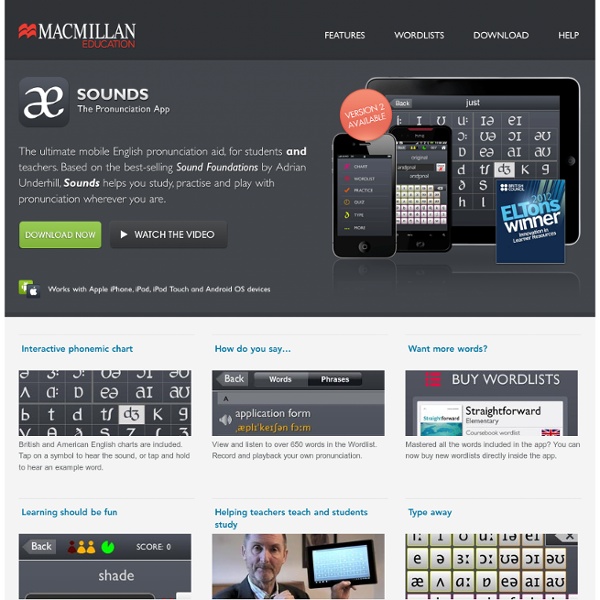
Sounds: The Pronunciation App You can look up and listen to words and phrases in the WORDLIST, plus record and compare your own pronunciation. If you’re using a Macmillan coursebook, you can now buy additional wordlists directly inside the app. PRACTISE your pronunciation reading, writing and listening skillsTest yourself with one of the pronunciation QUIZZESLEARN with lesson plans, videos and top tips for teachers, and study hints for students ► Interactive Phonemic Chart (British and American English) with high quality audio - tap to hear a sound, or tap and hold to hear the sound and an example word.► Work in British or American English, and switch between them at any time.► Vocabulary Wordlist (with over 650 words):- Phonemic transcriptions and audio- Record your own pronunciation- Purchase new wordlists from directly inside the app. - Bug fixes for error when updating app. The ultimate interactive English pronunciation tool, for both students AND teachers.
Teaching Kids with iPads – Part 1 of 5 | Elementary School Tech Ideas #edtech #edchat How to you teach these kids? A few months ago I took a survey of my elementary kids to see what kind of mobile technology they had at home and it turned out that 53% of my students in 3rd, 4th, and 5th grades had iPads and 82% had iPods! How do I teach students with iPads? So I called my friends over at Atomic Learning to brainstorm some ideas and we both agreed that this was a question worth answering. Planning iPad Projects: The first thing I did to get ready for my iPad Boot Camp was to start designing iPad projects, projects that were designed with a focus on Bloom’s Digital Taxonomy and the principles of UbD. Day One of iPad Boot Camp: So after two months of project planning, I started the iPad Boot Camp this past Monday with 10 students in the 3rd, 4th, and 5th grades to see how to teach students with iPads. Teaching with my iPad using Airplay. Sense of Purpose using Puppet Pals: our first project gave the students this challenge… Here are some photos from that project:
Explore | English Language Training Solutions How Does It Work? The Color Vowel™ Chart represents the vowel sounds of North American English. Each color in the Color Vowel™ Chart represents a single vowel sound. Each sound has a color name (such as GREEN) and a key word (such as TEA). The corresponding vowel sound is featured in both words. Explore Our Interactive Chart While the Color Vowel™ Chart appears simply to depict individual vowel sounds, it does much more than that. Here, it is important to focus on a fundamental rule of spoken English: each word has exactly one primary stressed syllable, and at the nucleus of that syllable is a vowel sound. One-syllable words contain one vowel sound (even if a word contains more than one vowel letter). The Color Vowel™ Chart provides teachers and learners with an accessible shorthand for talking about spoken English. Here’s an example taken from the classroom: Student: How do you say this word? Student: [who has already been introduced to the Color Vowel Chart] Um,… white.
English-speaking countries Have you ever wondered why you have to learn English at school? Did you know that the world speaks English? Do you know how many countries in the world have English as an official language? First, you need to know the origins and history of the English language. Visit the links on the left in the correct order to find out many interesting facts and figures about English, and try to answer these questions (you may want to copy the questions into your notebook or print them out to make your work easier): 1. After the hard work, have fun watching the four videos and discover how different English sounds in England, Australia, the USA and India.
Core activities for using the chart to integrate pronunciation In this article I’d like to speak to those teachers and offer you a basic method for using the chart, in fact a single core activity that powers up the chart, and from of which multiple other activities can be derived according to what you are doing. It is essentially a form of visual dictation, and once you get the hang of it you can adapt it to bring out the pronunciation content in any activity you are doing, without need for other materials. But before we start let me clarify that there are two steps to integrating the chart into the heart of language work. Step 1 involves introducing the chart and its sounds to students, a process which will take you an hour or so across two or three lessons with your class. That is enough to get the chart into circulation as a fully functioning learning tool. Now all that is just for a sound. You write the word in normal alphabetic spelling on the board, and you say the word. Point out the first word on the chart. And five top tips