

VOD, Netflix capte 30% du trafic Internet américain Selon une étude publiée par Sandvine, le service de location de vidéo en ligne Netflix est devenu si populaire aux Etats-Unis qu’il représente aujourd’hui 30% (29,7 exactement) de la consommation de la bande-passante américaine. «Netflix est désormais le roi indiscutable de la bande passante en Amérique du Nord», note l’étude. Pour ses auteurs, cette bascule confirme que «nous sommes désormais dans l’âge de la vidéo par Internet». «Les abonnés ont clairement adopté le service de vidéo en ligne de Netflix, modifiant fondamentalement le paysage Internet», estime Sandvine. Et le changement sera durable, le développement des terminaux mobiles comme l’iPad et des décodeurs numériques comme Roku et Boxee devant tirer davantage encore l’utilisation de Netflix aux États-Unis. 23,6 millions d’abonnés Lors de la précédente vague de l’étude, publiée à l’automne 2010, Netflix ne captait encore «que» 20,61% du trafic Internet aux heures de pointe. Sur le même sujet :
25 Ways To Plot, Plan and Prep Your Story I’m a panster at heart, plotter by necessity — and I always advocate learning how to plot and plan because inevitably someone on the business side of things is going to poke you with a pointy stick and say, “I want this.” Thus you will demonstrate your talent. Even so, in choosing to plot on your own, you aren’t limited to a single path. The Basic Vanilla Tried-And-True Outline The basic and essential outline. The Reverse Outline Start at the end, instead. Tentpole Moments A story in your head may require certain keystone events to be part of the plot. Beginning, Middle, End Write three paragraphs, each detailing the rough three acts found in every story: the inciting incident and outcome of the beginning (Act I), the escalation and conflict in the middle (Act II), the climactic culmination of events and the ease-down denoument of the end (Act III). A Series Of Sequences Chapter-By-Chapter For novel writers, you can chart your story by its chapters. Beat Sheet Mind-Maps Zero Draft Dialogue Pass
Simon Staffans: How to make your Transmedia project a reality July 4, 2011 OK, so your transmedia concept is ready to go. What next? Some tips from our resident expert By Simon Staffans Judging from eager conversations on conferences, amongst industry people and on blogs, Twitterfeeds and Facebook discussions, transmedia will not be going away in the foreseeable future. No wonder then that new transmedia projects are springing up left and right; from big marketing campaigns ahead of major television series (Game of Thrones, photo) to more stand-alone web-based ventures (Robert Pratten’s Lowlifes comes to mind as a great example from earlier this year). The question I’ll try to answer in this post is the very logical follow-up question – I have a great transmedia project; now what do I do with it? Firstly, there are as many approaches as there are transmedia projects. Is it what you think it is? Finally, hope for the best, and if it does get going, be prepared to work really really hard for a really really long time!
The Storytelling Mandala: Purpose-Inspired Transmedia Storytelling | Gauravonomics Marketers have always used stories to share information, change opinions and influence decisions. Now, as people create, consume and share brand stories in new ways, marketers need to go beyond the 30-sec product ad or the 300-word press release, and tell purpose-inspired transmedia stories that inspire, organize and energize people. Six Trends in Storytelling Let’s start by recapturing the six important trends that are reshaping how people create, consume and share brand stories: These six trends play an important role in the narrative arc we will draw next: from Hero’s Journey to Heroes to Everyday Heroes. From Hero’s Journey to Heroes to Everyday Heroes Heroʼs Journey: Storytelling The Heroʼs Journey is a good example of a monomyth, or a universal story, that cuts across all types of stories, including myths, movies, novels, and ads. According to Joseph Campbell, all stories follow the same three-part narrative structure of the Hero’s Journey. Heroes: Transmedia Storytelling
Hollywood Second-Guessing Comic-Con, Could Viral Marketing Be Next? The New York Times ran a piece yesterday about how movie studios are taking a more cautious approach to this year’s San Diego Comic-Con. After propelling the comic book convention into the mainstream in recent years, why are they turning away now? Also, what could this shift in priorities mean for viral marketing? Read my thoughts after the break. Why this sudden exodus from the mecca of geek culture? The timing isn’t very good for films either, as the late July timeframe doesn’t help most films coming out that summer and may be too early for next summer’s blockbusters. Fortunately, some studios look to take advantage as well, with Universal’s Cowboys & Aliens having a “serious stunt”, The Amazing Spiderman planning a big promotion, and other films from Paramount, Lionsgate, and Summit hosting panels. What could this mean for viral marketing in general? What do you think about this news? Apparently, the “serious stunt” for Cowboys & Aliens is in fact the film’s world premiere. Comments
Who is the Transmedia Producer | mayazuckerman.com Blog Posted in Blog on Tuesday, November 8th, 2011 at 6:29 am When I first heard the concept of Transmedia something awoken in me. The concept of orchestrating media was not alien to me. As a visual effects artist I have worked in everything from Film, animation, commercials, games, online, offline, television, creating, producing and directing and a stint in stop motion – years and years ago. But the concept of being intentional on how to spread your storyworld in the brave new world of multiscreens was extremely exciting to me. How would I fit in this world? What is the role I should play? Enter the Transmedia Producer!!! So how do you become one – that is what I embarked on discovering. There are so many amazing people online you can learn from. But the work of my dear friend Robert Pratten of truly gave me a clear sense of how to approach it. Karina Halpern of called it the synthesys – the person that helps all of it comes together.
Les programmes transmédia s'apprêtent à débarquer Une série de TF1 dont les téléspectateurs peuvent influencer le scénario sur le blog de l'héroine. Une websérie non-linéaire sur Arte, dont les personnages existent sur Facebook et Twitter, et dont les spectateurs peuvent naviguer entre une centaine de modules diffusés sur le web et le mobile, dans l'ordre ou le désordre. Un jeu qui s'articule autour d'un site communautaire, d'une série télé et d'un jeu de cartes à collectionner... Tous ces objets audiovisuels non identifiés ont un point commun : ce sont des contenus transmedia. Un vocable encore peu répandu, mais qui correspond à une évolution bien réelle du divertissement, à l'heure du téléspectateur et de l'internaute multitâches. Il ne faut toutefois pas confondre le transmedia avec le crossmedia, qui consiste à décliner un même contenu sur plusieurs plateformes. Jean-François Rodriguez est directeur jeu et transmedia chez Orange. Pourquoi Orange s'intéresse-t-il au transmedia ? Comment agissez-vous ?
Ma "big interview" dans Technikart En décembre dernier, le magazine Technikart a publié la "big interview de Henri Verdier" dont Cap Digital a mis en ligne une version PDF. Mais le texte n'est pas encore disponible sur la toile. Or, à la relecture, ce dialogue avec Olivier Malnuit couvre une grande part des problèmes économiques et sociaux qui brident encore le développement de cette industrie. C'est pourquoi je suis heureux de le partager avec vous. Henri Verdier, il y a dix ans, les start-up croulaient sous les investissements. Vous croyez ? Que va-t-il se passer, d’ici quelques années, si on n’aide pas plus les « jeunes entreprises innovantes » ? Comment ça ? Quel rôle peuvent jouer les pôles de compétitivité ? Quel sera le gros virage technologique de ces quatre prochaines années ? Vous avez des exemples ? D’autres tendances ? Et ça changera quoi si personne ne bouge ? Pourquoi, dès qu’on parle d’innovations Internet, a-t-on toujours l’impression que le monde s’arrête et commence aux Etats-Unis? Encore !?
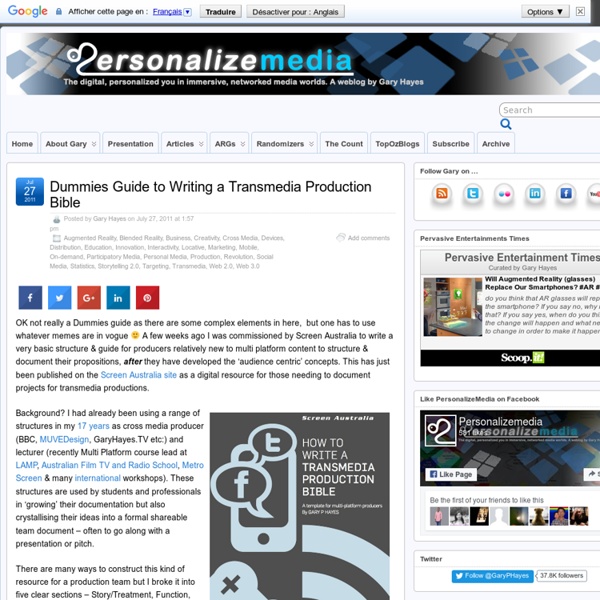
The Pixel Lab 2011 The Pixel Lab 2011 The Cross-Media Workshop with the support of the MEDIA Programme of the European Union, Medienboard, TorinoFilmLab, Skillset Film Skills Fund, ARTE, MEDIA Antenne Berlin-Brandenburg. Strategic partners EAVE, media.net The Pixel Lab is a European training hub set up to equip producers, storytellers and media professionals with the skills to create, produce and finance cross-media properties – stories that can span a combination of film, TV, online, mobile, interactive and gaming. WORKSHOP 1 Residential Week: 26 June-2 July 2011, Potsdam A residential 6-day-long workshop for 32 participants, half of whom are producers attending the lab with a project, took place at the 4* Resort Schwielowsee. DISTANCE LEARNING July – September 2011 (Producers with projects only) Producers attending with a project received distance learning from two cross-media experts to devise a selling document to take their project to the next stage.
Promouvoir le contenu Transmedia Promouvoir le contenu Transmedia janvier 14, 2011 Mise à jour 15/01 À l’heure actuelle, nous sommes à la pointe de l’iceberg créatif du Transmedia ; il y a déjà eu certaines implémentations intéressantes, mais ce n’est rien comparé à ce que nous verrons au cours des prochaines années et au-delà. En conséquence, il semble presque absurde de sauter la question du développement du Transmedia pour examiner comment les fils des histoires Transmedia – ces parties d’histoires non primordiales qui ajoutent à la narration globale – devrait être commercialisées. La question portait sur deux sorties simultanée de Disney, (jeu vidéo) et (film). Comme le montre le podcast Transmédia de la semaine , l’ère de la mise en ligne régulière d’histoires importantes sur les plates-formes autres que la plate-forme principale est sans doute terminé, à cet égard, les suites de ont été en avance sur leur temps. Argent et coût d’opportunité La préférence pour un résulta à court terme No related posts.
L’industrie du jeu vidéo parie sur des oeuvres transmedia Sur un marché ultra compétitif, comment faire pour vendre un jeu au-delà de sa cible traditionnelle ? La réponse du moment : faire du jeu une œuvre transmedia, avec tout autour des « compléments d’histoire » (BD, roman, jeu ad hoc sur les médias sociaux etc.). C’est en tout cas la stratégie marketing de Homefront, FPS qui sort en mars 2011 et qui était présenté, la semaine dernière, à Paris Game Week Du storytelling dans les FPS Contrairement à ce qu’on pourrait penser, l’histoire n’est plus pas à négliger dans les FPS. Au-delà du gameplay, le contexte narratif permettant d’introduire le jeu est un terrain idéal pour asseoir une véritable histoire. [youtube] Complémentaire et maline, la distribution d’un faux journal, « Le Resistant » permettait aux visiteurs du salon de plonger encore plus dans l’histoire. Mais tout cela ne représente que des bribes de la stratégie transmedia de Homefront. Un roman pour vendre un jeu ? Alors quels sont les avantages ?