

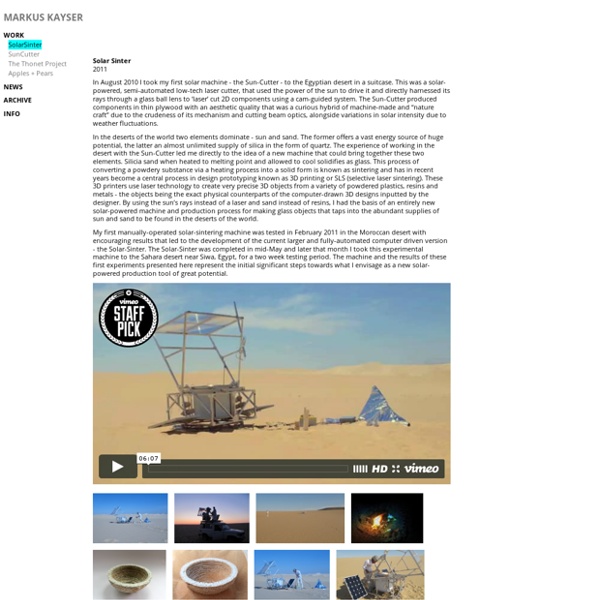
http://www.markuskayser.com/work/solarsinter/
Qu’est-ce qu’une piratebox? Bonjour et bienvenu à tous vous voici sur notre nouveau site pirateboxfr, ce site est consacré au phénomène qui commence à prendre pas mal d’ampleur en france: la piratebox. Pour ce ceux qui ne saurait pas ce que c’est je vous explique les grandes lignes: le but est de créer un espace de libre échange, une bulle hors de tout chemin battu et hors de la juridiction de autorités. C’est dans ce but qu’un américain, David Darts à décider de créer une boite permettant cela, il la baptisée piratebox. Maintenant entrons dans la partie un plus technique, vous vous demandez comment il a fait? Et bien c’est assez simple il vous suffit de posséder un routeur le plus petit étant actuellement le TP-MR3020 qui est une petite boite blanche de 6,5cm sur 7cm, il vous faut aussi une clé USB et une batterie pour pouvoir être nomade.
Markus Kayser Builds a Solar-Powered 3D Printer that Prints Glass from Sand and a Sun-Powered Cutter Industrial designer and tinkerer Markus Kayser spent the better part of a year building and experimenting with two fantastic devices that harness the sun’s power in some of the world’s harshest climates. The first he calls a Sun Cutter, a low-tech light cutter that uses a large ball lens to focus the sun’s rays onto a surface that’s moved by a cam-guided system. As the surface moves under the magnified light it cuts 2D components like a laser. The project was tested for the first time in August 2010 in the Egyptian desert and Kayser used thin plywood to create the parts for a few pairs of pretty sweet shades.
The Hole NYC » KATSU DRONE PAINTINGS OPENING preview: Thursday, April 10 6-9:30pm Open to the public Friday, April 11 11- 8pm Saturday, April 12 11-8pm Sunday, April 13 11-6pm L'extraordinaire imprimante 3D qui fabrique des objets à l'aide du soleil et de sable Vous avez aimé la Strati, première voiture créée grâce à une imprimante 3D ? Vous risquez d'adorer cette nouvelle imprimante 3D. Ce qui est surprenant, ce n'est pas ce qu'elle fabrique, mais la façon dont elle le produit. Markus Kayser, un artiste allemand basé à Londres et spécialisé dans les meubles a monté un projet complètement fou : l'impression 3D d'objets grâce à du sable et de l'énergie solaire. Et le plus impressionnante, c'est que cela marche.
Le MIT invente un web anti-NSA 01net le 26/03/14 à 19h06 Les révélations d’Edward Snowden, tout comme les désormais innombrables vols de données le prouvent : les sites web ne sont pas suffisamment sécurisés pour héberger des informations sensibles. C’est pourquoi une équipe de chercheurs du Massachusetts Institute of Technology (MIT) propose une nouvelle architecture web baptisée « Mylar », taillée sur mesure pour résister aux assauts des espions et des cybercriminels. Solar System Exploration Research Virtual Institute Building a base on the moon could theoretically be made much simpler by using a 3D printer to construct it from local materials. The concept was recently endorsed by the European Space Agency (ESA) which is now collaborating with architects to gauge the feasibility of 3D printing using lunar soil. “Terrestrial 3D printing technology has produced entire structures,” explained Laurent Pambaguian, heading the project for ESA. “Our industrial team investigated if it could similarly be employed to build a lunar habitat.” According to Pambaguian, ESA’s partners have devised a weight-bearing “catenary” dome design with a cellular structured wall to help shield against micrometeoroids and space radiation – incorporating a pressurized inflatable to shelter astronauts. Meanwhile, a hollow closed-cell structure – somewhat reminiscent of bird bones – provides a combination of strength and weight.
Massoud Hassani, l'afghan qui rêve de déminer le monde L’invention Mine Kafon est un outil supplémentaire contre le déminage. La Mine Kafon qui progresse à la force du vent peut enclencher une mine antipersonnel pour explosion tout en poursuivant sa route. Cette grosse boule composé de 70 tiges de bambou et d’un GPS permet de tracer des chemins déminés. À chaque utilisation, et pour coût de 40 euros, 3 ou 4 mines peuvent être désamorcées. L’Afghanistan possède un sol riche qui ne demande qu’à être exploité par la population locale (on y recense le diamant, lapis-lazuli, le saphir, gaz naturel, pétrole, le tungstène, le lithium, l’étain etc.) Cependant, les guerres successives ont laissé un pays criblé de mines antipersonnel.
Semi—Living Food and “Disembodies Cuisine” Semi-Living Food: “Disembodied Cuisine” Another way of treating living systems is by consuming them as food. Throughout history many humans have practiced some kind of division among living entities which are categorized as food or others (such as pets, ornaments, work etc.). These divisions are not always clear, and we must practice some kind of hypocrisy in order to be able to love and respect living things as well as to eat them. Our latest project titled ‘Disembodied Cuisine’ will be shown in an international biological art exhibition” L’art Biotech’ in Nantes, France March 2003. In the “Disembodied Cuisine” we will attempt to grow frog skeletal muscle over biopolymer for potential food consumption.
Stealth Wear Stealth Wear was exhibited at TANK Magazine HQ in London in January 2013. Presented by PRIMITIVE LONDON. Summary Collectively, Stealth Wear is a vision for fashion that addresses the rise of surveillance, the power of those who surveil, and the growing need to exert control over what we are slowly losing, our privacy. Building off previous work with CV Dazzle, camouflage from face detection, Stealth Wear continues to explore the aesthetics of privacy and the potential for fashion to challenge authoritarian surveillance.
We Hate the Users: An Interview with UBERMORGEN Several decades after the birth of artivism and net art, UBERMORGEN continue to make art with and about networked society. But where net art 1.0 was largely critical of capitalism’s use of networks, today UBERMORGEN’s tactics work through an aesthetics of affirmation. Interview by Stevphen Shukaitis Critical Engineer The Critical Engineer considers Engineering to be the most transformative language of our time, shaping the way we move, communicate and think. It is the work of the Critical Engineer to study and exploit this language, exposing its influence. – The Critical Engineering Manifesto CV Dazzle CV Dazzle was developed as my masters thesis at the Interactive Telecommunications Program at NYU. The goal of this ongoing research project is to create a growing catalog of designs and techniques that can be employed as camouflage against face detection. Project Summary CV Dazzle explores how fashion can be used as camouflage from face-detection technology, the first step in automated face recognition. CV Dazzle is form of expressive interference that takes the form of makeup and hair styling (or other modifications).
Newstweek Network intervention. Reality distortion device, 2011 Newstweek is a device for manipulating news read by other people on wireless hotspots. Built into a small and innocuous wall plug, the Newstweek device appears part of the local infrastructure, allowing writers to remotely edit news read on wireless devices without the awareness of their users. The project, developed in collaboration with Daniil Vasiliev, won the prestigious Golden Nica in the Interactive Art category at Ars Electronica in 2011. While news is increasingly read digitally, it still follows a top-down distribution model and thus often falls victim to the same political and corporate interests that have always sought to manipulate public opinion.