

Salem Witchcraft: the Events and Causes of the Salem Witch Trials By Tim Sutter © 2000-2003 What caused the Salem witch trials of 1692? This question has been asked for over 300 years. Although it is a simple question, it does not have an easy answer. Salem Politics Salem Village had a very colorful history before the famous witch trials. Many of the Salem Village farming families believed that Salem Town’s thriving economy made it too individualistic. The Putnams were the leaders of the separatist group primarily because they owned the most farmland in Salem Village. Contracts for ministers during this period often provided them with a modest salary, use of a house, and free firewood. In October of 1691 a new Salem Village Committee was elected that was comprised mostly of Parris’ opponents. Cold Winter Days The Rev. After chores were done, there was little entertainment for Betty and Abigail. Reading was a popular pastime during the winter months. Betty Parris, her cousin Abigail Williams, and two other friends formed such a circle. Salem Witchcraft
The 1920's - Roaring Twenties - The Nineteen Twenties in History Massachusetts PA Civil War Soldiers - 88th Regiment Co. B - Free Pennsylvania Genealogy Recruited in Berks County, Pennsylvania Neversink Zouaves 88th PA Regiment Co. B Captain Henry A. Source: Bates, Samuel P. Search PA Civil War Religion and the Founding of the American Republic | Exhibitions This exhibition demonstrates that many of the colonies that in 1776 became the United States of America were settled by men and women of deep religious convictions who in the seventeenth century crossed the Atlantic Ocean to practice their faith freely. That the religious intensity of the original settlers would diminish to some extent over time was perhaps to be expected, but new waves of eighteenth century immigrants brought their own religious fervor across the Atlantic and the nation's first major religious revival in the middle of the eighteenth century injected new vigor into American religion. The result was that a religious people rose in rebellion against Great Britain in 1776, and that most American statesmen, when they began to form new governments at the state and national levels, shared the convictions of most of their constituents that religion was, to quote Alexis de Tocqueville's observation, indispensable to the maintenance of republican institutions.
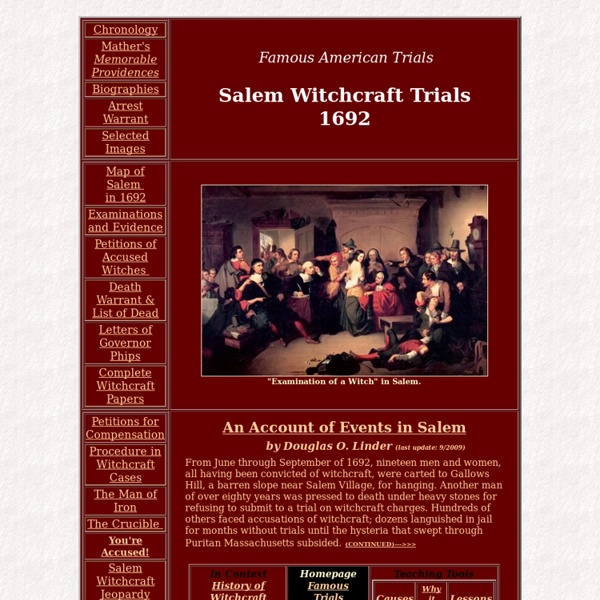
The Salem Witch Trials, 1692 The Salem Witch Trials, 1692 The seeds of the hysteria that afflicted Salem Village, Massachusetts were sown in January 1692 when a group of young girls began to display bizarre behavior. The tight-knit community was at a loss to explain the convulsive seizures, blasphemous screaming, and trance-like states that afflicted the youngsters. In February the village began praying and fasting in order to rid itself of the devil's influence. In March the afflicted girls accused Martha Corey. Friday March 11, 1692 was a day of fasting and prayer in Salem. "On, Monday, the 21st. of March, the magistrates of Salem appointed to come to examination of Goodwife Corey. The number of the afflicted persons were about that time ten, viz. four married women: Mrs. It was observed several times that if she did but bite her underlip in time of examination, the persons afflicted were bitten on their arms and wrists and produced the marks before the magistrates, ministers, and others.
Remembering Pearl Harbor: The USS Arizona Memorial Today the battle-scarred, submerged remains of the battleship USS Arizona rest on the silt of Pearl Harbor, just as they settled on December 7, 1941. The ship was one of many casualties from the deadly attack by the Japanese on a quiet Sunday that President Franklin Roosevelt called "a date which will live in infamy." The Arizona's burning bridge and listing mast and superstructure were photographed in the aftermath of the Japanese attack, and news of her sinking was emblazoned on the front page of newspapers across the land. The photograph symbolized the destruction of the United States Pacific Fleet at Pearl Harbor and the start of a war that was to take many thousands of American lives. Indelibly impressed into the national memory, the image could be recalled by most Americans when they heard the battle cry, "Remember Pearl Harbor." More than a million people visit the USS Arizona Memorial each year.
Lesson Plans In January 1692, the Salem witch trials began and changed life dramatically for the small farming community of Salem Village, part of the Massachusetts Bay colony. Believing themselves God's chosen people, the Puritan inhabitants of the village followed a strict Puritan code of hard work and religious devotion. They remained vigilant to the workings of the devil in their everyday lives and were dedicated to rooting out evil wherever they perceived its existence. However, the restrained and solemn appearance of the Puritan village belied fundamental economic, political, and interpersonal difficulties, which wrought fear, mistrust, and uncertainty throughout the community. After being regaled with magical tales of the West Indies by a Barbados-born slave named Tituba, two young Puritan girls began exhibiting peculiar symptoms, ranging from catatonic states to bodily contortions. Students will be able to: Standard 2B Standard 1: Language for Information and Understanding Standard 8 Web sites:
Seneca Indians The Seneca people living in Ohio during the eighteenth and nineteenth centuries were related to the Seneca tribe of New York. The Seneca in New York were one of the most powerful members of the Iroquois confederacy. As the westernmost members of the Iroquois Confederacy, the Seneca were known as the "Keepers of the Western Door." The Ohio Seneca spoke the Iroquois language. Many of these the group that became known as the Ohio Seneca left New York, hoping to find a better life in the Ohio Country. The Ohio Seneca came to live along the Sandusky River -- along with the Cayuga, the Shawnee, and the Ohio Seneca-Cayuga historically referred to as the "Mingo" -- after the American Revolution. Three bands of Seneca people are federally recognized by the U.S. government: the Seneca Nation of New York in far western New York; the Tonawanda band of Seneca Indians in New York; and the Seneca-Cayuga Indians of Oklahoma. See Also References