Les collections photographiques du musée de Bretagne - Accueil
Le musée de Bretagne collecte des photographies depuis la seconde moitié du 19e siècle. Évaluées à 400 000 négatifs sur verre et films souples et à plus de 13 000 tirages, ces collections sont les plus importantes du musée. Pour la première fois, une partie de ces fonds a été présentée au public à travers l’exposition Reflets de Bretagne – 160 ans de photographies inédites (29 juin 2012 - 06 janvier 2013). Couvrant les cinq départements historiques bretons, elle offrait un large et riche panorama de la Bretagne à travers tirages originaux d’auteurs et prises de vues d’anonymes. A l’occasion de cette exposition, une base de données dédiée aux fonds photographiques du musée a été constituée : elle vous propose près de 13 000 notices et 15 000 images, des années 1840 jusqu’à nos jours. Bon voyage photographique à tous… Tapez un mot ou un groupe de mots. Mosaïque Recherche avancée
The Democratic Party: America's Oldest Party (Snapshots in History): Dale Anderson: 9780756524500: Amazon.com: Books
accueil
«Les Nouveaux Constructeurs», solo exhibition Galerie RX, Paris March 16 - April 25, 2019 Stéphane Couturier, solo exhibition Musée National Fernand Léger - Biot (France) October 6, 2018 - March 4, 2019 Extension until april 29, 2019 « Connectivités », Half permanent Exhibition MUCEM – Marseille November 29, 2017 - December 30, 2020 Sète #18 ImageSingulières Editions Le Bec en l’Air Editions Xavier Barral, Paris « Stéphane Couturier » 200 pages, 25 x 28 cm Festival ImageSingulières, photographic commission - Sète (France) 2017Musée de la Photographie - Charleroi, Belgium Galerie Kornfeld - « So far So close » - Berlin Artothèque - « Alger, Climat de France » - Caen, France ArTsenal, centre départemental d’art contemporain - Rétrospéctive - Dreux, FranceLa Galerie Particulière - «Alger la Blanche» - Bruxelles Musée Nicéphore-Niépce - Chalon-sur-Saône - « Alger, Climat de France » La Galerie Particulière - Paris - « Anaklasis » Paris Photo, Galerie Particulière Booth - Grand Palais, Paris
amazon
Robert Frank Collection Guide
The Collection The Robert Frank Collection at the National Gallery of Art is the largest repository of materials related to renowned photographer and filmmaker Robert Frank. Spanning Frank's career from 1937 to 2005, the collection includes vintage and later prints, contact sheets, work prints, negatives, three bound books of original photographs, technical material, and various papers, books, and recordings. For a complete account of photographs, contact sheets, and work prints in the collection, see Robert Frank photographs, contact sheets, and work prints in the collection. To search the collection by title, key words, credit line, provenance, or accession number, please visit the National Gallery of Art collection search page. Regarding titles: please note that many are descriptive only, derived either from information given by Robert Frank to the National Gallery, or from notes he wrote on the sleeves that held his negatives.
amazon
Musée de la photographie
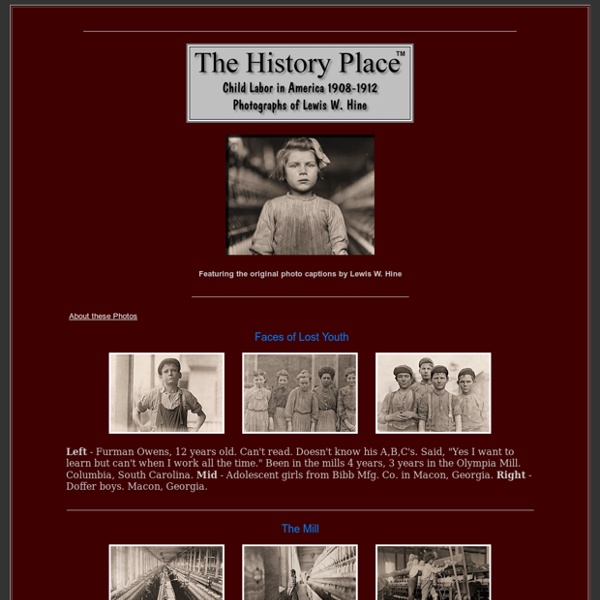
Documenting "The Other Half": The Social Reform Photography of Jacob Riis and Lewis Hine
Progressive Era Reform While the Gilded Age was an era of prosperity for many Americans, economic depressions brought hard times to many businesses and made sporadic employment a reality for the working class. Economic Instability The industrial plants that survived became more demanding in terms of both the speed and the regularity with which their workers produced goods. Increasingly frustrated by unfair demands, many laborers chose to strike. Strikes enabled laborers to express disagreement with the idea of a permanent wage-laboring class. Few working-class citizens were able to own or operate a business, buy property, or upgrade to better housing. Child Labor Reform Concern for the conditions of the poor gave way to a growing interest in the rights of the working class. [4] One of the most persistent causes of Progressive Era reformers was child labor reform. Physical ailments were common. Progressive Era reformers believed that child labor was detrimental to children and to society.
VILLE DE GENTILLY - MAISON DE LA PHOTOGRAPHIE ROBERT DOISNEAU
Loi Pinel à Gentilly (94250) Ville de Gentilly (94250) Programme immobilier en loi Pinel à Gentilly (94250) La ville de Gentilly a pour code postal 94250 et est située dans le Val de Marne (94) et la région île de France. Gentilly est une commune française partagée entre les cantons du Kremlin Bicètre et d'Arcueil. Zone Pinel A bis- Eligible Vous pouvez consulter d'autres villes éligibles à loi Pinel ou donnez votre avis sur les villes qui vous paraissent les plus intéressantes pour investir en loi Pinel. Maison de la photographie Robert Doisneau La maison de la photographie Robert Doisneau lui donna son nom en hommage à sa ville natale Entre autre curiosité architecturale et historique à Gentilly, n'hésitez pas à vous arrêter à la maison de la photographie. En avril 1996, la Maison était inaugurée avec l’exposition-manifeste « Est-ce ainsi que les hommes vivent… », qui présentait 80 photographes, originaires de 17 pays différents, et couvrait une période allant de 1905 à nos jours.
Woodrow Wilson Presidential Library
La photographie sociale
Chacun de nous est concerné par tous les problèmes sociaux et d'environnement. Non seulement parce que rien de ce qui est humain ne doit nous laisser indifférents mais parce que ces problèmes tiennent à la complexité des liens entre les phénomènes et à l'interdépendance des groupes dans le processus d'évolution rapide et de mondialisation de notre époque. Ils touchent - différemment et inégalement - tous les pays. Pour certaines catégories de populations, ils mettent en danger leur existence et hypothèquent leur avenir. Les domaines de la santé, de la démographie ou de l'écologie, par exemple, sont particulièrement caractéristiques de la gravité de ces problèmes et du caractère déjà irréversible de certaines atteintes. Ainsi des espèces disparaissent et notre écosystème se transforme dangereusement.