

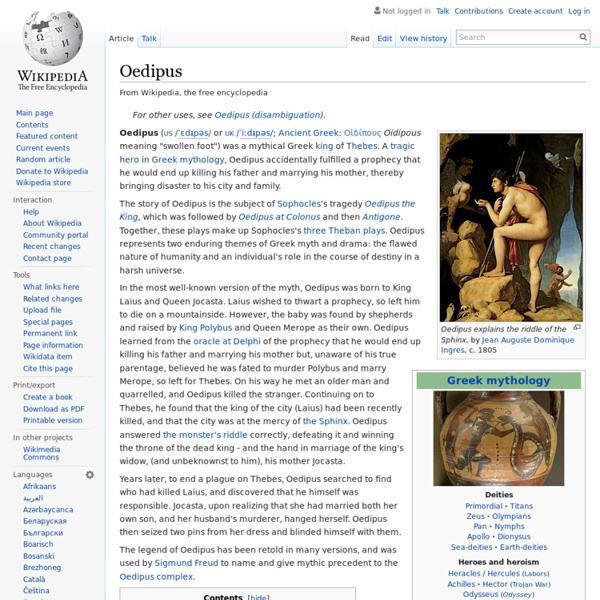
Seven Against Thebes Plot summary[edit] When Oedipus, King of Thebes, realized he had married his own mother and had two sons and two daughters with her, he blinded himself and cursed his sons to divide their inheritance (the kingdom) by the sword. The two sons, Eteocles and Polynices, in order to avoid bloodshed, agreed to rule Thebes in alternate years. After the first year, Eteocles refused to step down and as a result, Polynices raised an army (captained by the eponymous Seven) of Argives to take Thebes by force. The seven attackers and defenders in the play are: Mythic content[edit] The mythic theme passed into Etruscan culture: a fifth-century bronze mirrorback[7] is inscribed with Fulnice (Polynices) and Evtucle (Eteocles) running at one another with drawn swords. The Seven Against Thebes were Allies: Eteoclus and Mecisteus. The defenders of Thebes included See also Epigoni, the mythic theme of the Second War of Thebes Laius, Oedipus and The Sphinx[edit] Notes[edit] ^ Jump up to: a b Smyth, H.W. (1930). A.
Greek primordial deities Genealogy and nature[edit] The primordial gods are depicted as places or realms. A common example is Tartarus, who is depicted as the Underworld, Hell, and a bottomless abyss. Hesiod[edit] According to Hesiod's Theogony (ca. 700 BC): Other sources[edit] Other genealogy structures[edit] Philosophers of Classical Greece also constructed their own metaphysical cosmogonies, with their own primordial deities: Pherecydes of Syros (ca. 600–550 BC) made Chronos (time) the first deity in his Heptamychia.Empedocles (ca. 490–430 BC) wrote that Aphrodite and Ares[citation needed] were the first principles, who wove the universe out of the four elements with their powers of love and strife.Plato (ca. 360 BC) introduced the concept in Timaeus, the demiurge, modeled the universe on the Ideas. See also[edit] References[edit] External links[edit]
IMPORTANCE OF CORAL REEFS - Coral Reefs - Ocean World IMPORTANCE of CORAL REEFS Coral reefs are important for many reasons. Most importantly, they provide protection and shelter for many different species of fish. Without coral reefs, these fish are left homeless with nowhere to live and no where to have their babies. What Destroys Coral Reefs and How Can I Help? Go " FORWARD " to find out! Printer Friendly Page Fibonacci Numbers and The Golden Section in Art, Architecture and Music This section introduces you to some of the occurrences of the Fibonacci series and the Golden Ratio in architecture, art and music. Contents of this page The icon means there is a Things to do investigation at the end of the section. 1·61803 39887 49894 84820 45868 34365 63811 77203 09179 80576 ..More.. The Golden section in architecture The Parthenon and Greek Architecture The ancient Greeks knew of a rectangle whose sides are in the golden proportion (1 : 1.618 which is the same as 0.618 : 1). The Acropolis (see a plan diagram or Roy George's plan of the Parthenon with active spots to click on to view photographs), in the centre of Athens, is an outcrop of rock that dominates the ancient city. Links Modern Architecture The Eden Project's new Education Building The Eden Project in St. California Polytechnic Engineering Plaza As a guiding element, we selected the Fibonacci series spiral, or golden mean, as the representation of engineering knowledge. The United Nations Building in New York Music Art
Theban Cycle Detail of clay group with mythological scene from the Theban cycle, from the area of temple A at Pyrgi, mid-fifth century BC. The Theban Cycle (Greek: Θηβαϊκὸς Κύκλος) is a collection of four lost epics of ancient Greek literature which related the mythical history of the Boeotian city of Thebes.[1] They were composed in dactylic hexameter verse and were probably written down between 750 and 500 BC. The 9th-century AD scholar and clergyman Photius, in his Bibliotheca, considered the Theban Cycle part of the Epic Cycle; however, modern scholars normally do not. The stories in the Theban Cycle were traditional ones: the two Homeric epics, the Iliad and Odyssey, display knowledge of many of them. The most famous stories in the Cycle were those of Oedipus and of the "Seven against Thebes", both of which were heavily drawn on by later writers of Greek tragedy. The epics of the Theban Cycle were as follows: Select editions and translations[edit] Critical editions[edit] Translations[edit]
Golden Ratio in Art and Architecture Golden Ratio in Art & Architecture by Nikhat Parveen, UGA “Mathematics is the majestic structure conceived by man to grant him comprehension of the universe”- LE CORBUSIER One of the strongest advocates for the application of the Golden Ratio to art and architecture was the famous Swiss-French architect and Painter Le Corbusier (Charles-Edouard Jeanneret, 1887- 1965). Originally, Le Corbusier expressed rather skeptical, and even negative, views of the application of the Golden ratio to art, warning against the “replacement of the mysticism of the sensibility by the Golden Section.”In fact, a thorough analysis of Le Corbusier’s architectural designs and “Purists” paintings by Roger Herz-Fischler shows that prior to 1927, Le Corbusier never used the Golden ratio. Le Corbusier’s fascination with Aesthetics and with the Golden Ratio had two origins. The Modulor was supposed to provide “a harmonic measure to the human scale, universally applicable to architecture and mechanics.” Modulor man
Argonauts Story[edit] After the death of King Cretheus, the Aeolian Pelias usurped the Iolcan throne from his half-brother Aeson and became king of Iolcus in Thessaly (near the modern city of Volos). Because of this unlawful act, an oracle warned him that a descendant of Aeolus would seek revenge. Pelias put to death every prominent descendant of Aeolus he could, but spared Aeson because of the pleas of their mother Tyro. Instead, Pelias kept Aeson prisoner and forced him to renounce his inheritance. Aeson married Alcimede, who bore him a son named Jason. When Jason was 20 years old, an oracle ordered him to dress as a Magnesian and head to the Iolcan court. Another oracle warned Pelias to be on his guard against a man with one shoe. Jason was accompanied by some of the principal heroes of ancient Greece. The crew of the Argo[edit] There is no definite list of the Argonauts. Several more names are discoverable from other sources. Notes to the list[edit] Adaptations of the myth[edit] Literature[edit]
Euclid, the Father of Geometry - Greek Mathematics Euclid enters history as one of the greatest of all mathematicians and he is often referred to as the father of geometry. The standard geometry most of us learned in school is called Euclidian Geometry. Euclid gathered up all of the knowledge developed in Greek mathematics at that time and created his great work, a book called 'The Elements' (c300 BCE). Euclid probably attended Plato's academy in Athens before moving to Alexandria, in Egypt. Euclid's Elements Euclid's great work consisted of thirteen books covering a vast body of mathematical knowledge, spanning arithmetic, geometry and number theory. Books I - IV, and Book VI: Plane Geometry Books XI - XIII: Solid Geometry Books V and X: Magnitudes and Ratios Books VII - IX: Whole Numbers Euclid's Axioms Euclid based his approach upon 10 axioms, statements that could be accepted as truths. Euclid's First Group of Postulates - the Common Notions: The remaining five postulates were related specifically to geometry: Euclid's Influence
Odyssey Greek text of the Odyssey's opening passage The Odyssey (Greek: Ὀδύσσεια, Odýsseia) is one of two major ancient Greek epic poems attributed to Homer. It is, in part, a sequel to the Iliad, the other work ascribed to Homer. The poem mainly centers on the Greek hero Odysseus (known as Ulysses in Roman myths) and his journey home after the fall of Troy. It continues to be read in the Homeric Greek and translated into modern languages around the world. The Odyssey has a lost sequel, the Telegony, which was not written by Homer. Synopsis[edit] Exposition[edit] The Odyssey begins ten years after the end of the ten-year Trojan War (that is the subject of the Iliad), and Odysseus has still not returned home from the war. Odysseus' protectress, the goddess Athena, discusses his fate with Zeus, king of the gods, at a moment when Odysseus' enemy, the god of the sea Poseidon, is absent from Mount Olympus. Escape to the Phaeacians[edit] Odysseus' account of his adventures[edit] Return to Ithaca[edit]
EUCLID, The Elements Next: About this document Euclid is known to almost every high school student as the author of The Elements, the long studied text on geometry and number theory. No other book except the Bible has been so widely translated and circulated. From the time it was written it was regarded as an extraordinary work and was studied by all mathematicians, even the greatest mathematician of antiquity -- Archimedes, and so it has been through the 23 centuries that have followed. It is unquestionably the best mathematics text ever written and is likely to remain so into the distant future. This is a miniature from the manuscript of the Roman surveyors found in Wolfenbüttel, 6th century AD Euclid Little is known about Euclid, fl. 300BC, the author of The Elements. Almost everything about him comes from Proclus' Commentary, 4th cent AD. Euclid is said to have said to the first Ptolemy who inquired if there was a shorter way to learn geometry than the Elements: ...there is no royal road to geometry 1. 2.
Greek mythology Greek mythology is explicitly embodied in a large collection of narratives, and implicitly in Greek representational arts, such as vase-paintings and votive gifts. Greek myth attempts to explain the origins of the world, and details the lives and adventures of a wide variety of gods, goddesses, heroes, heroines, and mythological creatures. These accounts initially were disseminated in an oral-poetic tradition; today the Greek myths are known primarily from Greek literature. Archaeological findings provide a principal source of detail about Greek mythology, with gods and heroes featured prominently in the decoration of many artifacts. Geometric designs on pottery of the eighth century BC depict scenes from the Trojan cycle as well as the adventures of Heracles. Sources Literary sources The poetry of the Hellenistic and Roman ages was primarily composed as a literary rather than cultic exercise. Archaeological sources Survey of mythic history Origins of the world and the gods
Geometry in Art & Architecture Unit 3 Pythagoras & Music of the Spheres There is geometry in the humming of the strings ... there is music in the spacing of the spheres. Pythagoras From Egypt we move across the Mediterranean Sea to the Greek island of Samos, the birthplace of Pythagoras, whose ideas dominate most of the material in this course. We'll look at the Pythagoreans' ideas about numbers, as a prelude to our next unit on number symbolism. Our main link between Egypt and Greece seems to be Thales c 640-550 BC, father of Greek mathematics, astronomy, and Philosophy, and was one of the Seven Sages of Greece. Raphael's School of Athens Slide 3-1: Raphael's School of Athens 1510-11. Janson, H. Pythagoras is shown in this famous painting, done by Raphael in 1510-11, which also shows most of the Greek philosophers. Socrates sprawls on the steps at their feet, the hemlock cup nearby. His student Plato the idealist is on the left, pointing upwards to divine inspiration. Euclid is shown with compass, lower right. The Pythagoreans
Was There a Trojan War? The Size of Troy Troy appears to have been destroyed around 1180 B.C. (this date corresponds to the end of our excavation of levels Troy VIi or VIIa), probably by a war the city lost. There is evidence of a conflagration, some skeletons, and heaps of sling bullets. People who have successfully defended their city would have gathered their sling bullets and put them away for another event, but a victorious conqueror would have done nothing with them. But this does not mean that the conflict was the war--even though ancient tradition usually places it around this time. The main argument against associating these ruins with the great city described in the Iliad has been that Troy in the Late Bronze Age was a wholly insignificant town and not a place worth fighting over. A spectacular result of the new excavations has been the verification of the existence of a lower settlement from the seventeenth to the early twelfth centuries B.C. The Setting of the Iliad The Hittite Connection Share
Chapter 14 The Irrationals Selections from Julia E. Diggins, String, Straightedge, and Shadow Viking Press, New York , 1965. (Illustrations by Corydon Bell) Before the Secret Brotherhood was disbanded, its members really thought they had grasped the key to the cosmos. Then everything collapsed. "Himself" had said it: "Everything is number!" So they followed Pythagoras teaching that the universe was ruled by whole numbers That did not mean numbers for ordinary counting or calculating. In music, for instance, a sensational discovery about the relations of whole numbers and musical intervals was attributed to Pythagoras himself. One legend said that on his long voyages he listened to the music of flapping sails, and the wind whistling and whining through the ship's rigging and playing a melody on the ropes. But the most popular story told that the idea came to him straight from the stringed lyre of his "father" Apollo, who was also the god of music. 1, 2, 3, 4. And the Pythagoreans even used it for their astronomy.