

Hammurabi Map showing the Babylonian territory upon Hammurabi's ascension in c. 1792 BC and upon his death in c. 1750 BC Hammurabi (Akkadian from Amorite ʻAmmurāpi, "the kinsman is a healer", from ʻAmmu, "paternal kinsman", and Rāpi, "healer"; died c. 1750 BC) was the sixth king of Babylon (that is, of the First Babylonian Dynasty) from 1792 BC to 1750 BC middle chronology (1728 BC – 1686 BC short chronology[2]). He became the first king of the Babylonian Empire following the abdication of his father, Sin-Muballit, extending Babylon's control over Mesopotamia by winning a series of wars against neighboring kingdoms.[3] Although his empire controlled all of Mesopotamia at the time of his death, his successors were unable to maintain his empire. It has been said that Hammurabi was Amraphel, the King of Shinar in the Book of Genesis 14:1.[4][5] Hammurabi is known for the set of laws called Hammurabi's Code, one of the first written codes of law in recorded history. Reign and conquests Code of laws Notes
Canaanite religion Canaanite religion is the name for the group of Ancient Semitic religions practiced by the Canaanites living in the ancient Levant from at least the early Bronze Age through the first centuries of the Common Era. Canaanite religion was polytheistic, and in some cases monolatristic. Beliefs[edit] Pantheon[edit] Ba'al with raised arm, 14th-12th century BC, found at Ras Shamra (ancient Ugarit), Louvre A great number of deities were worshiped by the followers of the Canaanite religion; this is a partial listing: Afterlife; Cult of the Dead[edit] Cosmology[edit] So far, none of the inscribed tablets found in 1929 in the Canaanite city of Ugarit (destroyed ca. 1200 BC) has revealed a cosmology. From the union of El Elyon and his consort were born Uranus (Pronounced Oo(as in room)-ran-aws) and Ge (Pronounced Yee), Greek names for the "Heaven" and the "Earth". Mythology[edit] History[edit] The Canaanites[edit] Some[who?] Influences[edit] Contact with other areas[edit] Hebrew Bible[edit] Sources[edit]
6 Baffling Discoveries That Science Can’t Explain For those who don’t get to the bottom, the source of the article is cracked.com. It is posted here with many edits. Edits made were edits to remove opinion, swearing, vulgar comments and racism from the originial article so that it would be more acceptable for our audience. Original article sourced twice for those who want to see the full. Ancient cultures have left many relics and structures that have us guessing why, what and how. #6 - The Voynich Manuscript The Voynich manuscript is an ancient book that has thwarted all attempts at deciphering its contents. It appears to be a real language–just one that nobody has seen before. Translation: “…and when you get her to put the tennis racket in her mouth, have her stand in a fountain for a while. There is not even a consensus on who wrote it, or even when it was written. As you can imagine, proposed solutions have been all over the map. #5. #4. So what’s the big deal? Oddly, the pipes are clean of debris despite being older than Zeus. #3.
Comparing the Genesis and Babylonian stories of creation Evolution vs. creationism. Bible topics & stories. Sponsored link. Creation stories from the ancient Middle East: Walter Reinhold Warttig Mattfeld y de la Torre writes that one of his articles: "... is an attempt to briefly identify some of the Ancient Near Eastern Motifs and Myths from which the Hebrews apparently borrowed, adapted, and reworked in the Book of Genesis (more specifically Genesis 1-11).It is my understanding that Genesis' motifs and characters, God, Adam, Eve, the Serpent, and Noah, are adaptations and transformations of characters and events occurring in earlier Near Eastern Myths. He quotes W.G. "The authors of ancient cosmologies were essentially compilers. De la Torre concludes that Genesis 1-11: "... appears to be a reformatting of motifs and characters from four Mesopotamian myths: Of these four sources, Enuma Elish has the closest parallels with the first creation story in Genesis. Also: The Babylonian creation story is called by its first two words "Enuma Elish." H.C.
Documentary hypothesis Diagram of the Documentary Hypothesis. The documentary hypothesis (DH), sometimes called the Wellhausen hypothesis, proposes that the Pentateuch (the first five books of the Bible) was derived from originally independent, parallel and complete narratives, which were subsequently combined into the current form by a series of redactors (editors). The number of these narratives is usually set at four, but this is not an essential part of the hypothesis. The hypothesis was developed in the 18th and 19th centuries from the attempt to reconcile inconsistencies in the biblical text. The contribution of Julius Wellhausen, a Christian theologian and Christian biblical scholar, was to order these sources chronologically as JEDP, giving them a coherent setting in a notional evolving religious history of Israel, which he saw as one of ever-increasing priestly power. Before Wellhausen[edit] Outline of the hypothesis (Wellhausen's formulation)[edit] J, Jahwist source[edit] E, Elohist source[edit] H.W.
Holocaust Timeline: The Wannsee Conference On January, 20, 1942, Reinhard Heydrich, Himmler's second in command of the SS, convened the Wannsee Conference in Berlin with 15 top Nazi bureaucrats to coordinate the Final Solution (Endlösung) in which the Nazis would attempt to exterminate the entire Jewish population of Europe, an estimated 11 million persons. "Europe would be combed of Jews from east to west," Heydrich stated. The minutes of that meeting have been preserved but were edited by Heydrich substituting the coded language Nazis used when referring to lethal actions to be taken against Jews. If no children have resulted from the marriage, the person of mixed blood of the first degree will be evacuated or sent to an old-age ghetto (same treatment as in the case of marriages between full Jews and persons of German blood, point 3.) b) With Children. 5) Marriages between Persons of Mixed Blood of the First Degree and Persons of Mixed Blood of the First Degree or Jews.
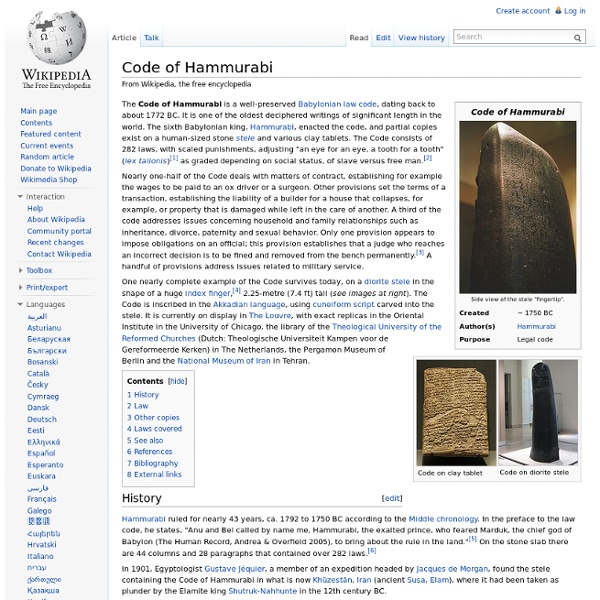
Cuneiform law Cuneiform law refers to any of the legal codes written in cuneiform script, that were developed and used throughout the ancient Middle East among the Sumerians, Babylonians, Assyrians, Elamites, Hurrians, Kassites, and Hittites.[1] The Code of Hammurabi is the most well-known of the cuneiform laws, but there were a number of precursor laws.[1] Features[edit] Although they were written in several different cities and kingdoms, these early laws have a number of formulae in common. While many of these codes are only partially known, they nevertheless paint a fairly clear picture that enables us to learn what issues pertaining to rules were considered significant by the societies they governed in the 3rd, 2nd, and 1st millennia BC. Unlike modern codes, Cuneiform law provides no universal formula for general areas of law. Cuneiform law is generally classified separately from later Middle Eastern law,[2] but has been viewed as a predecessor of Biblical and Jewish law. Timeline[edit]
David The Books of Samuel, 1 Kings, and 1 Chronicles are the only sources of information on David, although the Tel Dan Stele (dated c. 850–835 BC) contains the phrase בית דוד (Beit David), read as "House of David", which most scholars take as confirmation of the existence in the mid-9th century BC of a Judean royal dynasty called the House of David. He is depicted as a righteous king, although not without faults, as well as an acclaimed warrior, musician, and poet, traditionally credited for composing many of the psalms contained in the Book of Psalms. David is central to Jewish, Christian, and Islamic doctrine and culture. Biblical tradition maintains the Messiah's direct descent from the line of David. Biblical narrative[edit] Young David holds the impaled head of Goliath and marches before a general on a white horse, as envisioned by Poussin, ca. 1632 Saul rejected[edit] According to the biblical narrative, the prophet Samuel sought a new king from the sons of Jesse of Bethlehem. Author Dr.