

Henry Kissinger Un article de Wikipédia, l'encyclopédie libre. Henry Kissinger, né Heinz Alfred Kissinger ([haɪnts ˈalfʁɛt ˈkɪsɪŋɐ]) le à Fürth en Allemagne, est un politologue et diplomate américain. Juif et allemand de naissance, il émigre aux États-Unis en 1938 pour fuir les persécutions nazies et est naturalisé en 1943. Henry Kissinger est avec le milliardaire David Rockfeller et Zbigniew Brzezinski, un des membres importants de la commission trilatérale, un groupe regroupant les hommes d'affaires et les politiciens les plus influents au monde, et visant à favoriser la doctrine mondialiste [1],[2],[3],[4]. Il est actuellement président de Kissinger Associates dont il est également le fondateur. Biographie[modifier | modifier le code] Enfance et éducation[modifier | modifier le code] Henry Kissinger est né en Bavière à Fürth, dont il est plus tard devenu citoyen d'honneur, dans une famille juive allemande[5]. Expérience militaire[modifier | modifier le code] Dans son livre Les Crimes de M. 1957.
Halford Mackinder Sir Halford John Mackinder PC (15 February 1861 – 6 March 1947) was an English geographer, academic, the first Principal of University Extension College, Reading (which became the University of Reading) and Director of the London School of Economics, who is regarded as one of the founding fathers of both geopolitics and geostrategy. Early life and education[edit] Mackinder was born in Gainsborough, Lincolnshire, England, the son of a doctor, and educated at Queen Elizabeth's Grammar School, Gainsborough (now Queen Elizabeth's High School), Epsom College and Christ Church, Oxford. He received a degree in biology in 1883 and one in modern history the next year.[2] Career[edit] In 1887, he published "On the Scope and Methods of Geography", a manifesto for the New Geography.[3] A few months later, he was appointed as Reader in Geography at the University of Oxford, where he introduced the teaching of the subject. In 1895, he was one of the founders of the London School of Economics.
Extrait Halford John Mackinder Un article de Wikipédia, l'encyclopédie libre. Halford John Mackinder ( - ) est un géographe et géopoliticien britannique. Jeunesse[modifier | modifier le code] Réalisations[modifier | modifier le code] Mackinder est considéré comme l'un des pères fondateurs de la géographie moderne britannique, mais aussi de la géopolitique et de la géostratégie. En 1899, il réalise la première ascension du mont Kenya[1]. Mackinder introduit en 1887 l’enseignement de la géographie à l’Université d'Oxford et y fonde l'École de Géographie en 1899[2]. Mackinder est considéré comme l'un des principaux fondateurs de la géopolitique opérationnelle/active. Mackinder pense, à la manière de Friedrich Ratzel, que le monde doit être perçu à partir d'une cartographie polaire (et non une projection mercatorienne). Cette vision de la géopolitique cristallise le rapport de force qui oppose les puissances de la mer aux puissances terrestres. Travaux[modifier | modifier le code] Mackinder, H.J. Blouet, Brian. ↑ H.J.
robert-fisk-how-does-tony-blair-get-away-with-his-lies-9538846 Read more: Senior Labour figures distance themselves from former PM Having just spent several days travelling between three cities in Syria – and let’s have no illusions about the brutality of the Assad regime – I find it instructive to contemplate what Blair’s rebel chums in Syria are up to. Take the five-mile Aleppo airport road. It’s newly held by government troops, but the Islamists hold so much territory around the city that you have to first drive 16 miles in darkness to reach the city along dirt tracks and overflowing lagoons of untreated sewage and beneath a disused railway line where bright red tracer fire – from the men Blair would have us support – criss-crosses the road. So a snapshot of Aleppo today – which would be Mosul if Blair’s friends had won and if the West had shown “action” against the Assad regime. It’s a mirror world. “When it fell,” he says, “I felt that 1,500 years of civilisation had died. No need to ask why the army cannot retake the old city.
Irak : « Il y a là un piège fatal pour la stabilité et la paix civile à l’intérieur de chaque société Onze ans après l’invasion de l’Irak par les États-Unis, le pays risque encore et toujours de s’enfoncer dans la guerre civile. Un nouveau mouvement djihadiste, l’Etat islamique en Irak et au Levant, créé en Syrie, contrôle de fait la moitié occidentale du pays. « Ce qui est encore plus préoccupant c’est qu’existe maintenant une mythologie héroïque du djihadisme qui peut toucher beaucoup de monde », analyse Bernard Dréano, qui préside le Centre d’études et d’initiatives de solidarité internationale. Une idéologie sectaire qui profite aussi des abandons de la gauche en matière de solidarité internationale : vis-à-vis des Palestiniens comme du mouvement révolutionnaire syrien, coincé entre la dictature de Bachar Al-Assad et les djihadistes. Basta ! : D’où vient l’État islamique en Irak et au Levant ? En quoi cette formation se différencie-t-elle d’autres groupes djihadistes, comme al-Qaïda, le Front al-Nosra en Syrie ou Ansar Dine dans le Sahel ? Environ 300 Français combattent en Syrie ?
Leon Brittan: Britain has made the EU more liberal - Commentators In discussing Britain and the EU in the new world landscape, I have been drawing on my own experience of the Commission, my 11 years in Brussels. That experience leads me to one overriding conclusion. If we show commitment to the European project, we can persuade our partners to move massively in directions that we favour. I know we can do that, because we have so often succeeded. I've referred to our success in overcoming the opposition to enlargement. That does not mean artificially adopting a rhetoric with which we are not temperamentally comfortable.
Leon Brittan Early life Leon Brittan was born to parents of Lithuanian Jewish descent, and was educated at the Haberdashers' Aske's Boys' School and then Trinity College, Cambridge, where he was President of the Cambridge Union Society and Chairman of Cambridge University Conservative Association. His brother is Sir Samuel Brittan, an economics commentator at the Financial Times and financial journalist. He is a cousin of Conservative MP for Kensington Malcolm Rifkind,[1] as well as music producer Mark Ronson.[2] Political career MP and minister Resignation over the Westland affair In October 1986, in a House of Commons debate, Brittan made a bitter attack on Michael Heseltine, accusing him of "thwarting the Government at every turn" in its handling of the Westland affair. In 1989, Brittan revealed in a Channel 4 programme that two senior Downing Street officials, Bernard Ingham and Charles Powell, had approved the leaking of the letter from the Solicitor General. Phone tapping court case Peerage
H. G. Wells Un article de Wikipédia, l'encyclopédie libre. Pour les articles homonymes, voir Wells. Herbert George Wells, plus connu sous la signature H. G. Wells, né le 21 septembre 1866 à Bromley dans le Kent, Royaume-Uni et mort le 13 août 1946 à Londres, est un écrivain britannique surtout connu aujourd'hui pour ses romans de science-fiction. Biographie[modifier | modifier le code] Il fut un auteur très prolifique qui écrivit aussi bien des romans réalistes que de la science-fiction, comme des essais sur l'histoire de l'humanité ou l'évolution future de la société. Enfance et jeunesse[modifier | modifier le code] H.George Wells fut le cinquième et dernier enfant de Joseph Wells, un jardinier et joueur de cricket devenu boutiquier, et de Sarah Neal, une ancienne domestique. Un incident survenu alors qu'il n'avait que sept ans fut déterminant pour la suite de sa vie. Années d'études[modifier | modifier le code] H. L'écrivain[modifier | modifier le code] Wells écrivit aussi des ouvrages spécialisés.
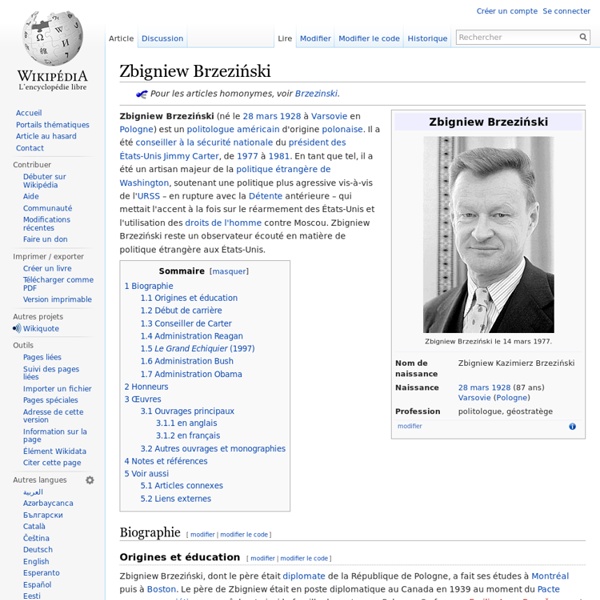
Il est aussi l'un des artisans de l'Opération Cyclone, par laquelle Washington soutient les moudjahidins afghans dès juillet 1979.
Brzeziński écrit une note au président après que celui-ci a décidé d'aider les moudjahidins, pour indiquer que l'aide provoquerait à son avis l'invasion de l'Afghanistan par l'URSS, ce qui s'est effectivement produit en décembre.
Deux décennies plus tard, se félicitant que les Soviétiques se soient épuisés dans le « piège afghan », il répondra à l'accusation d'avoir provoqué l'intervention soviétique: "Nous n'avons pas poussé les Russes à intervenir, mais nous avons sciemment augmenté la probabilité qu'ils le fassent" by cyrilcab Apr 30