Terre
Gunter Pauli
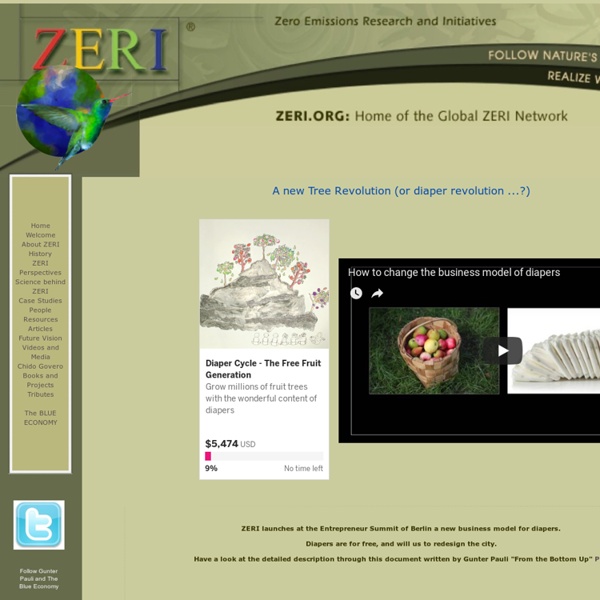
que la producción de Ecover estimulaba, conducía a ame-nazar el bosque tropical. Básicamente, su muy festejadonegocio exportaba polución de Europa a Asia. Cuando ins-tó a sus socios mayoritarios a replanteárselo, estos no qui-sieron..... así que se marchó. Se fue a Tokio, a la Universi-dad de las Naciones Unidas, donde lanzó el programa“Iniciativas para la Investigación en Cero Emisiones” -ZERI-en 1994. “Una red internacional de científicos, empresarios, gobiernos y educadores que buscan soluciones para responder a las necesidades bá-sicas de la humanidad: agua, comida, salud, vivienda, energía y traba- jo”. “La Naturaleza no conoce el concep-to de residuo o basura, la única especie capaz de producir algo que ninguna otra, ni ella misma, desea, es la especie humana”. Aprendiendo de la Naturaleza “Biomimesis una palabra acuñada por J en 1997,trata más acerca de aprender de la Naturaleza, que sobre la naturaleza.” Hacia un nuevo paradigma industrial , con-cluye G Las fábulas juntoJ
Gunter Pauli: «Suivre la sagesse de la nature»
Le créateur de la fondation ZERI (Recherche et initiatives pour zéro pollution) prône une économie s’inspirant des écosystèmes naturels pour résoudre les crises économique, sociale et écologique. Qu’est-ce que l’«économie bleue» ? C’est un modèle qui suit la sagesse des écosystèmes. Ils fournissent énergie et aliments, recyclent les déchets, répondent aux besoins de tous et se régénèrent sans cesse. Cela ressemble à l’économie circulaire. Celle-ci est une bonne approche, mais il faut aller bien au-delà. Dans votre livre et sur votre site web, vous avez sélectionné 183 innovations. Au-delà de la technologie, il est crucial d’imaginer de nouveaux modèles d’affaires. Pourquoi, à votre avis ? Depuis Descartes, nous compartimentons tout. L’Indonésie vient d’adopter l’économie bleue comme axe de développement… Elle l’a même inscrite au menu du forum de l’Apec (Coopération économique pour l’Asie-Pacifique) en octobre. Est-ce une première ? Des entreprises vous suivent-elles ? Dix ans.
4 – Participation | Incredible Edible Fréland
– Bienvenue sur la page participation ! – L’action des incroyables comestibles est une initiative citoyenne ouverte à tous ! Pour participer, c’est simple et accessible à chacun. Cela ne demande aucun moyen particulier. Voici une proposition de méthode en 5 étapes, réalisable en un temps très court : Étape 1 : on constitue une équipe locale avec d’autres familles pour initialiser l’action à plusieurs. Étape 2 : chaque membre du groupe prend une bêche de jardinier en main et va poser, avec les autres, devant la pancarte de la commune, en tenant le visuel « Incroyables Comestible France » pour donner de la force au mouvement global et enraciner l’action sur votre territoire. Étape 3 : chaque foyer réalise une plantation sur son espace privé, en bordure “non fermée” de l’espace public et prend des photos de l’installation avec la mention “nourriture à partager” des « incroyables Comestibles » ; C’est ouvert à tous ! Vous êtes tous les bienvenus ! Allez-y, plantez pour le partage ! Enjoy!
50 Places To Buy Affordable Ethical Fashion Brands Online | Ethical Fashion and Clothing Blog
If you are a regular reader of my blog, you will probably have read my moans and groans in the past about how difficult it can be to find a good choice of ethical and affordable fashion. I have in the past used this as an excuse for not buying ethically. But recently, whilst bumbling around the internet I have come across more and more ethical fashion brands which I really like. I decided to try and prove myself wrong about the lack of choice and compile a list of 50 online places to buy affordable ethical fashion online. Making this list has proved a really useful exercise and I will definitely be using it as reference when shopping online in the future. So here they are! 1. 2. 3. Outfit from ASOS Africa 4. 5. 6. 7. 8. 9. 10. 11. Isabelle Dress from Daisy Hill 12. 13. 15. 16. 17. 18. 19. 20. 21. 22. 23. Nina Dress by Komodo 24. 25. 26. 27. 28. 29. 30. 31. 32. 33. 34. 35. 36. 37. 38. 39. 40. 41. 42. Satin Sweetheart Dress by Tara Starlet 43. 44. 45. 46. 47. 48. 49. 50. With warmest wishes
Fixers Collective NYC | Working Together to Fix the Things in Our Lives
Green Blog