

The Novel 100: The 100 Greatest Novels of All Time Multiple Listings:9 authors wrote two of the books listed on TIME Magazine's list of the best English-language novels published since 1923: Evelyn Waugh (Brideshead Revisited; A Handful of Dust) George Orwell (1984; Animal Farm) Graham Greene (The Heart of the Matter; The Power and the Glory) Philip Roth (American Pastoral; Portnoy's Complaint) Saul Bellow (The Adventures of Augie March; Herzog) Thomas Pynchon (The Crying of Lot 49; Gravity's Rainbow) Virginia Woolf (Mrs. Dalloway; To the Lighthouse) Vladimir Nabokov (Lolita; Pale Fire) William Faulkner (Light in August; The Sound and the Fury) Authors on Two Separate ListsTIME Magazine's list of "100 Best Movies" released since 1923 is a companion to TIME Magazine's list of "100 Best Novels" (written in English) published since 1923. A total of 92 authors are represented on the "Best Novels" list. About 500 directors, writers and starring actors are noted in the "100 Best Movies" list. Notes about how the list was created
Mortimer J. Adler Mortimer Jerome Adler (December 28, 1902 – June 28, 2001) was an American philosopher, educator, and popular author. As a philosopher he worked within the Aristotelian and Thomistic traditions. He lived for the longest stretches in New York City, Chicago, San Francisco, and San Mateo, California.[1] He worked for Columbia University, the University of Chicago, Encyclopædia Britannica, and Adler's own Institute for Philosophical Research. Biography[edit] New York City[edit] Adler was born in New York City on December 28, 1902, to Jewish immigrants. Chicago[edit] In 1930 Robert Hutchins, the newly appointed president of the University of Chicago, whom Adler had befriended some years earlier, arranged for Chicago’s law school to hire him as a professor of the philosophy of law; the philosophers at Chicago (who included James H. "Great Books" and beyond[edit] Adler and Hutchins went on to found the Great Books of the Western World program and the Great Books Foundation. Popular appeal[edit]
Great books The great books are those books that are thought to constitute an essential foundation in the literature of Western culture. Specified sets of great books typically range from 100-150, though they differ according to purpose and context. For instance, some lists are built to be read by undergraduates in a college semester system (130 books, Torrey Honors Institute),[1] some are compiled to be sold as a single set of volumes (500 books, Mortimer Adler), while some lists aim at a thorough literary criticism (2,400 books, Harold Bloom).[2] Concept[edit] The great books are those that tradition, and various institutions and authorities, have regarded as constituting or best expressing the foundations of Western culture (the Western canon is a similar but broader designation); derivatively the term also refers to a curriculum or method of education based around a list of such books. Origin[edit] In 1909, Harvard University published a 51-volume great books series, titled the Harvard Classics.
Khan Academy The Greatest Books: The Best Books of All Time - 1 to 50 In Which These Are The 100 Greatest Writers Of All Time The 100 Greatest Writers of All Time by WILL HUBBARD and ALEX CARNEVALE Other lists of this kind have been attempted, none very successfully. We would like to stress that there is a crucial difference between "an important writer" and "a great writer"; the latter is at this time our sole interest. We will account for some of the names that did not make this list in a later dispatch. There is nothing bad to say about anyone we list here, except in some cases that they were anti-Semitic or racist, hated women or hated men. 100. Prose stylist nonpareil, he addressed the dichotomy of race, the loneliness of existence. 99. The gestamtkunstwerk ('total work of art') was all the rage in Europe early in the last century, but Balzac was on the case almost a hundred years before. 98. The greatest artist Poland would ever spawn, Milosz was still composing vital poetry until his death in 2004. 97. When we speak of 'wit' in the theater we owe a debt to G. 96. Anti-semite? 95. 94. 93. 92. 91. 90. 89.
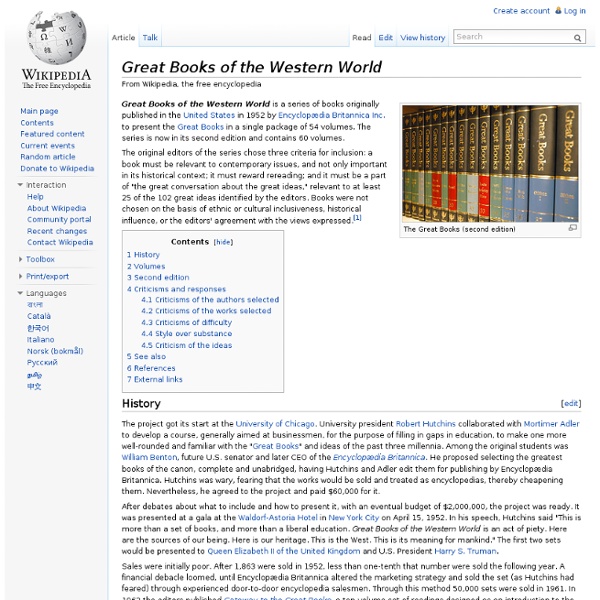
A Syntopicon: An Index to The Great Ideas A Syntopicon: An Index to The Great Ideas (1952) is a two-volume index, published as volumes 2 and 3 of Encyclopædia Britannica’s collection Great Books of the Western World. Compiled by Mortimer Adler, an American philosopher, under the guidance of Robert Hutchins, president of the University of Chicago, the volumes were billed as a collection of the 102 great ideas of the western canon. The term “syntopicon” was coined specifically for this undertaking, meaning “a collection of topics.”[1] The volumes catalogued what Adler and his team deemed to be the fundamental ideas contained in the works of the Great Books of the Western World, which stretched chronologically from Homer to Freud. The Syntopicon lists, under each idea, where every occurrence of the concept can be located in the collection’s famous works. History[edit] The Syntopicon was created to set the Great Books collection apart from previously published sets (such as Harvard Classics). Purpose[edit] Content[edit] [edit]
Harvard Classics Charles William Eliot, compiler and editor of the Harvard Classics anthology. The Harvard Classics, originally known as Dr. Eliot's Five Foot Shelf, is a 51-volume anthology of classic works from world literature, compiled and edited by Harvard University president Charles W. Eliot and first published in 1909.[1] Eliot had stated in speeches that the elements of a liberal education could be obtained by spending 15 minutes a day reading from a collection of books that could fit on a five-foot shelf. (Originally he had said a three-foot shelf.) Eliot worked for one year with William A. Contents[edit] The Harvard Classics Shelf of Fiction[edit] The Harvard Classics Shelf of Fiction was selected by Charles W. Enduring success[edit] As Adam Kirsch, writing for Harvard magazine in 2001, notes, "It is surprisingly easy, even today, to find a complete set of the Harvard Classics in good condition. Similar compendia[edit] References[edit] Further reading and external links[edit]
The Secret of the Fibonacci Sequence in Trees As I headed to the exhibit where the hamadryas baboons ( Papio hamadryas ) resided, I knew something interesting would happen over the next few hours. As I walked into the exhibit, I found two mothers pulling their infants' tails to keep them from straying. This particular act reminded me of how some parents put leashes on their children so they won't wander too far. Throughout my life I have enjoyed observing animals and the way they interact with their surroundings. When I visit zoos, I always wonder how much the animals' behavior is affected by their captivity. The null hypothesis for my first question is that there will be no differences in the behaviors of captive hamadryas baboons compared to wild hamadryas baboons. My null hypothesis for the second question is that no one behavior will occur more frequently than any other behavior among the captive baboons at the Prospect Park Zoo. After learning their identities, I wrote their names in a chart in my field journal. Ho, Raymond.
50 Most Influential Books of the Last 50 (or so) Years In compiling the books on this list, the editors at SuperScholar have tried to provide a window into the culture of the last 50 years. Ideally, if you read every book on this list, you will know how we got to where we are today. Not all the books on this list are “great.” The criterion for inclusion was not greatness but INFLUENCE. The books we chose required some hard choices. We also tried to keep a balance between books that everyone buys and hardly anyone reads versus books that, though not widely bought and read, are deeply transformative. 1. 2. 3. 4. 5. 6. 7. 8. 9. 10. 11. 12. 13. 14. 15. 16. 17. 18. 19. 20. 21. 22. 23. 24. 25. 26. 27. 29. 30. 31. 32. 33. 34. 35. 36. 38. 39. 40. 41. 42. 43. 45.
The Great Books Syntopicon The two volumes that make up the Syntopicon comprise a distinctive kind of index. The term "syntopicon" means a collection of topics. In these two volumes there are nearly 3,000 topics parceled out among 102 ideas. The purpose of these volumes is to provide a subject-matter index to writings included in the Great Books of the Western World. Underlying the creation of the Syntopicon is the conviction that the books in this set have an overall unity in the discussion of common themes and problems. The lines along which a syntopical reading of the Great Books can be done are the main lines of the continuous discussion that runs through the thirty centuries of western civilization. The 102 ideas. Why 102 ideas instead of an even 90, 100, or no? The arrangement of the Syntopicon. The 102 chapters comprise the heart (and bulk) of the Syntopicon. Readers will notice that in some chapters a few topics contain no references.
Western canon Origins[edit] The process of listmaking—defining the boundaries of the canon—is endless. The philosopher John Searle has said: "In my experience there never was, in fact, a fixed 'canon'; there was rather a certain set of tentative judgments about what had importance and quality. Such judgments are always subject to revision, and in fact they were constantly being revised. One of the notable attempts at compiling an authoritative canon in the English-speaking world was the Great Books of the Western World program. An earlier attempt, the Harvard Classics (1909), was promulgated by Harvard University president Charles W. ... Debate[edit] Defenders maintain that those who undermine the canon do so out of primarily political interests, and that such criticisms are misguided and/or disingenuous. One of the main objections to a canon of literature is the question of authority—who should have the power to determine what works are worth reading and teaching? Works[edit] Examples[edit]