Choisissez
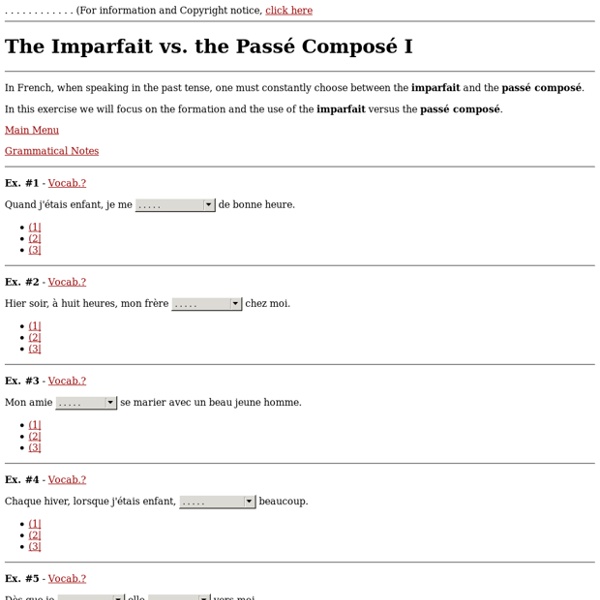
Passé composé ou Imparfait?
One of the most striking differences between French and English is in verb tenses. Learning how to use the various past tenses can be very tricky, because English has several tenses which either do not exist in or do not translate literally into French - and vice versa. During the first year of French study, every student becomes aware of the troublesome relationship between the two main past tenses. The imperfect [je mangeais] translates to the English imperfect [I was eating] while the passé composé [j'ai mangé] literally translates to the English present perfect [I have eaten] but can also be translated as the English simple past [I ate] or the emphatic past [I did eat]. It is extremely important to understand the distinctions between the passé composé and imperfect in order to use them correctly and thus express past events accurately. IntroductionUses of the passé composé and imperfectCompare passages and discover key words and phrasesTest: Passé composé vs Imperfect
Après que (indicatif ou subjonctif ?)
Débats en décembre 1998 Philippe Deschamp (15.12.1998) . — Eh oui, comme « lorsque », « après que » se construit avec l’indicatif ou le conditionnel, pas le subjonctif : Je monterai dans ma chambre après qu’il sera parti. L’explication selon laquelle la subordonnée exprime un passé certain par rapport à l’action principale me parait correcte. Je ne vois aucune raison de compliquer cela avec un subjonctif, qui est censé introduire une incertitude, comme c’est le cas avec « avant que », par exemple. Rodrigo Reyes (16.12.1998) . — Oui, bien sûr, tu ne vois aucune raison. Moi, de mon côté, je peux te sortir une liste assez conséquente de phénomènes de la langue pour lesquels « je ne vois aucune raison ». Peut-être que tu vis dans une grotte, ou dans un sous-sol de [ton institut], sans télé, sans voir personne de la journée, je ne sais pas. Commentaire de l’éditeur Un débat s’est engagé sur le mode régi par la locution conjonctive après que. Il est d’ailleurs un bon moyen de se le rappeler.
Discours direct et indirect
Discours direct | Discours indirect ____________________________________________________________________________________________________________ Elle dit : ' Il chante '. Elle dit qu' il chante. Elle dit : ' Il ne chante pas '. Elle dit qu'il ne chante pas . Elle demande ' Est-ce qu'il chante ? Elle demande ' Qu'est-ce qu'il chante?' Elle dit à Pierre: 'Va faire les commissions!' Exercice : Sur le modèle du cours, transposer les phrases suivantes du discours direct au discours indirect : Intermédiaire Fin de l'exercice de français "Discours direct et indirect"Un exercice de français gratuit pour apprendre le français ou se perfectionner.
italy
Qu'est-ce que la traduction ? - Is it intercultural?
Dimanche 20 novembre 7 20 /11 /Nov 11:12 A chaque fois que j’explique à quelqu’un que je viens de rencontrer que je fais une école de traduction, on me répond les trois quarts du temps : « Ah oui, tu peux faire quoi avec ça, interprète ? ». Que nous dit le nouveau petit Robert de la langue française 2009 ? Déjà, traduction et interprétation sont deux choses très différentes ! « Je parle pas mal anglais, j’pourrais très bien traduire aussi en fait ! Bon, toujours convaincu de pouvoir traduire comme ça ? Et d’ailleurs, qu’est-ce qu’on peut traduire ? Bon, je pense qu’on va s’arrêter là pour aujourd’hui, je ne voudrais pas vous submerger d’informations ! ISITement vôtre, Charlotte D. Pour lire l'article en anglais : link Pour lire l'article en italien : link
Related:
Related:

