NYPL | Blog: Library Voices
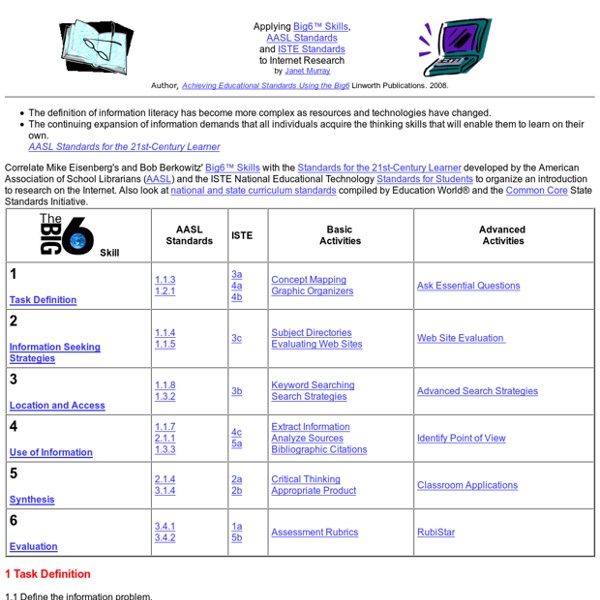
by Anne Rouyer. Supervising Librarian PSSSTT! Let me let you in on a little librarian research secret: finding information at branches and online isn't hard (anyone can do it). In fact, in this digital age of online databases, Google and Wikipedia we are on information overload. Well, we know how to evaluate information, dissect it, analyze it, reassemble it and put it to use effectively. "The Big6 Skills" process isn't a shortcut. Step 1: Defining the Assignment or Project What is it exactly your teacher wants from you? Step 2: Research Strategizing and Planning Now that you understand the assignment, have chosen your topic and written down what you need to find out, you must decide how to go about finding the information you need. One key to good research are good keywords. Tip: An online library database is always preferable to a Googled website. *A quick word on Wikipedia. Step 3: Location, Location, Location Step 4: Exploring, Evaluating and Extracting Step 5: Information Fusion
Literacy in the Digital Age
I have identified thirteen literacies that our students need to become well-rounded 21st-century citizens. These literacies are not taught as separate literacies but are taught across the content areas. If you find a link that is not working, please let me know the title and I will fix it! There is a new book out, Developing Digital Literacies, by Dustin Summey.
Researching with the Big 6! Model - Home
Big6 Information and Technology Skills: Essential and Relevant
Presented by Dr. Mike Eisenberg, Professor and Dean Emeritus, University of Washington’s Information School Sponsored by Libraries Unlimited If you attended the live session, you’ll be emailed a CE certificate within 24 hours of the webinar. Is information literacy learning (and the Big6) passé? Last time we checked, this is still the information age and students are facing even more challenging information problems than ever. Well-known educator and visionary Mike Eisenberg presented a content-packed webinar that emphasized practical strategies for defining and delivering a relevant and meaningful information and technology skills instructional program. Dr. Join the SLC @ The Forefront community to network with educators, participate in online discussions, receive invitations to upcoming webinars, view past webinars, take a quiz to receive a CE certificate for a past webinar, and access free resources.
S.O.S. for Information Literacy
Big6 Information and Technology Skills: Essential and Relevant
Presented by Dr. Mike Eisenberg, Professor and Dean Emeritus, University of Washington’s Information School Sponsored by Libraries Unlimited If you attended the live session, you’ll be emailed a CE certificate within 24 hours of the webinar. If you view the recording and would like a CE certificate, join the SLC @ The Forefront community and go to the Webinar Archives folder to take the CE quiz. Is information literacy learning (and the Big6) passé? Obsolete? Last time we checked, this is still the information age and students are facing even more challenging information problems than ever. Well-known educator and visionary Mike Eisenberg presented a content-packed webinar that emphasized practical strategies for defining and delivering a relevant and meaningful information and technology skills instructional program. Dr.
The Big Reveal - Libraries Transform, But Only with Expert Librarians
By Sara Kelly Johns, Susan D. Ballard, and Dorcas Hand The ALA Initiative “Libraries Transform” has been further defined during this past year by ALA President Julie Todaro as “Libraries Transform: The Expert in the Library.” In developing her initiative, Julie tapped the three of us to join her task force and chair the school group, and we in turn tapped a group of respected practitioners to build a set of resources to define and support the professional growth of school librarians. Our team’s initial work involved searching for articles and AASL position statements to define Dispositions and Competencies for effective practice, Leadership and Collaboration to strengthen impact, Value and Measurables to offer administrators and policy makers, and Advocacy tips to benefit community awareness. Next we took the School Librarian Competencies based on the PSELs (April 2017) as the core of a rubric for self-assessment for school librarians. Like this: Like Loading...
TheBig6.org