iPhone keeps record of everywhere you go | Technology
Security researchers have discovered that Apple's iPhone keeps track of where you go – and saves every detail of it to a secret file on the device which is then copied to the owner's computer when the two are synchronised. The file contains the latitude and longitude of the phone's recorded coordinates along with a timestamp, meaning that anyone who stole the phone or the computer could discover details about the owner's movements using a simple program. For some phones, there could be almost a year's worth of data stored, as the recording of data seems to have started with Apple's iOS 4 update to the phone's operating system, released in June 2010. "Apple has made it possible for almost anybody – a jealous spouse, a private detective – with access to your phone or computer to get detailed information about where you've been," said Pete Warden, one of the researchers. Simon Davies, director of the pressure group Privacy International, said: "This is a worrying discovery.
Microsoft iPhone app creates panoramic photos | iPhone Atlas
A new iPhone app from Microsoft can create full panoramas from a series of individual photos that you snap with your device's camera. Compatible with the iPhone 3Gs and 4, the iPad 2, and the iPod Touch 4G, Photosynth is simple to use since Microsoft does most of the hard work. You simply point your device at the subject and tap the screen to snap the first photo. A green framing box helps you position your device so that each shot lines up with each other. If you make a mistake or want to redo a shot, you can tap an Undo button to remove each previous image one at a time. You can view your new photo in the app by tapping on its thumbnail image. Microsoft offers a few ways for you to publish your handiwork. The ability to assemble a panorama from separate pictures was initially slated to appear in Microsoft's Bing iPhone app , but the company apparently decided to turn that feature into its own dedicated application.
Your iPhone Is Tracking Your Every Move
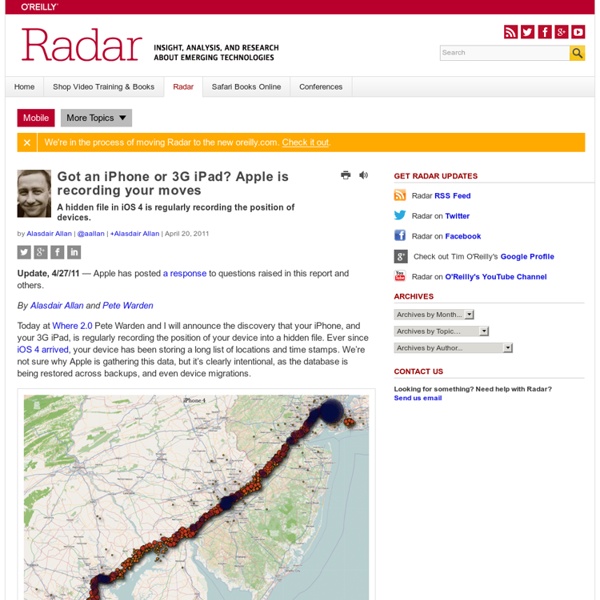
Researchers have discovered that the iPhone is keeping track of where you go and storing that information in a file that is stored – unencrypted and unprotected – on any machine with which you synchronize your phone. It is not clear why Apple is collecting this data. Data scientists Alasdair Allan and Pete Warden came across the file – “consolidated.db” – while they were thinking about the potential trove of mobile data stored on a cellphone and thinking about ways to visualize this data. Allan and Warden will present their findings today at the Where 2.0 conference. While it is not unusual for cellphones to track users’ location, that information is typically kept behind a firewall and it requires a court order for others to be able to access it. This isn’t the case with this particular file, raising serious questions about privacy and security. Tracking Your Coordinates Since iOS4 The file contains longitude and latitude data, recording the phone’s coordinates along with a timestamp.
Photosmith: Useful iPad companion for Lightroom | Deep Tech
Some of us with a bunch of photos on an iPad would rather add keywords and captions than slap on yet another sepia-tone art filter. Enter C Squared Enterprises' Photosmith. This $17.99 app, released today, is a companion to Adobe Systems' Lightroom software for editing and cataloging photos. I've been trying beta versions, and I think the app could be a useful addition for some photographers--especially if the software and the iPad's abilities continue to grow beyond today's limitations. Photosmith can't match what Lightroom proper can do, of course--the iPad's memory, keyboard, and processor power can't keep up with a personal computer's hardware. Think of Photosmith's purpose as a variation on the adage that the best camera is the one you have with you, except with the computers you use to handle photos. The app lets you add keywords (aka tags), captions, titles, color coding, and star ratings to photos. Some other examples of serious, if not essential, tablet apps:
Tous les utilisateurs d'iPhone sont pistés
Dire où l'on se trouve en permanence via son smartphone, c'est simple comme bonjour : on peut le déclamer à qui ça intéresse (indice : personne) via les versions mobiles des réseaux sociaux type Facebook ou Twitter, ou check-iner comme un fou sur les appli spécifiques de géolocalisation comme Foursquare. Mais il y a un autre moyen, d'autant plus simple qu'il est automatique : avoir un iPhone et permettre sans le savoir à Apple de pister nos moindres déplacements. La découverte est signée Alasdair Allan et Pete Warden, deux spécialistes qui l'ont annoncé aujourd'hui à la conférence Where 2.0 après l'avoir explicité sur le site Radar . Concrètement, d'après Radar, les localisations sont stockées dans un fichier appelé consolidated.db, avec coordonnées géographiques évoluant en fonction de la date d'enregistrement. Un logiciel baptisé iPhone Tracker est disponible pour lire à son tour ce genre de traces. Lire les réactions à cet article. Alexandre HERVAUD
Getting the Most Out of Your iPhone: 20 Easy Tricks and Tips - Steve Kovach & Jay Yarow - Technology
The horror-movie trope owes its heritage to Haitian slaves, who imagined being imprisoned in their bodies forever. In the original script for 1968’s Night of the Living Dead, the director George A. Romero refers to his flesh-eating antagonists as “ghouls.” By the time Dawn of the Dead was released in 1978 the cultural tide had shifted completely, and Romero had essentially reinvented the zombie for American audiences.
Apple Q&A on Location Data
CUPERTINO, Calif.--(BUSINESS WIRE)--Apple would like to respond to the questions we have recently received about the gathering and use of location information by our devices. 1. 2. 3. 4. 5. 6. 7. 8. 9. 10. Software Update Sometime in the next few weeks Apple will release a free iOS software update that: reduces the size of the crowd-sourced Wi-Fi hotspot and cell tower database cached on the iPhone, ceases backing up this cache, and deletes this cache entirely when Location Services is turned off. In the next major iOS software release the cache will also be encrypted on the iPhone.
Average iPhone owner spends 84 minutes a day using the 108 apps on their handset
A survey of the 1,000 iOS devices that synchronize with Appsfire's mobile app discovery and sharing platform reveal some interesting statistics about app usage by its iOS owners. Summarized in an infographic, the compiled statistics show that most of its iOS users prefer native apps to web apps. The average user spends 84 minutes a day using on-device applications and a mere ten minutes on the web using web-based applications. Breaking it down even further, Appsfire suggests that 58% of installed applications are free, 23% are paid and 19% are the default apps on the handset. While the results are compelling, they represent a subset of users who are focused on finding and using applications.