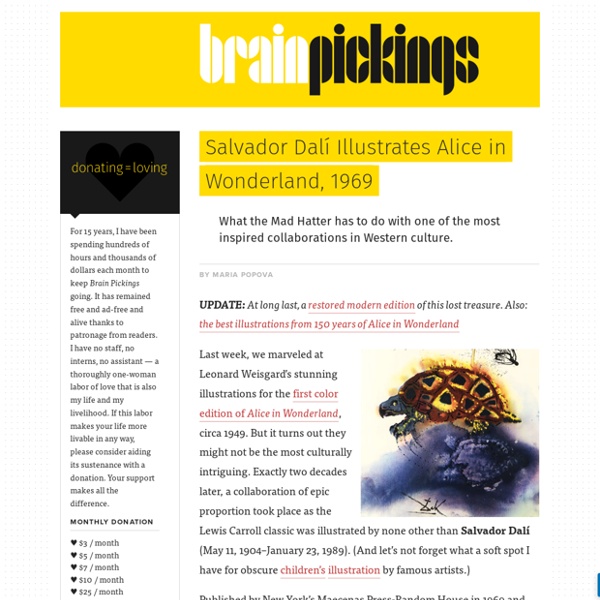
my alice in wonderland
Star Maker
Star Maker is a science fiction novel by Olaf Stapledon, published in 1937. The book describes a history of life in the universe, dwarfing in scale Stapledon's previous book, Last and First Men (1930), a history of the human species over two billion years. Star Maker tackles philosophical themes such as the essence of life, of birth, decay and death, and the relationship between creation and creator. A pervading theme is that of progressive unity within and between different civilizations. Some of the elements and themes briefly discussed prefigure later fiction concerning genetic engineering and alien life forms. Arthur C. Plot[edit] The book begins with a single human narrator from England who is, via unexplained means, transported out of his body and finds himself able to explore space and other planets. The disembodied travelers encounter many ideas that are interesting from both science-fictional and philosophical points of view. Contents[edit] Appendix: A Note on Magnitude
Greek Girl Reaches for Euro Stars
A Greek street artist, under the name of Bleeps.gr, has created this artistic statement in the street of Athens. “I aim at questioning the maturity of European union, which is depicted as a young girl trying to reach between the stars,” he says of this piece. The European Union flag has precisely 12 stars, but a starfish has been added to criticize the fact that each country, starting with Greece, is weakening, facing devastating impacts due to the credit crisis. In the end, the sky ends up at the bottom of the sea. Bleeps.gr website via [Wooster Collective]
Gabriel Moreno
Gabriel Moreno does beautiful work with such basic materials: a pen and a brush. His illustrations begin in black and white, upon which Moreno builds, adding layers of color and images of other places and people tattooed into their skin. Flowers, birds, and faces organically expand from his subjects, as if a rush of creativity, or a dream, is escaping them.
Lewis Carroll (Charles Dodgson) was a mathematician...
No Logo
Focus[edit] However, while globalization appears frequently as a recurring theme, Klein rarely addresses the topic of globalization itself, and usually indirectly. (She would go on to discuss globalization in much greater detail in her 2002 book, Fences and Windows.) Summary[edit] The book comprises four sections: "No Space", "No Choice", "No Jobs", and "No Logo". "No Space"[edit] The book discusses how brand names such as Nike or Pepsi expanded beyond the mere products which bore their names, and how these names and logos began to appear everywhere. Klein argues that large multinational corporations consider the marketing of a brand name to be more important than the actual manufacture of products; this theme recurs in the book and Klein suggests that it helps explain the shift to production in Third World countries in such industries as clothing, footwear, and computer hardware. "No Choice"[edit] "No Jobs"[edit] "No Logo"[edit] Criticism[edit] Awards[edit] The book won the following awards:
the ANTHROPOLOGiST
List of Russian artists
This is a list of artists of the Russian Federation, Soviet Union, Russian Empire, Tsardom of Russia and Grand Duchy of Moscow, including ethnic Russians and people of other ethnicities. This list also includes those who were born in Russia but later emigrated, and those who were born elsewhere but immigrated to the country and/or worked there for a significant period of time. For the full plain list of Russian artists on Wikipedia, see Category:Russian artists. See also: List of Russian architects, List of Russian inventors, List of Russian explorers, List of Russian language writers, Russian culture Alphabetical list[edit] A[edit] B[edit] C[edit] D[edit] E[edit] F[edit] G[edit] H[edit] I[edit] J[edit] K[edit] L[edit] M[edit] N[edit] O[edit] P[edit] R[edit] S[edit] T[edit] U[edit] V[edit] W[edit] Y[edit] Z[edit] See also[edit]