

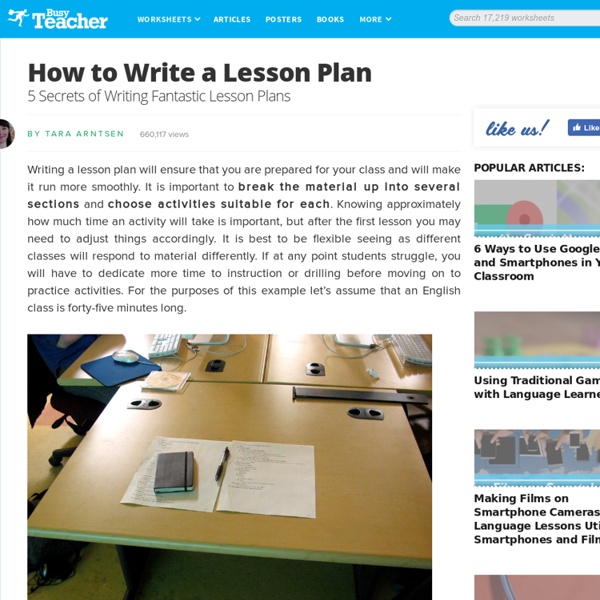
teachingenglish.org You can travel without a list of course but you will avoid a few problems if you spend a bit of time planning – not a whole week though. That would be silly. A few minutes should be enough. New teachers who have had training will have been evaluated and assessed on their lesson plans. You can find lesson plan templates on the Internet too – that you can fill out yourself for your own classes. More experienced teachers tend to spend less time on lesson planning. But what the wise teachers have in common - whether they are new or more experienced - is that they understand the importance of lesson planning but are 100% practical in their approach. No more burnout – a simple guide to successful and time-efficient lesson planning Gather everything you need (course book, teacher’s book, class register, timetable, etc.) and make a cup of tea. Finally, here’s an example of one of my lesson plans – and YES!
Un exemple de plan de formation en anglais pour des apprentis- Anglais LP Le rythme de formation des apprentis est particulier et spécifique à chaque structure. En effet, l’alternance entre les périodes en entreprise et les périodes scolaires impose une progression adaptée. Ici, les apprentis viennent au lycée une semaine sur deux et ne disposent que de peu de temps quand ils sont en entreprise pour approfondir les notions étudiées en classe. Un scénario, ou bien une tâche intermédiaire d’un scénario très court, doit donc être organisé sur 3 heures. De plus, les apprentis sont demandeurs de situations ancrées dans la réalité de leur travail en entreprise et "prêtes à l’emploi". Il sera intéressant pour les niveaux première et terminale d’exploiter le domaine culturel 2 du programme : "Etudier et travailler" le monde professionnel (Industry, Business and Services) emploi et mobilité (Working abroad) mais aussi les domaines :
229 FREE Pronunciation Worksheets Pronunciation - sometimes known as “pro-nuhn-see-EY-shuhn” - is one of the simplest ESL topics to explain, at least in theory; and also one of the hardest for students to get exactly right. As you know, there’s a big gap between grammatical fluency and native-sounding speech - and even long before that, in ESL levels one and two, it’s crucial to make sure students pronounce their vocabulary words in ways that’ll be easily understandable to native speakers. But sometimes, they just can’t seem to hear the difference between their pronunciation and yours - which can be a tough barrier to break through. Depending on the level of your class, you might take any of a number of different approaches when teaching pronunciation. You might pause the lesson when a student’s pronunciation is wrong, and repeat the word with him or her until it sounds better. Whatever your approach, BusyTeacher.org has 229 pronunciation worksheets to back you up. Not sure which worksheet to choose?
Course planning Pre-service teacher training courses typically focus on the detailed planning of a 40 minute or 60 minute lesson and don’t focus attention on how to go about planning a much longer scheme of work. This is also an important area to consider though, because most teachers are involved in teaching courses, which may typically last anywhere between 30 and 120 hours. The aim of this article is to share some of the conclusions of a recent project I was part of, with the hope that it might enable other teachers to plan a little faster too! Why do we plan our lessons? I think that most teachers plan lessons in order to feel more confident in the class itself. The aim of planning is also to map out learning activities in a coherent, logical way, in order to help students understand, learn and practice concepts and skills which will develop their abilities in English. Why, What and How? At the start of a course, we need to sit down and think about ‘What’ we intend to cover in the course, and ‘Why’.
Realia In this tip I’d like to offer a few suggestions for activities using realia and to consider why we may want to bring things into the class. Why use realia in class? The main advantage of using real objects into the classroom is to make the learning experience more memorable for the learner. To give a couple of simple examples, if you are going to teach vocabulary of fruit and vegetables it can be much more affective for students if they can touch, smell and see the objects at the same time as hearing the new word. A second example would be if you are going to teach some functional language for asking for the timetable for a train. Here is a selection of activities involving realia. Tourist informationGather some city/town maps from the tourist information bureau wherever you are. These are just a few ideas to get you started - I hope you enjoy them! Further reading
Construire un scénario pédagogique à partir de ressources brutes (2° partie) Participation aux TraAM (travaux académiques mutualisés) 2013-2014 Ce travail de création de séquences s’inscrit dans la suite du travail commencé en 2012-2013 dont la publication se trouve ici. Le GEP-Langues (groupe d’expérimentation pédagogique) a déposé sa candidature aux TraAM et a répondu à l’appel concernant l’axe sur la production de fichiers audio dans une langue authentique pour l’entraînement à l’épreuve de compréhension de l’oral, mais également et surtout sur la didactisation de ces ressources afin de permettre aux élèves de développer des stratégies d’écoute efficaces et indispensables pour tout type de supports. Le GEP-Langues gère et alimente depuis 2008 une banque de sons, Audio Lingua, qui offre à ce jour plus de 3700 fichiers mp3 en 10 langues. Les mises à jour sont régulières : plus de 700 nouveaux fichiers en 2013-2014, plus de 900 nouveaux fichiers dans l’année scolaire 2011-2012, plus de 850 nouveaux fichiers dans l’année 2012-2013. Liste des séquences
264 FREE Back to School Activities & Worksheets Ready to start your class off right? The first day of class is an important time for teachers and students alike - it’s the time to learn all your students’ names, set the tone for your classroom, and make sure everyone’s feeling relaxed and ready to learn. You probably don’t want to charge in with too much new material on the very first day - after all, it’s important for your students to feel relaxed around you, and around each other, so they’ll be comfortable enough to learn and produce the new ESL concepts you’ll be sharing with them. The question is, how can you help them feel relaxed? With BusyTeacher.org’s 264 resources for the first day of school, of course! Want to start things off as simply as possible? Whether your class if full of young kids or full-grown business English students, BusyTeacher.org’s 264 first-day-of-school worksheets offer something just right for your class. You can dive into our collection of first-day-of-school worksheets in a few different ways.
Which Early Childhood Experiences Shape Adult Life? | MindShift | KQED News By Maanvi Singh, NPR Most of us don’t remember our first two or three years of life — but our earliest experiences may stick with us for years and continue to influence us well into adulthood. Just how they influence us and how much is a question that researchers are still trying to answer. Two studies look at how parents’ behavior in those first years affects life decades later, and how differences in children’s temperament play a role. The first study, published Thursday in Child Development, found that the type of emotional support that a child receives during their her first three and a half years has an effect on education, social life and romantic relationships even 20 or 30 years later. Babies and toddlers raised in supportive and caring home environments tended to do better on standardized tests later on, and they were more likely to attain higher degrees as adults. Raby used data collected from 243 people who participated in the Minnesota Longitudinal Study of Risk.
English Language Resources from Macmillan Dictionary We frequently create unique English language resources from our dictionary content. These resources are designed to help make the information on macmillandictionary.com more accessible to English language learners. Using all of our expertise in the area of language learning, we create educational material that is both unique and entertaining. Keep your eyes on this page. Red Words & Stars pack The Red Words and Stars are one of Macmillan Dictionary's most popular features. download the pack Classroom poster Get your hands on the new Macmillan Dictionary classroom poster that includes a grammar and vocabulary quiz. download the poster download quiz answers Watch Michael's webinar on Top Tips for Building Vocabulary Did you know that you can do a lot more with dictionaries than searching for definitions? download the presentation Do the Trending Words of 2015 Quiz! Are you up to scratch with the latest lingo? Infographics Are you looking for a new way to learn or teach vocabulary? BuzzWords quiz
reseau canopé-vidéos + obj détaillés Écouter Peut comprendre une information factuelle directe sur des sujets de la vie quotidienne ou relatifs au travail en reconnaissant les messages généraux et les points de détail, à condition que l’articulation soit claire et l’accent courant. – B1 Parler en interaction Peut participer activement à toute discussion sur un thème qui lui est familier. – B1 Peut participer activement à une conversation d’une certaine longueur sur la plupart des thèmes d’intérêt général. – B2 Parler en continu Peut faire un bref exposé quand il/elle a pu se préparer et quand les auditeurs connaissent le thème. – A2 Peut faire un exposé simple et direct, préparé, sur un sujet familier dans son domaine, assez clair pour être suivi sans difficulté la plupart du temps et dans lequel les points importants sont expliqués avec assez de précision. – B1 Peut développer un exposé de manière claire et méthodique en soulignant les points significatifs et les éléments pertinents. – B2