

Mondes virtuels Plongez dans l'histoire et le futur des mondes virtuels afin de mieux comprendre, derrière l'enthousiasme ou l'agacement que génère un monde comme Second Life, les enjeux techniques et sociétaux des univers virtuels. Lors du succès de Second Life, de 2003 à 2007, les « univers virtuels » eurent de nouveau le vent en poupe. Ce ne fut pas la première fois, en deux décennies, qu'ils bénéficièrent ainsi des feux de la rampe. La réalité virtuelle fit la Une des médias dès la fin des années 1980, l'époque des expérimentateurs de la Nasa vêtus de combinaisons de cuir moulantes et coiffés d'énormes casques d'immersion, et du film Le Cobaye, pour ceux qui s'en souviennent. Puis, la réalité virtuelle sombra dans l'oubli jusqu'en 1995, année de l'apparition du Virtual Reality Modeling Language (VRML, langage de description d'univers virtuels en trois dimensions) qui devait, pensait-on, transformer le Web en un gigantesque espace 3D. Dossier réalisé par Rémi Sussan d'InternetActu.net, CC by-nc 2.0.
Virtual learning environment A virtual learning environment (VLE), or learning platform, is an e-learning education system based on the web that models conventional in-person education by providing equivalent virtual access to classes, class content, tests, homework, grades, assessments, and other external resources such as academic or museum website links. It is also a social space where students and teacher can interact through threaded discussions or chat. It typically uses Web 2.0 tools for 2-way interaction, and includes a content management system. Virtual learning environments are the basic components of contemporary distance learning, but can also be integrated with a physical learning environment[1] which may be referred to as blended learning. Virtual learning can take place synchronously or asynchronously. A virtual learning environment can also include students and teachers “meeting” online through a synchronous web-based application. Major Components Of Virtual Learning Environment[edit] Purpose[edit]
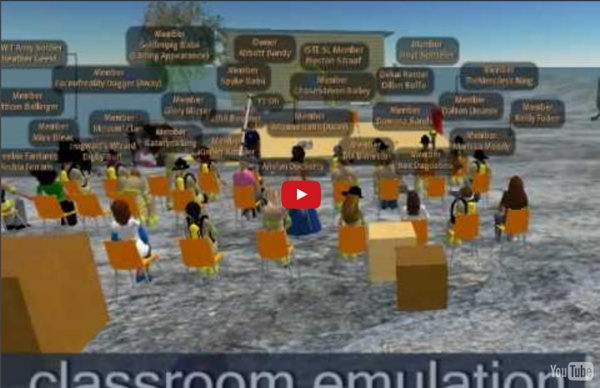
Blog » Tutorials For more SLOODLE videos, visit the SLOODLE Channel on YouTube: Contents: SLOODLE 1.x videos SLOODLE Awards videos SLOODLE 0.4 videos, plus… SLOODLE 1.x Learning With SLOODLE – Part 1: Mike McKay introduces the use of SLOODLE in a virtual world learning environment – Part 1 outlines some of the common processes and tools for linking student identity in the virtual world to the web-based elearning system. Part 2: Mike outlines how he runs discussion groups in Second Life – including use of the SLOODLE DropBox – with modifications to allow the submission of notecards – with submissions sent to the Moodle website. Part 3: Mike outlines the use of the SLOODLE award system to support assessment with automatically graded quizzes. SLOODLE Awards: Installation Mike McKay demonstrates installation and use of the SLOODLE Awards system Part 1: SLOODLE 0.4: Setting Up and Getting Started Instalación, configuración y uso SLOODLE (0.3/0.4)
The Future of Virtual Worlds: A Prelude My last posts discussed how Linden Lab's Enterprise-focused business strategy between 2008-2010 helped derail Second Life’s fast-track growth and contributed to the subsequent history of grid contraction and active user stagnation. Before I look at possible futures, I want to provide some contextual background, inspired by Marshall McLuhan, on how new mediums evolves over time. The Evolution of New Mediums We can’t fully understand or foresee the ramifications of new technology when it arrives. From the invention of the motion pictures to the introduction of the computer, we first view new mediums within the context of what came before. That’s why new mediums are often christened with two-word names like “motion picture,” “horseless carriage,” and “smart phone.” Each appellation presents the new technology in the light of the previous paradigm. For instance, people first thought of cars as essentially faster horses.