

PCCL - Physique Chimie au Collège et au Lycée : soutien scolaire en animations pédagogiques flash de cours et exercices corrigés de sciences physiques. cinquieme - quatrieme - troisieme - seconde - premiere - terminale - 5e 4e 3e 2e 1S TS jusqu'au baccala Physics 121.6 Applets The following is a list of applet collections that you may find useful. In the table above however I have links to a few of the many applets available on the web that I think are most useful in illustrating the concepts of this course. Applets 1 - Graphs of Position and Velocity This Applet shows a cow on roller skates! Note the shape of the position vs. time graph and the velocity verses time graph for each of the following cases. Try different non-zero initial velocities with zero acceleration. This second applet displays much the same thing. Run Applet... Applets 2 - Vector Addition This Shockwave applet shows the addition of two vectors (Red vector + Green vector = Blue vector). Run Applet... Another applet which shows much the same thing in a slightly different way.... Run Applet... Applets 3 - Projectile Motion This Applet shows the path of a cannonball fired into the air over a horizontal ground. Run Applet... Here is another applet showing projectile motion with no air resistance.
Conservation of Energy | Circus Physics | Classroom | Circus The aerial acrobatics of the Russian Barre routine require exquisite balance, timing, and years of training. That's not enough though; conservation of energy plays a big role as well. At the top of the jump, Anna's energy is entirely potential but as she falls, her energy turns kinetic. Landing on the bar, the energy changes form once more, stored as elastic energy in the bending bar. Watch the Video Questions to Consider While Watching the Video What forms of energy do you see? Digging Deeper As Anna jumps and lands on the bar, her energy changes forms multiple times, but notice that her total energy, the bar on the right, never changes. At the top of the jump, Anna's energy is entirely in the form of gravitational potential energy, P. P = mgh As she begins to fall back down, her velocity increases as her height decreases. K = ½mv² When Anna lands on the bar, her kinetic energy is transferred to bending the bar, and now takes the form of elastic energy, U. U = ½kd² Your Turn g x h = ½ x v²
Math, Physics, and Engineering Applets Oscillations and Waves Acoustics Signal Processing Electricity and Magnetism: Statics Electrodynamics Quantum Mechanics Linear Algebra Vector Calculus Thermodynamics Mechanics Miscellaneous Licensing info. Links to other educational sites with math/physics-related information or java applets useful for teaching: And when you get tired of learning, here is some fun stuff: Pong Simulation Circuit-level simulation of original 1972 Pong. Physics Flashlets Michael Fowler See also our Applets! This is a collection of Flash animations to make learning physics easier! Pythagoras: prove Pythagoras’ Theorem fast by moving triangles around with your mouse. Eclipse of the Moon: a short movie of the Moon moving through the Earth’s shadow, and how it appears from Earth. Ptolemy's Epicycles for Inner Planet Motion: actually a simplified version, with just the basic epicycle idea illustrated. Ptolemy's Epicycles for the Outer Planets: again, just the basic epicycle idea. Earth-Mars Line of Sight in Two Models. Kepler’s Laws: construct your own planetary orbits and check Kepler’s Laws! The Inner Planets: a movie of the inner planets in orbit ... and here are the Outer Planets. Galileo's "Compound Motion": Galileo realized that the motion of a projectile was a compound of constant speed horizontal motion and constant acceleration vertical motion -- we give an animation of his diagram. Trip to Mars! Carnot Cycle: the Carnot engine in action! Chinese Version
Physics Flash Animations We have been increasingly using Flash animations for illustrating Physics content. This page provides access to those animations which may be of general interest. The animations will appear in a separate window. The animations are sorted by category, and the file size of each animation is included in the listing. In addition, I have prepared a small tutorial in using Flash to do Physics animations. LInks to versions of these animations in other languages, other links, and license information appear towards the bottom of this page. The Animations There are 99 animations listed below. Other Languages and Links These animations have been translated into Catalan, Spanish and Basque: En aquest enllaç podeu trobar la versió al català de les animacions Flash de Física. Many animations have been translated into Greek by Vangelis Koltsakis. Most animations have been translated into Hungarian by Sandor Nagy, Eötvös Loránd University.
Physics Animations by Dr. Michael R. Gallis Penn State Schuylkillmrg3@psu.edu Select a category from the menu at left to browse the catalogue of animations by category. Most animations are 512 by 384 pixel avi files and are generally several megabytes long. Small screenshots are provided, and the user may view the animation in three ways: direct link to the media file, and two versions of a link to a page with the animation embeded in a web page with a brief comment on the animation. Project Page The animations project has its very own YouTube Channel. CWIS Portal to the Animations. A blog has been created to discuss the creation of the animations. -=Papers and Presentations=- Artificial Video for Video Analysis, MichaelR. 3-D Animations for Introductory Electromagnetism, MichaelR. Animations for Introductory Courses, Dr. See also Visual Mathematics by Dr.
One Race, Every Medalist Ever - Interactive Graphic Sources: "The Complete Book of the Olympics" by David Wallechinsky and Jaime Loucky, International Olympic Committee; Amateur Athletic Assocation; Photographs: Chang W. Lee/The New York Times, Getty Images, International Olympic Committee By KEVIN QUEALY and GRAHAM ROBERTS Usain Bolt vs. 116 years of Olympic sprinters Based on the athletes’ average speeds, if every Olympic medalist raced each other, Usain Bolt (the London version) would win, with a wide distribution of Olympians behind him. Usain Bolt2012 Meters behind 2012 Bolt Medals by country This chart includes medals for the United States and Australia in the "Intermediary" Games of 1906, which the I.O.C. does not formally recognize. Notable winners of the 100-meter sprint Archie Hahn United States The “Milwaukee Meteor” also won the 50-meter dash and the 200-meter dash in 1904. Jesse Owens Also set the world record in the 4x100 relay and Olympic records in the long jump and 200-meter dash. Jim Hines Carl Lewis
ippex online - main
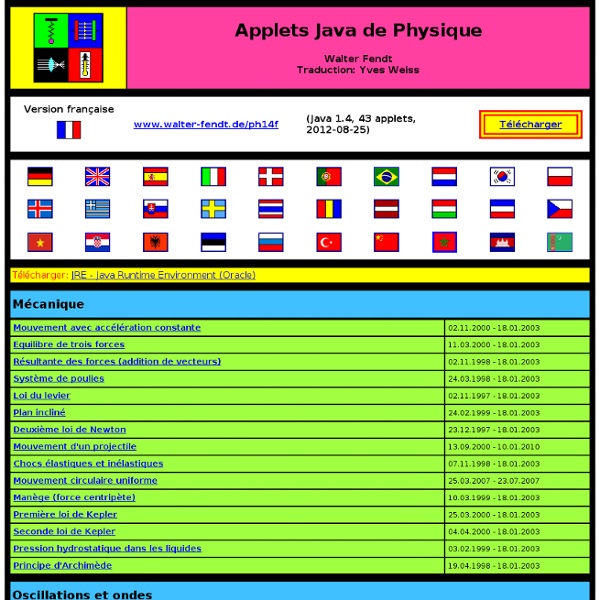
Ce site rassemble presque tous les sujets qui peuvent être abordés dans les 3 cours obligatoires de physique de cégep. Les applets sont d’excellents outils pour enseigner car ils sont très visuels et permettent aux étudiants de se figurer des mouvements qu’un tableau et une craie ne peuvent pas faire. by vincentlafond Feb 3