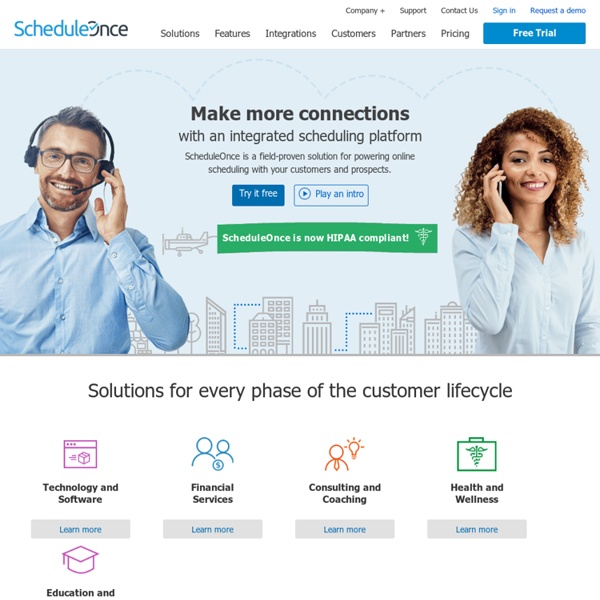
Meeting Scheduler – Online Meeting Scheduling
Find a time for a group meeting Collect availability and easily find a meeting time that works for any number of attendees. Accept appointments for yourself Share your MeetMe link and easily fill your calendar with one on one meetings and appointments. Accept appointments for your team Create MeetMe pages for your team members and enable your customers to easily book them online. Offer multiple meeting types Offer multiple meeting types, each with its own availability and settings, with or without services. Offer multiple services, each with its own settings, for yourself or for your entire team. Offer multiple locations, each with its own availability and settings, with or without services.
http://www.scheduleonce.com/
Meet With Approval
Jira Greenhopper
Cet article présente l’utilisation de la suite Atlassian dans le cadre d’une équipe de développement. Après une brève présentation des différents outils, la suite sera mise en perspective selon 2 axes : Un axe “Performance” : comment améliorer la performance des équipes de développement à l’aide (entre autre) des produits AtlassianUn axe “Cycle de développement” : illustration de l’utilisation de la suite Atlassian le long du cycle de développement logiciel, incluant la gestion de projet Nous présenterons dans le même temps les principales intégrations de la suite ainsi qu’une sélection des plugins incontournables. Enfin nous essayerons de situer l’éditeur vis-à-vis de ses concurrents et d’estimer les perspectives pour les années à venir.
How to find connections and get recommendations on LinkedIn
Now that you have your LinkedIn profile set up and ready to impress, you will need to start making connections to grow your LinkedIn network. In this second article Kristi Hines shows you how to do that. Now that you have your LinkedIn profile set up and ready to impress, you will need to start making connections to grow your LinkedIn network. How connections work LinkedIn classifies people within your network as 1st, 2nd, or 3rd connections.
Klok
Logiciel SEO Soft : logiciel de referencement gratuit Google
Suivez et améliorez vos positionnements et votre référencement Google. Simple, performant et gratuit (open source sous la licence GPL 3) SEO Soft est le logiciel de positionnement le plus utilisé depuis plus de 4 ans. Pour la plupart des sites internet, Google est la source de trafic la plus importante. Pour augmenter le nombre de vos visiteurs issus de Google, il est très important d'optimiser le référencement de ses mots clefs. SEO Soft vous assiste dans cette tâche. SEO Soft recueille les positions de vos sites dans Google en fonction des mots clefs que vous configurez.
Building Collaborative Communities - An Essay by Scott London
In 1995, I was commissioned by the Pew Partnership for Civic Change to study how collaboration was being used in the United States to build and strengthen community. While there are many forms of collaboration, my research focused on one type in particular—the kind carried out by individuals, groups and organizations in the public sphere. This form of collaboration can be described as a process of shared decision-making in which all the parties with a stake in a problem constructively explore their differences and develop a joint strategy for action. This essay appears in 'On Collaboration' — a collection edited by Marie Bak Mortensen and Judith Nesbitt (London: Tate, 2012).
web site tree generator and directory to html conversion tool
Art HTML Listing creates filtered, sorted, fully customizable directory listings, indexes, menus, maps and trees in HTML, DHTML, XML, text and CSV formats, as well as the list of MP3 and image files. It is designed for webmasters, developers and system administrators and for those users who need to make / print folder listings. The main difference from DHTML menu making programs is that you don't need to manually enter lots of menu items - the program scans files and makes menus automatically. A picture is worth a thousand words, see Art HTML Listing screenshots. Benefits
Impact Amplifier accelerates the growth of high impact, high growth SMEs
Free online website design tools
Designing or building your own website? Try these free online webmaster design tools to create static or dynamic navigation bars, buttons, tooltips, drop down menus, popup windows, css tags or IE Scrollbar Themes without knowing HTML or coding! Simply copy the code produced and paste it into your webpage where you wish it to appear!
Non-profit charity and social enterprise fundraising
Final Draft, GoldPocket Bring Interactive Television Capabilities To Scriptwriting Software
In Search of..... - TV.com www.tv.com/shows/in-search-of Narrarated by Leonard Nimoy, In search of was a 30 minute syndicated show that covered a wide range of paranormal topics. It pioneered a lot of the methodology that ... Search Engine - Download.com
Related:
Related: