

The Eight Best Rage Comics Ever We’ve all been there: surfing the internet, trolling for some cheap LULz, and there we find ourselves: face to face with he-lair-i-ous rage comics. For your viewing pleasure, we have compiled the 8 best rage comics ever: Holla Back Job Interview Watching Other People Use Computers Changing The Wife’s Tire We Almost Died
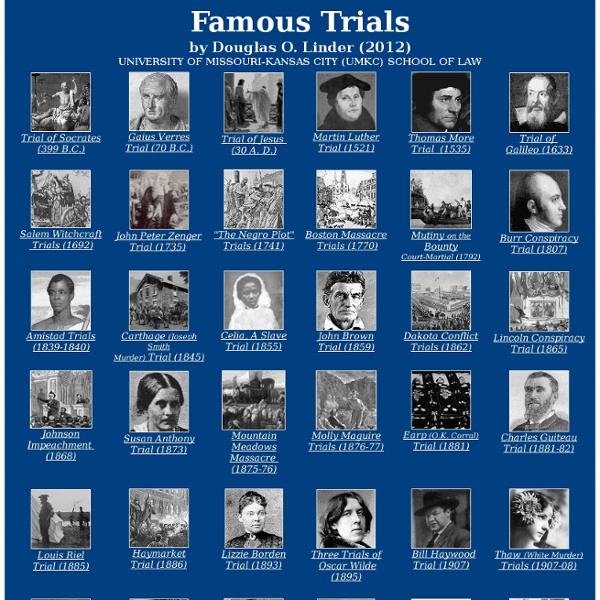
The Lindy Chamberlain (Dingo) Trial of 1981-82. On August 17, 1980, at a campsite near Australia's famous Ayer's Rock, a mother's cry came out of the dark: "My God, my God, the dingo's got my baby!" Soon the people of an entire continent would be choosing sides in a debate over whether the cry heard that night marked an astonishing and rare human fatality caused by Australia's wild dogs or was, rather, in the words of the man who would eventually prosecute her for murder, "a calculated, fanciful lie." A jury of nine men and three women came to believe the latter story and convicted Lindy Chamberlain for the murder of her ten-week-old daughter, Azaria. Three years later, while Lindy dealt with daily life in a Darwin prison, police investigating the death of a fallen climber discovered Azaria's matinee jacket near a dingo den, and the Australian public confronted the reality that its justice system had failed.
Some paradoxes - an anthology Buddha Teachings Following the Buddha's FootstepsInstilling Goodness SchoolCity of Ten Thousand BuddhasTalmage, CA 95481 As a child, Siddhartha the Buddha, was troubled by some of the same thoughts that children today have. They wonder about birth and death. They wonder why they get sick and why grandfather died. Because the Buddha knew what was in the hearts of children and human kind, he taught everyone how to live a happy and peaceful life. Life in the Palace Buddhism is one of the major religions in the world. Soon after Prince Siddhartha was born, the wise men predicted that he would become a Buddha. At the age of sixteen, Prince Siddhartha married a beautiful princess, Yasodhara. The Four Sights Soon Siddhartha became disillusioned with the palace life and wanted to see the outside world. On his fourth trip, he saw a wandering monk who had given up everything he owned to seek an end to suffering. Renunciation Leaving his kingdom and loved ones behind, Siddhartha became a wandering monk. Enlightenment
Logical Fallacies and How to Spot Them Logical Fallacies and How to Spot Them In the Evolution vs. Creationism debate, it is important to be able to spot all the logical fallacies that Creationists tend to throw around. This essay covers many bare essentials of logical thinking, as well as ways to critically evaluate an argument. The logical fallacies listed here are the ones most often used by Creationists, although Creationists have, to date, used almost every single logical fallacy in existence to "prove" their case. THE STRAWMAN ATTACK: The strawman is, perhaps, the most heavily-employed tactic used by Creationists. "Evolution is a ridiculous theory! This is an example of a strawman attack. Spotting a strawman attack isn't that hard. Strawman attacks, once exposed for what they are, are not all that difficult to counter. THE FALSE DILEMMA FALLACY: The false dilemma is at the heart of the Creationist argument. If you look carefully, you'll also notice the strawman attack. "Isaac Newton was a believer in Creation.
Atheist's Wager One formulation of the Atheist's Wager suggests that one should live a good life without religion, since Martin writes that a loving and kind god would reward good deeds, and if no gods exist, a good person will leave behind a positive legacy.[1][2] The second formulation suggests that, instead of rewarding belief as in Pascal's wager, a god may reward disbelief, in which case one would risk losing infinite happiness by believing in a god unjustly, rather than disbelieving justly.[3] Explanation[edit] The Wager states that if you were to analyze your options in regard to how to live your life, you would come out with the following possibilities:[1][4][5] The following table shows the values assigned to each possible outcome: A benevolent god exists No benevolent god exists References[edit]
Write Your Name in Elvish in Ten Minutes Write Your Name in Elvish in Ten Minutes You want to write your name in Elvish, but every place you go seems to make it harder than it ought to be. Elvish writing looks beautiful and mysterious, but does it really have to be impossible to understand? Why doesn't somebody just spell out the alphabet so you can simply substitute the letters and get straight to the result? Here's the alphabet. That's it. Generally the vowels go above the consonants, but sometimes, in the case of Y and silent E, they go below. The straight line underneath is just one way to make one character do the work of two. The line above a consonant means that a nasal N or M precedes the consonant in question. Here's one last example with two different letter combinations. I am often asked how to handle double vowel situations. That's all you need to get started. Please be aware that there are many ways to write English words in Elvish. Good luck! Ned Gulley Want an Elvish tattoo? Want an Elvish t-shirt?
Teaching World History & Geography - Conceptual Frameworks What to teach: conceptual frameworks This is the second component of a world history and geography body of knowledge to be taught in school: ....... chronological narrative ....... conceptual frameworks ....... thinking strategies What are conceptual frameworks? It is the job of conceptual frameworks to connect and organize knowledge to make it more meaningful. The alphabet, for example, is an artificial structure imposed on spoken language that enables us to read and write. A review of literature from history education and cognitive research strongly suggests that conceptual frameworks, by whatever name, contribute to meaningful understanding and should be a major component of history education. Themes History and geography educators often speak in terms of "themes" that represent an interest in phenomena that are manifested across several historical periods and/or geographic locations, and thus may offer useful insights into how humans generally behave and how the world generally works.