

WW2 - The Real Adolf Hitler and The Thule Society The planning of the Second World War started when Adolf Hitler joined a secret society called the Thule Society in 1919. It was in this group that he found the perverted beliefs that were later to lead him in his control of the German government. In the Thule Society: "... the sun played a prime role... as a sacred symbol of the Aryans, in contrast to... the moon, revered by the Semitic peoples. The Fuhrer saw in the Jewish people, with their black hair and swarthy complexions, the dark side of the human species, whilst the blond and blue-eyed Aryans constituted the light side of humanity. ... Hitler undertook to extirpate from the material world its impure elements."1 In addition to sun (or light) worship, the Thule Society also practiced Satan worship: "The inner core within the Thule Society were all Satanists who practiced Black Magic."2 Eckart claimed to be the initiator of Hitler into the secrets of Satan worship. There is a great deal of confusion in studying Hitler's family tree.
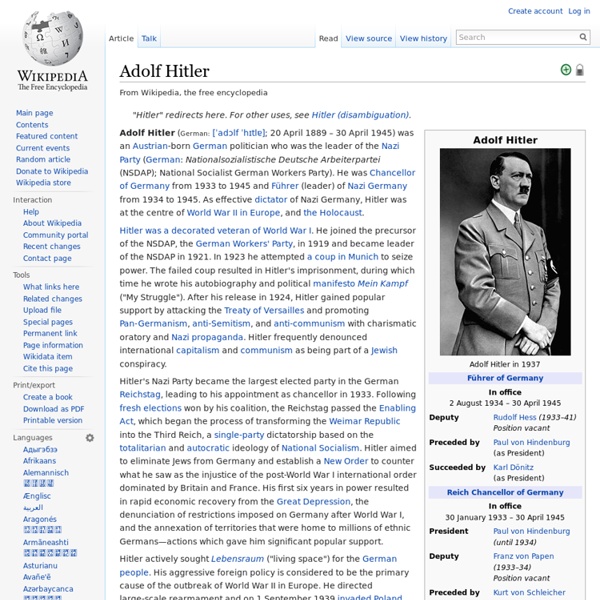
Adolf Hitler Adolf Hitler was born on 20th April, 1889, in the small Austrian town of Braunau near the German border. Both Hitler's parents had come from poor peasant families. His father Alois Hitler, the illegitimate son of a housemaid, was an intelligent and ambitious man and was at the time of Hitler's birth, a senior customs official in Lower Austria. Alois had been married before. In 1873 he had married Anna Glasl, the fifty-year-old adopted daughter of another customs collector. Klara Polzl, Hitler's mother, left home at sixteen to to join the household of her second cousin, Alois Hitler. Franziska saw Klara as a potential rival and insisted that she left the household. The first of the children of Alois's third marriage, Gustav, was born in May 1885, to be followed in September the following year by a second child, Ida, and another son, Otto, who died only days after his birth. In 1895, when Hitler was six years old, his father, Alois Hitler retired from government service. Louis L. Dr.
Nazism Nazism, or National Socialism in full (German: Nationalsozialismus), is the ideology and practice associated with the 20th-century German Nazi Party and state as well as other related far-right groups. Usually characterised as a form of fascism that incorporates scientific racism and antisemitism, Nazism originally developed from the influences of pan-Germanism, the Völkisch German nationalist movement and the anti-communist Freikorps paramilitary culture in post-First World War Germany, which many Germans felt had been left humiliated by the Treaty of Versailles. German Nazism subscribed to theories of racial hierarchy and social Darwinism, asserted the superiority of an Aryan master race, and criticised both capitalism and communism for being associated with Jewish materialism. The Nazi Party was founded as the pan-German nationalist and antisemitic German Workers' Party in January 1919. Etymology Position in the political spectrum Origins Völkisch nationalism
Rights Rights are legal, social, or ethical principles of freedom or entitlement; that is, rights are the fundamental normative rules about what is allowed of people or owed to people, according to some legal system, social convention, or ethical theory.[1] Rights are of essential importance in such disciplines as law and ethics, especially theories of justice and deontology. Rights are often considered fundamental to civilization, being regarded as established pillars of society and culture,[2] and the history of social conflicts can be found in the history of each right and its development. According to the Stanford Encyclopedia of Philosophy, "rights structure the form of governments, the content of laws, and the shape of morality as it is currently perceived Definitional issues[edit] There is considerable disagreement about what is meant precisely by the term rights. One way to get an idea of the multiple understandings and senses of the term is to consider different ways it is used.
Nazi Propaganda "Propaganda tries to force a doctrine on the whole people... Propaganda works on the general public from the standpoint of an idea and makes them ripe for the victory of this idea." Adolf Hitler wrote these words in his book Mein Kampf (1926), in which he first advocated the use of propaganda to spread the ideals of National Socialism -- among them racism, antisemitism, and anti-Bolshevism. Following the Nazi seizure of power in 1933, Hitler established a Reich Ministry of Public Enlightenment and Propaganda headed by Joseph Goebbels. The Ministry's aim was to ensure that the Nazi message was successfully communicated through art, music, theater, films, books, radio, educational materials, and the press. There were several audiences for Nazi propaganda. Real and perceived discrimination against ethnic Germans in east European nations which had gained territory at Germany's expense following World War I, such as Czechoslovakia and Poland, was the subject of Nazi propaganda.
German Propaganda Archive (Guide Page) Nazi and East German Propaganda Guide Page Propaganda was central to Nazi Germany and the German Democratic Republic. The German Propaganda Archive includes both propaganda itself and material produced for the guidance of propagandists. The goal is to help people understand the two great totalitarian systems of the twentieth century by giving them access to the primary material. For further information on the site, see the FAQ. My book titled Bending Spines: The Propagandas of Nazi Germany and the German Democratic Republic (Michigan State University Press, 2004) provides an analysis of much of the material on the German Propaganda Archive. This site is maintained by: Randall Bytwerk [My e-mail address is available on the FAQ page.] Professor Emeritus Calvin College Page design by Rob Veenstra
Moses Moses (Hebrew: מֹשֶׁה, Modern Moshe Tiberian Mōšéh ISO 259-3 Moše ; Syriac: ܡܘܫܐ Moushe; Arabic: موسى Mūsā ) was, according to the Hebrew Bible, the Qur'an, and Baha'i scripture, a former Egyptian prince and warrior,[citation needed] later turned religious leader, lawgiver, and prophet, to whom the authorship of the Torah is traditionally attributed. Also called Moshe Rabbenu in Hebrew (מֹשֶׁה רַבֵּנוּ, Lit. "Moses our Teacher/Rabbi"), he is the most important prophet in Judaism.[1][2] He is also an important prophet in Christianity and Islam, as well as a number of other faiths. According to the Book of Exodus, Moses was born in a time when his people, the Children of Israel, were increasing in numbers and the Egyptian Pharaoh was worried that they might ally with Egypt's enemies. God sent Moses back to Egypt to demand the release of the Israelites from slavery. Name The biblical text explains the name Mošeh משה as a derivation of the root mšh משה "to draw", in Exodus 2:10:
Nazi concentration camps Nazi Germany maintained concentration camps (German: Konzentrationslager, or KZ) throughout the territories it controlled. The term was borrowed from the British concentration camps of the Second Anglo-Boer War. The first Nazi concentration camps were erected in Germany in March 1933 immediately after Hitler became Chancellor and his NSDAP was given control over the police through Reich Interior Minister Wilhelm Frick and Prussian Acting Interior Minister Hermann Göring. Heinrich Himmler's SS took full control of the police and concentration camps throughout Germany in 1934–35. The concentration camps were administered since 1934 by Concentration Camps Inspectorate which in 1942 was merged into SS-Wirtschafts-Verwaltungshauptamt and were guarded by SS-Totenkopfverbände. Pre-war camps The Dachau camp was created for holding political opponents. Inspection by the Nazi party and Himmler at the Dachau Protective Custody Camp on 8 May 1936. World War II Internees Treatment Total casualties
The Holocaust The Holocaust (from the Greek ὁλόκαυστος holókaustos: hólos, "whole" and kaustós, "burnt")[2] also known as Shoah (Hebrew: השואה, HaShoah, "the catastrophe"; Yiddish: חורבן, Churben or Hurban, from the Hebrew for "destruction"), was the mass murder or genocide of approximately six million Jews during World War II, a programme of systematic state-sponsored murder by Nazi Germany, led by Adolf Hitler and the Nazi Party, throughout the German Reich and German-occupied territories.[3] Of the nine million Jews who had resided in Europe before the Holocaust, approximately two-thirds were killed.[4] Over one million Jewish children were killed in the Holocaust, as were approximately two million Jewish women and three million Jewish men.[5] A network of over 40,000 facilities in Germany and German-occupied territory were used to concentrate, hold, and kill Jews and other victims.[6] The persecution and genocide were carried out in stages. Etymology and use of the term Distinctive features Origins
Adolf Hitler Adolf Hitler, a charismatic, Austrian-born demagogue, rose to power in Germany during the 1920s and early 1930s at a time of social, political, and economic upheaval. Failing to take power by force in 1923, he eventually won power by democratic means. Once in power, he eliminated all opposition and launched an ambitious program of world domination and elimination of the Jews, paralleling ideas he advanced in his book, Mein Kampf. His "1,000 Year Reich" barely lasted 12 years and he died a broken and defeated man. 1. 2. 3. 4. Adolf Hitler was born on April 20, 1889, the fourth child of Alois Schickelgruber and Klara Hitler in the Austrian town of Braunau. When Adolf was three years old, the family moved to Passau, along the Inn River on the German side of the border. Following another family move, Adolf lived for six months across from a large Benedictine monastery. By 1900, Hitler's talents as an artist surfaced. Adolf's father died in 1903 after suffering a pleural hemorrhage. 1. 2.
German Jews during the Holocaust 1933-1939 In January 1933, some 522,000 Jews by religious definition lived in Germany. Over half of these individuals, approximately 304,000 Jews, emigrated during the first six years of the Nazi dictatorship, leaving only approximately 214,000 Jews in Germany proper (1937 borders) on the eve of World War II. In the years between 1933 and 1939, the Nazi regime had brought radical and daunting social, economic, and communal change to the German Jewish community. Six years of Nazi-sponsored legislation had marginalized and disenfranchised Germany's Jewish citizenry and had expelled Jews from the professions and from commercial life. By early 1939, only about 16 percent of Jewish breadwinners had steady employment of any kind. World War II Yet the most drastic changes for the German Jewish community came with World War II in Europe. Following the outbreak of war on September 1, 1939, the government imposed new restrictions on Jews remaining in Germany. Deportation
Adolf Hitler being the most famous Nazi ruler could be linked with Mrs.Dwyer because they were implanted with this setreotypical mind set in which the societes they affect were considered as a nuisance. While following this mind set because a majority of the population believed it they not only commited human rights crimes but they also did not put themselves in the skin of those who were affected. by gomezguay Oct 30
This awesome article teaches us about the life of Adolf Hitler one of the most feared dictator during world war 2. We can compare Adolf Hitler with Mrs Dwyer because they are both the leader of there population. For exemeple, Hitler would commande the german army to hurt and kill the jews and in sweet grass baskets Mrs Dwyer commands the teachers to be mean and punishe sevearly the native kids. by aria.khaksar Oct 15