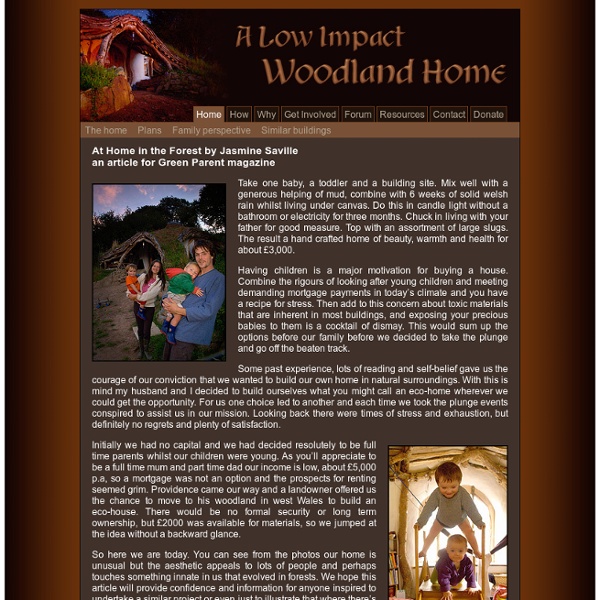
Green Building Design and Construction Home Page Skip to: Content | Footer | Accessibility A-Z Index Green Building Home Page Program Highlights... Sustainable design or building "green" is an opportunity to use our resources efficiently while creating healthier buildings. Check This Out! Program Information and Activities Last updated: September 13, 2011 Back to Top | Help | Contact Us | Site Index | Conditions of Use | Privacy Policy ©1995, 2014 California Department of Resources Recycling and Recovery (CalRecycle). Environmentally-Friendly Houses "QUANTUM SHOT" #233Link - article by Joshua S. Hill and Avi Abrams Most ecologically friendly house designs This article is co-written by our guest blogger Joshua S. "A Low Impact Woodland Home" by Simon Dale Now I had originally intended to take you on a tour through all the wonderful ecologically-clean houses that exist in our wonderful world, but it turns out that as a group, those who tend towards these houses apparently disdain the creation of a decent website, and even further hate actual content. Simon, with his wife, father in law and two young children spent 4 months building what they have termed a low impact woodland home, which is now their family home. Simon, who is more than willing to tote the fact that he is in no way an architect or certified builder, believes that a house of this scale is within the reach of any able-bodied person. The house, which was built with a maximum regard for the environment around it, is dug soundly into the hill around it. See more photos here
Pollarding Pollarding is a pruning system in which the upper branches of a tree are removed, promoting a dense head of foliage and branches. It has been common in Europe since medieval times and is practised today in urban areas worldwide, primarily to maintain trees at a predetermined height.[1] Traditionally, trees were pollarded for one of two reasons: for fodder to feed livestock, or for wood. Fodder pollards produced "pollard hay", which was used as livestock feed; they were pruned at intervals of two to six years so their leafy material would be most abundant. Wood pollards were pruned at longer intervals of eight to 15 years, a pruning cycle that tended to produce upright poles favored for fence rails and posts, as well as boat construction. Older pollards often become hollow, so can be difficult to age accurately. Practice[edit] The same trees two years later. Pollards cut at only about a metre or so above the ground are called stubs (or stubbs). Species[edit] Origin and usage of term[edit]
Stone Sculptures, carving marble, limestone, soapstone, alabaster That's the million dollar question. There are a number of ways. I took an art class in college and there was an art student that had finished a piece in stone. It was so beautiful that I had to try it. So you have a number of choices to make. 1) Take an art class in college. 2) Ask the local colleges if they are going to have a stone-carving workshop. 3) Go to the library and take out a book on stone carving and use the resources at the end of this page to get your supplies. Stone Availability of carving stone Depending on where you live, you can probably find SOME kind of stone to carve within driving distance. Kinds of stone to carve From the softest to the hardest; 1)Soapstone Available in many different colors and textures. Tools These are available from a number of resources and I have listed some (Check the Internet for more). Sandbags You MUST have sandbags before you start carving to support your stone on while carving. Personal protection The how and whys of carving. Sanding Polishing
Yurt Buildng Here is a free copy of my book Build your own yurt, written in 1995, It has been used by a great many people who have built their own yurts. Our designs have progressed enormously since 1995. For a much more comprehensive guide see The Complete Yurt Handbook or see the rest of our website A complete guide to making a Mongolian Ger by P.R. Third Edition Fully revised and expanded for 1998 Internet Edition Jan 2000 The Yurt The English word Yurt comes from the Russian Yurta describing a circular trellis walled framed tent. The Kirgiz yurt with bent-wood roof poles and crown and a domed overall shape. The two tiered yurt with a pointed roof and two layers of wall section placed one on top of the other. The Mongol or Kalmuk ger with straight roof poles, a heavy timber crown, often supported by two upright poles, and fitted with a wooden door. This proven design is equally well suited to the many uses for moveable dwellings in this country. Figure 1.
Coppicing The same alder stool after one year's regrowth Coppicing is a traditional method of woodland management which takes advantage of the fact that many trees make new growth from the stump or roots if cut down. In a coppiced wood, young tree stems are repeatedly cut down to near ground level. In subsequent growth years, many new shoots will emerge, and, after a number of years the coppiced tree, or stool, is ready to be harvested, and the cycle begins again. Typically a coppiced woodland is harvested in sections or coups[1] on a rotation. Coppicing maintains trees at a juvenile stage, and a regularly coppiced tree will never die of old age—some coppice stools may therefore reach immense ages. Coppiced stems are characteristically curved at the base. History[edit] In the days of charcoal iron production in England, most woods in ironmaking regions were managed as coppices, usually being cut on a cycle of about 16 years. Current practice[edit] The Sal tree is coppiced in India.[5] Wildlife[edit]
Supplier of tools for masons and carvers, construction and mining, Toll Free in NA: 1 866 683-1285 Old Garage turned Mini Dream Home! | Hello there! It’s been a busy week with a trip to Seattle for the Picasso exhibition and a drive out to the coast but I knew I had to share this amazing remodel with you before the week came to a close. Everyone loves good makeovers and the ones involving tiny spaces, creative design and ingenious solutions are my all time favorites! Check out how Seattle artist, designer and welder, Michelle de la Vega, created this beautiful little 250 sq. ft. haven… The before… This lonely little detached garage is just begging for some love. The after! A cozy, light filled sleeping loft is so perfect for the space. The kitchen is well organized and accessible with open storage solutions. The rustic wood burning stove becomes sculptural in this room along with Michelle’s own art installations. The glass boxes housing pillow forms are actually a tribute to Michelle’s father. You know I am a big fan of great bathroom design and this one delivers. How many of us have garages that only house our junk!?
NCFed - The National Coppice Federation How to carve stone | Architecturals.net How do you get started? That's the million dollar question. There are a number of ways. So you have a number of choices to make. 1) Take an art class in college. 2) Ask the local colleges if they are going to have a stone-carving workshop. 3) Go to the library and take out a book on stone carving and use the resources at the end of this page to get your supplies. Stone Availability of carving stone Depending on where you live, you can probably find SOME kind of stone to carve within driving distance. Kinds of stone to carve From the softest to the hardest; 1)Soapstone Available in many different colors and textures. Tools These are available from a number of resources and I have listed some (Check the internet for more). Sandbags You MUST have sandbags before you start carving to support your stone on while carving. Personal protection These are the most important sculpting supplies there are. The hows and whys of carving. The first step is roughing out the stone. Next comes the file. Sanding
Smaller Than Your Living Room: 7 Of The World's Best Nano Houses | Co.Design Studio-apartment dwellers may feel reasonably content living a small-scale existence. But if transplanted in the country, how many would opt for a similarly sized house? Driven by a commitment to reduce energy consumption and built space, there’s a growing trend among the eco-conscious to build tiny homes. Will they inspire “real housewives” of Beverly Hills to abandon their McMansions, short of a foreclosure notice? Check out the slideshow of 7 houses from the book.