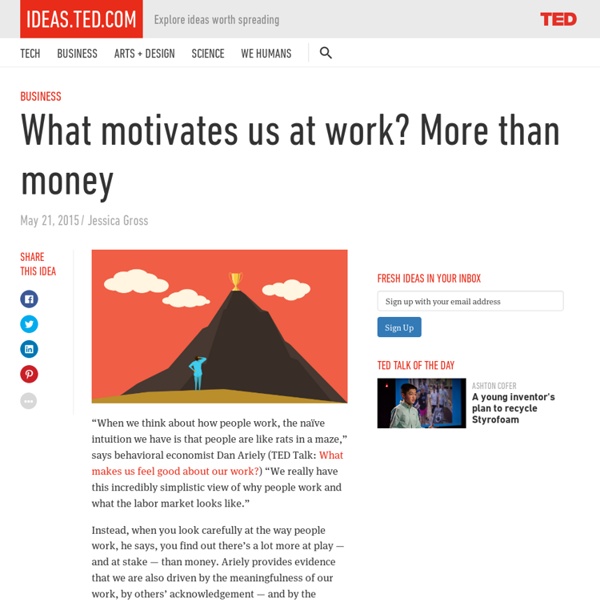
What motivates us at work? More than money
“When we think about how people work, the naïve intuition we have is that people are like rats in a maze,” says behavioral economist Dan Ariely (TED Talk: What makes us feel good about our work?) “We really have this incredibly simplistic view of why people work and what the labor market looks like.” Instead, when you look carefully at the way people work, he says, you find out there’s a lot more at play — and at stake — than money. Ariely provides evidence that we are also driven by the meaningfulness of our work, by others’ acknowledgement — and by the amount of effort we’ve put in: the harder the task is, the prouder we are. “When we think about labor, we usually think about motivation and payment as the same thing, but the reality is that we should probably add all kinds of things to it: meaning, creation, challenges, ownership, identity, pride, etc.,” Ariely says.
The Science of Improving Motivation at Work
All motivation comes from within, whether it is triggered by rewards or endeavors that enhance one’s self-image or simply comes from intrinsically-motivating activities that we engage in for no reward other than the enjoyment these activities bring us. Realizing this makes the topic of employee motivation quite daunting for people managers, leaders, and human resources professionals alike. But organizations that provide their members with meaningful, engaging work not only contribute to the growth of their bottom line but also create a sense of vitality and fulfillment that echoes across their organizational cultures and their employees’ personal lives. An organization’s ability to learn, and translate that learning into action rapidly, is the ultimate competitive advantage. Jack Welch Motivation in the Workplace Motivation in the workplace has been traditionally understood in terms of extrinsic rewards, be in the form of compensation, benefits, perks, awards, or career progression. Theory Z
Related:
Related: