Elizabeth I of England
Elizabeth I (7 September 1533 – 24 March 1603) was Queen of England and Ireland from 17 November 1558 until her death. Sometimes called The Virgin Queen, Gloriana or Good Queen Bess, the childless Elizabeth was the fifth and last monarch of the Tudor dynasty. Elizabeth was the daughter of Henry VIII by second wife, Anne Boleyn, who was executed two and a half years after Elizabeth's birth. Anne's marriage to Henry VIII was annulled, and Elizabeth was declared illegitimate. Her half-brother, Edward VI, ruled until his death in 1553, bequeathing the crown to Lady Jane Grey and ignoring the claims of his two half-sisters, Elizabeth and the Roman Catholic Mary, in spite of statute law to the contrary. However, Edward's will was set aside and Mary became queen, deposing Lady Jane Grey. In 1558, Elizabeth succeeded her half-sister to the throne, and she set out to rule by good counsel.[1] She depended heavily on a group of trusted advisers, led by William Cecil, Baron Burghley. Early life
Henry8England
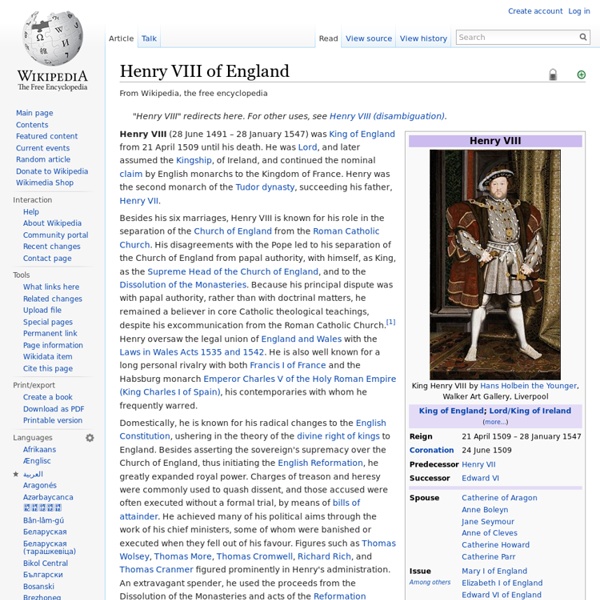
Henry VIII (28 June 1491 – 28 January 1547) was King...
Thomas More
Pope Pius XI canonised More in 1935 as a martyr of the schism that separated the Church of England from Rome; Pope John Paul II in 2000 declared More the "heavenly Patron of Statesmen and Politicians".[4] Since 1980, the Church of England has remembered More liturgically as a Reformation martyr.[5] In 2002, he was placed at number 37 in the BBC's poll of the 100 Greatest Britons.[6] Early life[edit] More began his studies at Oxford in 1492, and received a classical education. Studying under Thomas Linacre and William Grocyn, he became proficient in both Greek and Latin. More left Oxford after only two years—at his father's insistence—to begin legal training in London at New Inn, one of the Inns of Chancery.[9]:xvii[11] In 1496, More became a student at Lincoln's Inn, one of the Inns of Court, where he remained until 1502, when he was called to the Bar.[9]:xvii Spiritual life[edit] Family life[edit] More's decision to educate his daughters set an example for other noble families.
Catherine of Aragon
Catherine of Aragon (Castilian: Catalina; 16 December 1485 – 7 January 1536) was Queen of England from 1509 until 1533 as the first wife of King Henry VIII; she was previously Princess of Wales as the wife of Prince Arthur. The daughter of Queen Isabella I of Castile and King Ferdinand II of Aragon, Catherine was three years old when she was betrothed to Prince Arthur, heir apparent to the English throne. They married in 1501, and Arthur died five months later. In 1507, she held the position of ambassador for the Spanish Court in England, becoming the first female ambassador in European history. Catherine subsequently married Arthur's younger brother, the recently succeeded Henry VIII, in 1509. By 1525, Henry VIII was infatuated with Anne Boleyn and dissatisfied that his marriage to Catherine had produced no surviving sons, leaving their daughter, the future Mary I of England, as heiress presumptive at a time when there was no established precedent for a woman on the throne.
Workshop of Hans Holbein the Younger Portrait of Henry VIII Google Art Project
Feudalism
Feudalism was a set of legal and military customs in medieval Europe that flourished between the 9th and 15th centuries. Broadly defined, it was a system for structuring society around relationships derived from the holding of land in exchange for service or labour. Although derived from the Latin word feodum or feudum (fief),[1] then in use, the term feudalism and the system it describes were not conceived of as a formal political system by the people living in the medieval period. There is also a broader definition, as described by Marc Bloch (1939), that includes not only warrior nobility but all three estates of the realm: the nobility, the clerics and the peasantry bonds of manorialism; this is sometimes referred to as a "feudal society". Definition Etymology The term "feodal" was used in 17th century French legal treatises (1614)[11][12] and translated into English legal treatises as an adjective, such as "feodal government". Another theory was put forward by Archibald R. Vassalage
Anne Boleyn
Anne Boleyn (/ˈbʊlɪn/, /bəˈlɪn/ or /bʊˈlɪn/)[3][4] (c. 1501[1] – 19 May 1536) was Queen of England from 1533 to 1536 as the second wife of King Henry VIII and Marquess of Pembroke in her own right.[5] Henry's marriage to Anne, and her subsequent execution, made her a key figure in the political and religious upheaval that was the start of the English Reformation. Anne was the daughter of Thomas Boleyn, 1st Earl of Wiltshire, and his wife, Lady Elizabeth Howard, and was educated in the Netherlands and France, largely as a maid of honour to Claude of France. She returned to England in early 1522, to marry her Irish cousin James Butler, 9th Earl of Ormond; the marriage plans ended in failure and she secured a post at court as maid of honour to Henry VIII's wife, Catherine of Aragon. Early in 1523 there was a secret betrothal between Anne and Henry Percy, son of the 5th Earl of Northumberland. Henry and Anne married on 25 January 1533. Early years Netherlands and France
indeks