

Your Zen Life What To Do When You're Feeling Defeated If things are going catastrophically awry, you are allowed to wallow, of course you are -- but for exactly four minutes. Here's what to start during minute five. By Amy Shearn 1. Pull a Pixar What you're feeling: Your pink slip/parking ticket/deadline/social gaffe snowballed into a huge pile of panic. What to do about it: "One trick I've learned is to force myself to make a list of what's actually wrong," writes Ed Catmull, PhD,, president of Walt Disney and Pixar Animation Studios, in his new book Creativity, Inc.: Overcoming the Unseen Forces That Stand in the Way of True Inspiration. 2. What you're feeling: You've accomplished zip. What to do about it: Check out Chino Otsuka's images of her adult self Photoshopped into childhood photos. 3. What you're feeling: The presentation flopped. What to do about it: Head to Admitting Failure. 4. What you're feeling: Something very, very bad has happened to you. 5. What you're feeling: Do you even have a purpose in life? 6.
10 Inspiring TED Talks for Startups The mission of TED (Technology Education Design) is to promote "ideas worth spreading." And as such, there is plenty of material that entrepreneurs - folks definitely interested in spreading their ideas - can find inspiring in the recordings available on TED's website. We've gone through the archives and hand-picked some of our favorite TED talks for startups. Granted, it's hard to select just ten to feature here out of the 700-some-odd videos available. 1. 2. 3. 4. 5. 6. 7. 8. 9. 10.
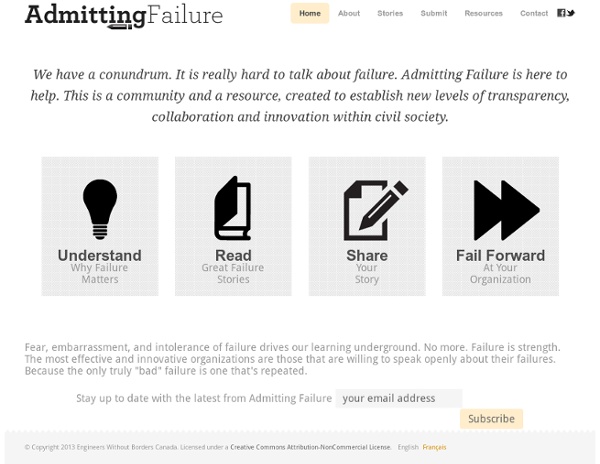
New Web Site Encourages Charities to Admit Errors - World View For the past two years, I’ve called for charities to admit their failures. I wrote about this issue just last week. So I’m happy to announce that on January 14, a new Web site was launched to provide a platform for admitting mistakes, and it’s aptly named admittingfailure.com, created by Engineers Without Borders Canada. That organization and GlobalGiving have both already included stories of their own mistakes. In addition, Engineers Without Borders Canada released its 2011 Failure Report, detailing more projects that did not achieve full success. In its press release announcing the new site, Engineers Without Borders described its goals for the new Web site as an “effort to get a seemingly simple but virtually non-existent practice adopted throughout the development sector.” I challenge all charities to publicly admit and share their mistakes, and I challenge all individual donors to write to the nonprofits they support and encourage them to share their mistakes as well. Return to Top
Carissa K. - writer J’ai déménagé de Venise à San Francisco : 5 commandements utiles à tous | De Venise à San Francisco Image extraite de l’émission « Les déménageurs de l’extrême » Partir, c’est mourir un peu, disait Edmond Haraucourt dans son si beau poème « Rondel de l’Adieu »... Ouais, ben Edmond, il n’a pas dû quitter la Haute-Marne pour un autre continent, parce que partir, c’est surtout jeter beaucoup. Choisir un déménageur international Pour choisir votre déménageur, un conseil : faites jouer la concurrence. Surtout, n’oubliez pas de vérifier qu’ils possèdent bien le label FIDI / FAIM afin de ne pas avoir affaire à une arnaqueur. Consultez trois entreprises de déménagement pour comparer les devis. 35 000 foyers français ont quitté la France en 2011. Surtout quand le déménagement en question est de Venise – sur une île donc – vers San Francisco, sur un continent, loin. Très loin donc très cher, le déménagement. Si cher que l’on ne pourra pas tout emmener. Des prix ? Et là, on ne peut faire autrement que de regarder sa maison : est-ce que ce que je possède vaut 1 000 euros le mètre cube ?
6 ReadWriteStart Lists: Our Best Startup Advice - ReadWriteStart In a recent conversation here at ReadWriteStart we were talking about what readers want most. Beyond stories about where the latest funding opportunities are found, and beyond wanting to know what startups are doing that works, we know that sometimes our startup readers just want some simple practical advice. Towards that end we've posted many a list. And now it's time for a review. Here are six of our best lists in abbreviated form. From how not to kill your startup, to public speaking, to funders to follow, we at ReadWriteStart want to help. 6 Approaches to Your Company Blog The Operations BlogThe Veteran / Inspirational BlogThe Prediction BlogThe Research BlogThe Community / Advocate BlogThe Coolhunter Blog Kevin Rose's 10 Tips for Entrepreneurs Just Build It Iterate Hire Your Boss Demand Excellence Raising Money Hack the Press Invest in Advisors Connect With the Community Leverage Your User Base to Spread the Word Analyze Your Traffic 6 Great Approaches to Public Speaking
Low Overhead Doesn't Equal High-Quality Philanthropy - World View A series of posts about the misconceptions created by charity Web sites continues today. Misconception No. 4: Low administrative costs are a good indicator of the quality of the organization According to Money for Good, the amount spent on administration costs is the number one item that donors look for when deciding whether or not to give. The problems caused by the incessant need to keep overhead at a minimum are well laid out in the Stanford Social Innovation Review’s article “The Nonprofit Starvation Cycle.” This misconception is probably the hardest one to break for two reasons. First, many charity rating systems use overhead costs as one of the primary factors in determining nonprofit scores. I hope with the pending release of Charity Navigator 2.0, which uses indicators of effectiveness and results, more rating systems will decrease their emphasis on administration costs in determining nonprofit scores. What message is your organization’s Web site giving donors? Return to Top
Accueil | WTF is the normcore ? Posted by marieadle on mars 27, 2014 · Poster un commentaire On est une fois de plus tombé dans l’absurde. A force de chercher l’originalité et la singularité, les hipsters sont tombés dans la normalité. Alors que le mot normcore (contraction de normal et hardcore), n’existait pas il y a encore quelques semaines, voilà que le ashtag (je n’ai pas trouvé le symbole sur mon ordi) normcore est … Lire la suite Le Freitag : une dichotomie territoriale Posted by marieadle on mars 25, 2014 · Poster un commentaire A vos selles ! Tinder : le jeu qui s’enflamme Posted by marieadle on mars 20, 2014 · Un commentaire Le bobo a décidé de s’inscrire sur Tinder, l’application qui monte et qui te rend presque ringard si tu n’es pas dessus. Chez I Feel Bio, I feel pas bien du tout! Posted by marieadle on mars 11, 2014 · Poster un commentaire Ca faisait longtemps que je n’avais pas mis les pieds chez I Feel BIO rue de la Corraterie. Nom de Zeus Marty, elles reviennent!!! Merci Le Temps!
16 Habits Of Highly Sensitive People Do you feel like you reflect on things more than everyone else? Do you find yourself worrying about how other people feel? Do you prefer quieter, less chaotic environments? If the above sound true to you, you may be highly sensitive. While recent interest in introversion — driven largely by high-profile publications on the subject, including Susan Cain’s book “Quiet,” — has brought more awareness to personality traits that value less stimulation and higher sensitivity, Aron notes that highly sensitive people still tend to be considered the “minority.” But “minority” doesn’t mean bad — in fact, being highly sensitive carries a multitude of positive characteristics. 1. One of the hallmark characteristics of highly sensitive people is the ability to feel more deeply than their less-sensitive peers. 2. People who are highly sensitive will react more in a situation. 3. Depending on the culture, sensitivity can be perceived as an asset or a negative trait, Zeff explains. 4. 5. 6. 7. 8. 9. 10.